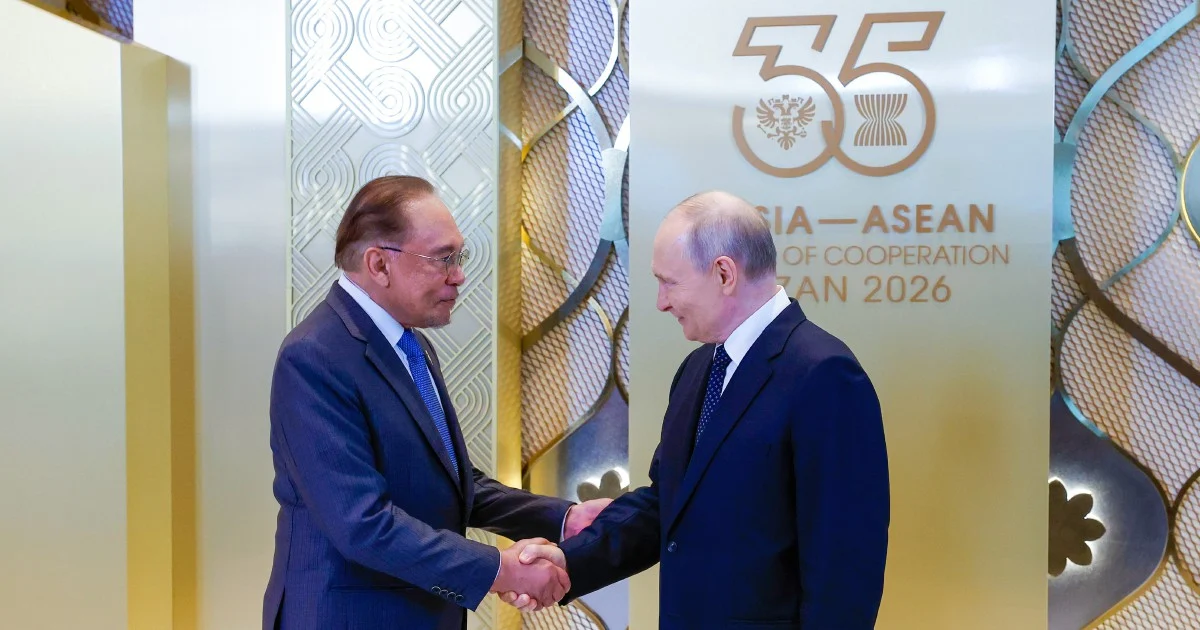
Prime Minister Datuk Seri Anwar Ibrahim and Russian President Vladimir Putin convened in Kazan to explore avenues for strengthening the strategic relationship between Malaysia and Russia, with particular emphasis on energy security arrangements and innovative approaches to expanding bilateral trade through the use of local currencies rather than traditional foreign exchange mechanisms.
The discussion reflects Malaysia's broader strategic positioning in an increasingly multipolar geopolitical landscape, where diversifying energy partnerships and reducing reliance on established currency arrangements have become central concerns for regional stability. For a nation heavily dependent on energy imports and deeply integrated into regional supply chains, the conversation carries significance beyond the bilateral frame, signalling Malaysian interest in hedging risks through expanded cooperation with major energy producers and exploring alternatives within existing international trade structures.
Energy security represents a critical vulnerability for Malaysia, where petroleum and natural gas resources are finite and domestic production has declined over successive decades. The interaction with Putin underscores Kuala Lumpur's pragmatic approach to securing reliable energy supplies from diverse sources, a strategy that becomes increasingly important as regional demand surges and global energy transitions accelerate. Russia's substantial hydrocarbon reserves and established export infrastructure position it as a potential long-term partner, particularly as Malaysia navigates the transition toward cleaner energy while maintaining energy affordability and industrial competitiveness.
The emphasis on local currency transactions signals deeper economic recalibration within Malaysia's foreign trade framework. By conducting business in ringgit and ruble, both nations reduce exposure to volatility in major reserve currencies and diminish reliance on dollar-denominated systems that have historically dominated international commerce. This approach resonates with broader regional trends in Southeast Asia, where several nations have explored similar mechanisms with major trading partners to insulate their economies from external shocks and strengthen bilateral relationships through deeper financial integration.
Bilateral cooperation between Malaysia and Russia extends beyond energy and trade mechanics into defence, technology, and educational exchanges. The meeting in Kazan provided an opportunity to assess progress across multiple sectors and identify areas where intensified collaboration could deliver mutual benefits. Malaysia's position as a Muslim-majority nation with substantial influence in regional organisations like ASEAN grants it particular diplomatic relevance for Russia, which has invested considerably in cultivating relationships across the Indo-Pacific to counterbalance Western strategic dominance.
The timing of such discussions carries weight within Malaysia's broader foreign policy framework. As tensions persist between major powers and regional stability becomes increasingly contested, Malaysian leadership has consistently advocated for maintaining balanced relationships and avoiding forced choices between competing blocs. The engagement with Russia demonstrates this principle in practice, reflecting a pragmatic commitment to protecting Malaysian interests through diversified partnerships rather than exclusive alignments.
Energy cooperation frameworks between nations typically encompass multiple dimensions including direct supply arrangements, joint investment in extraction and processing infrastructure, technological transfer, and personnel training. The conversation between Anwar and Putin likely explored mechanisms through which Malaysian companies might participate in Russian energy projects, whether through exploration partnerships, downstream refining operations, or equity stakes in energy enterprises. Such involvement would provide Malaysia with greater transparency into supply chains and potentially offer more favourable long-term pricing arrangements than spot market purchases.
Trade in local currencies addresses structural inefficiencies in bilateral commerce where both sides must convert through international markets, incurring transaction costs and exposure to exchange rate fluctuations. Direct ringgit-ruble transactions facilitate faster settlement, reduce banking intermediaries, and create stronger incentives for commercial relationships. For Malaysian exporters and importers, this arrangement simplifies logistics and improves profit margins. For Russia, particularly amid international sanctions limiting its access to certain currency markets, such arrangements strengthen bilateral trade resilience and demonstrate continued economic engagement beyond Western-aligned structures.
The conversation also reflects broader Malaysian strategy regarding technology and capacity building in energy sectors. Russia possesses considerable expertise in Arctic energy exploration, renewable energy development, and efficient energy transmission systems—knowledge areas where Malaysian partnerships could enhance local capabilities and support the nation's clean energy transition objectives. Joint ventures or technology licensing agreements emerging from high-level discussions often take months to materialise, but they establish policy frameworks enabling subsequent commercial negotiations.
From a Southeast Asian perspective, Malaysia's engagement with Russia through energy diplomacy influences regional calculations and demonstrates that ASEAN nations maintain strategic flexibility in international relationships. Thailand, Vietnam, and Indonesia have similarly cultivated energy partnerships with Russia and other major powers, reflecting recognition that regional prosperity depends partly on stable energy supplies sourced from multiple suppliers rather than concentrated sources vulnerable to geopolitical disruption.
The discussion between these two leaders also carries implications for Malaysia's relations with other major trading partners, particularly in light of evolving international sanctions regimes and divided global architecture. By maintaining substantive engagement with Russia on economic matters, Malaysia positions itself as a pragmatic actor committed to mutual benefit rather than ideological positioning, reinforcing its relevance as a potential mediator in international disputes and a stable trading partner for nations across the geopolitical spectrum.
Looking forward, the meeting likely establishes trajectories for follow-up discussions involving technical teams and sector-specific experts who will translate strategic intent into concrete commercial arrangements. Energy cooperation frameworks typically require extensive due diligence, regulatory harmonisation, and investment commitments that develop through sustained diplomatic momentum rather than spontaneous implementation.

%22%2F%3E%3C%2Fpattern%3E%3C%2Fdefs%3E%3Crect%20width%3D%22100%25%22%20height%3D%22100%25%22%20fill%3D%22url(%23ph21o2sg)%22%2F%3E%3Crect%20width%3D%22100%25%22%20height%3D%22100%25%22%20fill%3D%22url(%23ph21o2sp)%22%2F%3E%3Ctext%20x%3D%2250%25%22%20y%3D%2250%25%22%20text-anchor%3D%22middle%22%20dominant-baseline%3D%22central%22%20fill%3D%22rgba(255%2C255%2C255%2C0.95)%22%20font-family%3D%22Georgia%2C%20'Times%20New%20Roman'%2C%20serif%22%20font-weight%3D%22700%22%20font-size%3D%22170%22%20letter-spacing%3D%22-0.02em%22%3EGabungan%3C%2Ftext%3E%3C%2Fsvg%3E)