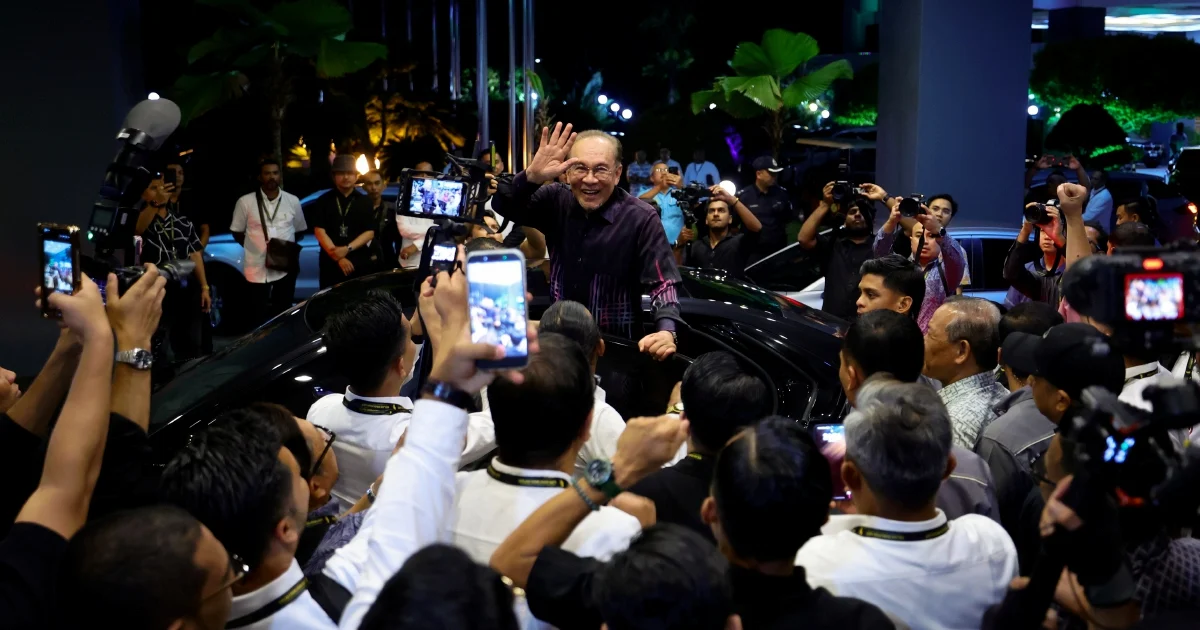
Prime Minister Datuk Seri Anwar Ibrahim has reframed Malaysia's fundamental challenges, positioning institutional corruption and the misuse of governmental authority as more consequential threats than racial discord. Speaking in Seremban, Anwar articulated a vision of national priorities that deemphasises ethnic grievances in favour of addressing systemic abuses perpetrated by those in positions of influence.
This pronouncement reflects a deliberate rhetorical shift within Malaysia's current political landscape. Rather than engaging in debates centred on communal sensitivities—a staple of Malaysian political discourse for decades—Anwar has chosen to pivot the national conversation toward governance integrity and the accountability of power-holders. The strategic recalibration suggests an attempt to unify citizens across demographic lines by identifying a shared adversary: institutional malfeasance and the exploitation of public office for personal or partisan gain.
The timing and framing of Anwar's statement carry significant implications for Malaysia's political future. By emphasising that abuse of power represents the nation's principal concern, the Prime Minister implicitly critiques administrative practices that may have flourished under previous administrations whilst signalling his government's commitment to reversing such patterns. This narrative serves multiple purposes: it legitimises efforts to reform public institutions, justifies scrutiny of past officials' conduct, and attempts to construct a unifying platform that transcends traditional fault lines in Malaysian society.
Within Malaysia's pluralistic context, where ethnic and religious identities have historically been intertwined with political competition and resource distribution, Anwar's repositioning of national grievances carries considerable weight. For decades, Malaysian politicians have leveraged communal anxieties to consolidate support, often framing issues through the lens of inter-ethnic competition. By contrast, Anwar's insistence that power abuse rather than racial differences constitutes the primary obstacle to national progress represents an alternative framework—one that redefines the nation's problems in terms of institutional accountability rather than demographic conflict.
The emphasis on governmental integrity also resonates with growing public sentiment regarding corruption and institutional failure. Successive scandals involving high-profile officials, misappropriated funds, and breached public trust have eroded confidence in administrative systems across Malaysian society. Anwar's articulation thus taps into broader frustrations that transcend ethnic boundaries, potentially mobilising constituencies united by expectations of honest governance rather than fragmented by competing claims grounded in identity politics.
This recalibration does not, however, erase Malaysia's persistent communal sensitivities. The constitutional architecture enshrining Malay-Muslim privileges, the delicate arrangement of power-sharing between federal and state levels based on ethnic distribution, and deeply rooted narratives concerning historical injustices remain structural features of Malaysian politics. Anwar's rhetorical emphasis on power abuse does not fundamentally alter these underlying realities; rather, it offers a supplementary diagnostic framework through which citizens might understand their circumstances and expectations of government.
For Southeast Asian observers, Anwar's positioning carries broader significance. Regional governments across Southeast Asia have grappled with similar tensions between identity-based politics and institutional legitimacy. By articulating a vision wherein governance integrity supersedes communal divisions as the primary political concern, Anwar contributes to an emerging discourse suggesting that institutional performance and accountability may constitute more robust foundations for political legitimacy than appeals to ethnic or religious solidarity alone.
The practical implications of this rhetorical shift remain to be tested through policy implementation. Should Anwar's administration pursue systematic institutional reforms, prosecute officials engaged in corruption regardless of political affiliation or ethnic identity, and demonstrate transparent governance, the framing would acquire substantive credibility. Conversely, should the emphasis on power abuse serve merely as rhetorical ornamentation whilst patronage systems and institutional capture persist, the stated priorities would appear hollow to observers and citizens alike.
The challenge for Malaysia's political leadership involves translating this articulated vision into concrete institutional change. Citizens across all communities harbour grievances regarding corruption, nepotism, and the perceived self-interest of those wielding public authority. Whether Anwar's government can construct mechanisms genuinely constraining power abuse—through reformed judiciary independence, strengthened anti-corruption agencies, transparent budgetary processes, and accountability mechanisms—will determine whether this rhetorical repositioning represents genuine strategic recalibration or tactical manoeuvring.
Anwar's framing also invites reflection on whether communal and institutional concerns exist as mutually exclusive categories or whether they remain intertwined within Malaysia's context. Critics might contend that corruption and power abuse have historically been distributed unevenly across ethnic groups, thereby acquiring communal dimensions even when framed as administrative issues. The extent to which Anwar's government addresses this entanglement will substantially influence the credibility of his assertion that institutional integrity rather than racial harmony constitutes the nation's paramount challenge.
%22%2F%3E%3C%2Fpattern%3E%3C%2Fdefs%3E%3Crect%20width%3D%22100%25%22%20height%3D%22100%25%22%20fill%3D%22url(%23ph4gg8ng)%22%2F%3E%3Crect%20width%3D%22100%25%22%20height%3D%22100%25%22%20fill%3D%22url(%23ph4gg8np)%22%2F%3E%3Ctext%20x%3D%2250%25%22%20y%3D%2250%25%22%20text-anchor%3D%22middle%22%20dominant-baseline%3D%22central%22%20fill%3D%22rgba(255%2C255%2C255%2C0.95)%22%20font-family%3D%22Georgia%2C%20'Times%20New%20Roman'%2C%20serif%22%20font-weight%3D%22700%22%20font-size%3D%22136%22%20letter-spacing%3D%22-0.02em%22%3ERonaldinho%3C%2Ftext%3E%3C%2Fsvg%3E)
%22%2F%3E%3C%2Fpattern%3E%3C%2Fdefs%3E%3Crect%20width%3D%22100%25%22%20height%3D%22100%25%22%20fill%3D%22url(%23phcc5ig)%22%2F%3E%3Crect%20width%3D%22100%25%22%20height%3D%22100%25%22%20fill%3D%22url(%23phcc5ip)%22%2F%3E%3Ctext%20x%3D%2250%25%22%20y%3D%2250%25%22%20text-anchor%3D%22middle%22%20dominant-baseline%3D%22central%22%20fill%3D%22rgba(255%2C255%2C255%2C0.95)%22%20font-family%3D%22Georgia%2C%20'Times%20New%20Roman'%2C%20serif%22%20font-weight%3D%22700%22%20font-size%3D%22320%22%20letter-spacing%3D%22-0.02em%22%3E13%3C%2Ftext%3E%3C%2Fsvg%3E)