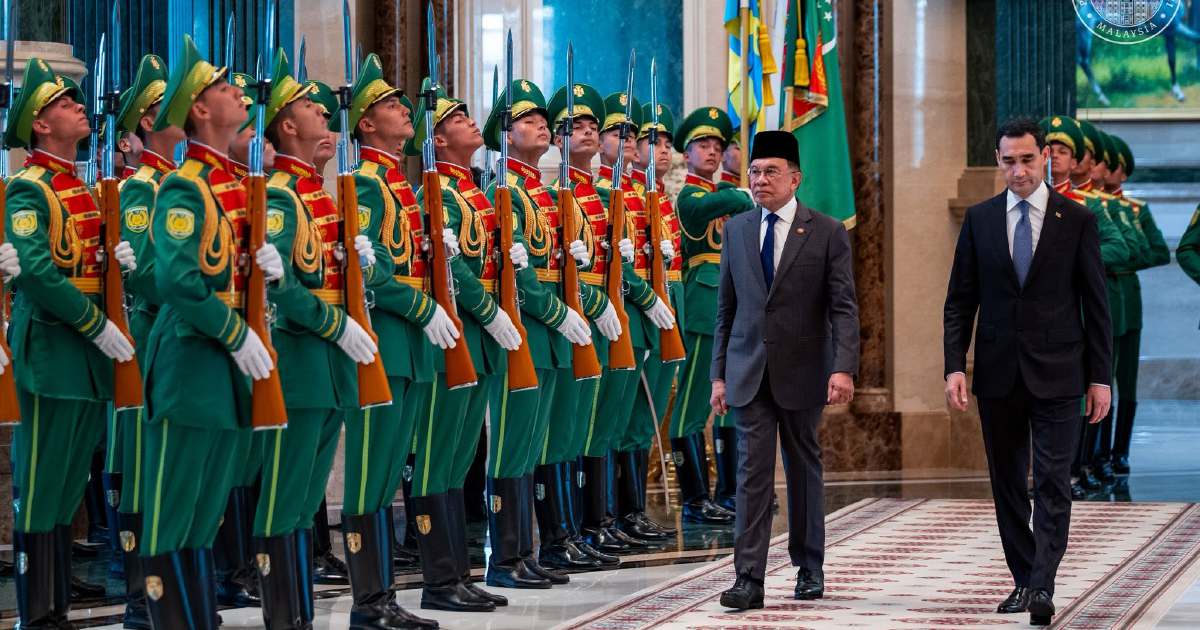
Prime Minister Datuk Seri Anwar Ibrahim was given the full ceremonial treatment during his first official visit to Turkmenistan, with the Ashgabat Presidential Palace hosting an elaborate welcome ceremony that underscored the diplomatic significance of the occasion. The formal reception, conducted today, represents a notable milestone in Malaysian-Turkmen bilateral relations and signals Kuala Lumpur's determination to deepen ties with strategic partners across the Central Asian region.
This inaugural visit by Anwar since assuming the prime ministerial office carries particular importance given Malaysia's broader pivot towards expanding economic and political partnerships beyond its traditional Southeast Asian sphere. Central Asia has increasingly featured in Malaysian strategic calculations, with policymakers recognising the region's potential as a gateway to energy resources, emerging markets, and alternative trade corridors that could reduce economic dependence on conventional routes through the Strait of Malacca and South China Sea.
Turkmenistan's significance for Malaysia extends across multiple dimensions. The Central Asian nation holds substantial reserves of natural gas and oil, making it an attractive partner for a resource-dependent economy such as Malaysia's. Furthermore, Turkmenistan's geographic position along historic trade routes positions it as a crucial node in Belt and Road initiatives and broader Eurasian connectivity projects that Malaysia has sought to engage with constructively.
The presidential welcome ceremony serves as a diplomatic signal that both nations view their relationship as worthy of high-level political engagement. Such ceremonial protocols are seldom extended without deliberate strategic intent, suggesting that substantive discussions regarding trade, investment, and bilateral cooperation feature prominently on the agenda during Anwar's time in Ashgabat. The formality of the reception also indicates Turkmen receptiveness to deepening engagement with Southeast Asian partners.
For Malaysia, this visit represents an opportunity to diversify its international engagement profile at a time when regional geopolitical tensions remain elevated. By cultivating stronger connections with Central Asian states, Malaysia can position itself as a bridge between East and West, building relationships that transcend traditional bloc alignments. This approach aligns with Anwar's broader foreign policy vision of fostering pragmatic partnerships grounded in mutual economic benefit rather than ideological considerations.
The timing of this visit also merits consideration. Malaysia has been progressively increasing its diplomatic footprint across Asia, with recent high-level visits and delegations suggesting a more assertive approach to international engagement. Anwar's presence in Turkmenistan demonstrates this commitment in concrete terms, moving beyond rhetorical emphasis on regional cooperation towards tangible political and economic initiatives.
Turkmenistan itself has been gradually opening its doors to greater international engagement, particularly with Asian nations. The country's historical isolation has been gradually eroding, with increased interest from powers across Asia seeking to establish stronger commercial and strategic relationships. Malaysia's proactive diplomatic outreach therefore arrives at a propitious moment when Turkmen leadership appears receptive to expanding bilateral cooperation with partners beyond its traditional spheres of engagement.
Economic dimensions will likely dominate substantive discussions during this visit. Malaysian companies and investors have shown increasing interest in Central Asian markets, particularly in energy, technology, and telecommunications sectors. Conversely, Turkmen firms may view Malaysia as an entry point to Southeast Asian markets, creating potential for mutually beneficial commercial partnerships. Trade facilitation agreements and investment frameworks could emerge from this high-level engagement.
Cultural and people-to-people exchange also feature prominently in contemporary bilateral relations between nations seeking to develop deeper connections. Educational partnerships, particularly in fields such as Islamic studies and Islamic finance where Malaysia possesses considerable expertise, could be explored during Anwar's visit. Such exchanges lay the groundwork for sustained engagement extending beyond government-to-government interactions.
For Malaysian observers, this visit underscores the importance of diversifying foreign partnerships as regional dynamics continue evolving. While ASEAN cooperation remains foundational to Malaysian foreign policy, engagement with distant but strategically significant partners such as Turkmenistan reflects the complexity of contemporary international relations. It demonstrates that Malaysian diplomacy operates simultaneously at multiple geographic levels, from immediate Southeast Asian concerns to broader Eurasian engagement.
The ceremonial nature of Anwar's reception suggests that both governments have invested considerable effort in orchestrating this meeting, indicating serious intent regarding relationship development. Such high-level attention typically precedes announcements of concrete cooperation frameworks, potentially including memoranda of understanding on trade, investment, education, or other sectors.
Looking forward, this visit may catalyse broader Malaysian engagement with the Central Asian region. If successful, it could encourage subsequent visits by other senior Malaysian officials and establish precedents for regular high-level dialogue. The success of this inaugural engagement will likely determine the trajectory of Malaysian-Turkmen relations for years to come, potentially opening pathways for Malaysian businesses and institutions to establish meaningful presence in Central Asia.