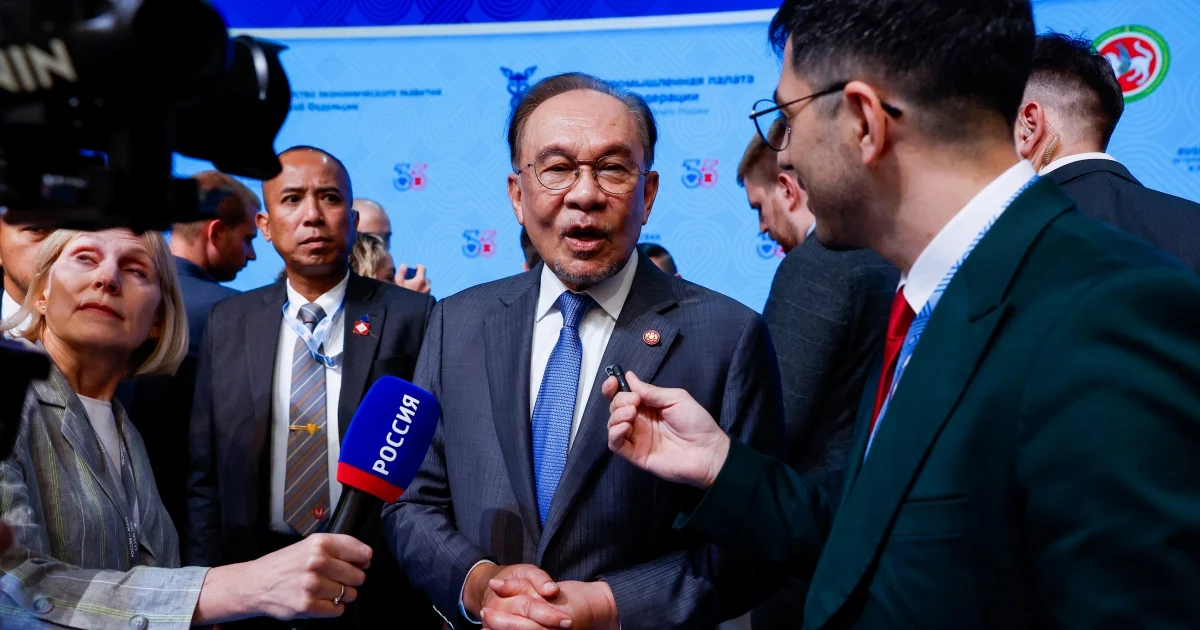
Prime Minister Datuk Seri Anwar Ibrahim has made a compelling case for cultural diplomacy as a cornerstone of international relations, citing his own affinity for Russian musical traditions and literary works during remarks in Kazan. The observation underscores a broader philosophical approach to statecraft that prioritises human connections and intellectual dialogue alongside conventional economic and political engagement.
Anwar's acknowledgement of his fondness for Russian cultural products reflects a nuanced understanding of soft power—the capacity to influence nations through attraction to culture, values, and ideas rather than coercive means. In an era where bilateral relations often centre on trade volumes, infrastructure investments, and security arrangements, the Prime Minister's emphasis on artistic appreciation serves as a reminder that nations are ultimately built on shared human experiences and mutual recognition of creative achievement.
The remarks carry particular resonance given Malaysia's historical trajectory as a multicultural society that has long benefited from cultural cross-pollination. For decades, Malaysian audiences have been exposed to diverse artistic traditions—from classical music to contemporary cinema—that have enriched public discourse and broadened perspectives. Anwar's positioning of cultural exchange as functionally equivalent to economic cooperation suggests a vision of foreign policy that extends beyond transactional relationships toward genuine civilisational understanding.
Russia's literary heritage, spanning figures from Tolstoy to Dostoevsky to Chekhov, has shaped global intellectual discourse for two centuries. These works explore profound questions of human nature, morality, and social responsibility that transcend geographical and temporal boundaries. Similarly, Russian musical traditions—encompassing classical composers like Tchaikovsky and Shostakovich, as well as folk traditions—represent significant contributions to humanity's artistic canon. The Prime Minister's openness to engaging with these cultural products demonstrates the kind of receptive intellectual posture that can facilitate deeper bilateral understanding.
From Malaysia's strategic perspective, strengthening ties with Russia through multiple channels including cultural engagement offers diversification benefits. While economic partnerships and security considerations remain paramount, the cultivation of people-to-people connections through literature, music, film, and academic exchange creates multiple pathways for cooperation and reduces reliance on any single dimension of the relationship. Cultural ambassadors—whether writers, musicians, or artists—often reach audiences that conventional diplomacy cannot.
The concept of cultural diplomacy has gained prominence in Southeast Asian policy circles in recent years, particularly as regional governments recognise that soft power can complement traditional diplomacy. Indonesia, Thailand, and Singapore have all invested in cultural promotion initiatives, sponsoring international performances and literary exchanges. Malaysia's own contributions to this arena—from film festivals to heritage preservation efforts—have generally focused on indigenous and regional traditions. Anwar's remarks suggest a willingness to expand this aperture to encompass non-regional cultural traditions as well.
For ordinary Malaysians, the significance of the Prime Minister's comments lies in the validation they provide for personal intellectual pursuits across cultural boundaries. In an increasingly polarised world, where cultural and religious identity often becomes a source of tension, the elevation of shared artistic appreciation as a diplomatic tool carries symbolic importance. It suggests that engaging with foreign cultures need not dilute local identity but rather enriches it through exposure to universal human truths expressed through different traditions.
The relationship between Russia and Malaysia has historically been pragmatic rather than deeply integrated, focused primarily on trade and diplomatic recognition. However, cultural initiatives could provide the foundation for more substantive engagement. Russian universities, for instance, could attract Malaysian scholars, while Malaysian arts organisations could collaborate with Russian counterparts on joint productions. Student exchange programmes and translation initiatives would further deepen mutual understanding.
Moreover, Anwar's comments occur within the context of Malaysia's broader foreign policy positioning. As the nation navigates complex regional dynamics and seeks to maintain balanced relationships with major powers, cultural diplomacy offers a relatively non-controversial avenue for strengthening ties. Unlike security agreements or economic partnerships, which invariably trigger scrutiny and debate, cultural exchange typically generates goodwill and faces minimal domestic opposition.
The emphasis on literature and music also reflects an intellectual dimension to statecraft that is sometimes overshadowed by economic metrics and military capabilities. Leaders who demonstrate engagement with artistic traditions signal a governance philosophy that values aesthetics, meaning-making, and human flourishing alongside material development. For a nation aspiring to middle-income status and beyond, such positioning can enhance soft power and international reputation.
Looking forward, Malaysian institutions could consider expanding cultural programming around Russian traditions. Educational institutions might introduce Russian language and literature courses at secondary and tertiary levels, while cultural centres could host film screenings and musical performances. Such initiatives would complement official diplomatic channels and create grassroots connections that prove resilient across changes in political leadership.
Ultimately, Anwar's remarks serve as a timely reminder that international relations operate across multiple registers simultaneously. While economic cooperation and strategic alignment remain essential, the connections forged through shared appreciation of art, music, and literature create a human foundation upon which more durable and authentic partnerships can be built. In Malaysia's case, embracing cultural exchange with diverse nations, including Russia, represents both a practical diplomatic strategy and an investment in a more culturally literate and cosmopolitan society.

%22%2F%3E%3C%2Fpattern%3E%3C%2Fdefs%3E%3Crect%20width%3D%22100%25%22%20height%3D%22100%25%22%20fill%3D%22url(%23ph21o2sg)%22%2F%3E%3Crect%20width%3D%22100%25%22%20height%3D%22100%25%22%20fill%3D%22url(%23ph21o2sp)%22%2F%3E%3Ctext%20x%3D%2250%25%22%20y%3D%2250%25%22%20text-anchor%3D%22middle%22%20dominant-baseline%3D%22central%22%20fill%3D%22rgba(255%2C255%2C255%2C0.95)%22%20font-family%3D%22Georgia%2C%20'Times%20New%20Roman'%2C%20serif%22%20font-weight%3D%22700%22%20font-size%3D%22170%22%20letter-spacing%3D%22-0.02em%22%3EGabungan%3C%2Ftext%3E%3C%2Fsvg%3E)