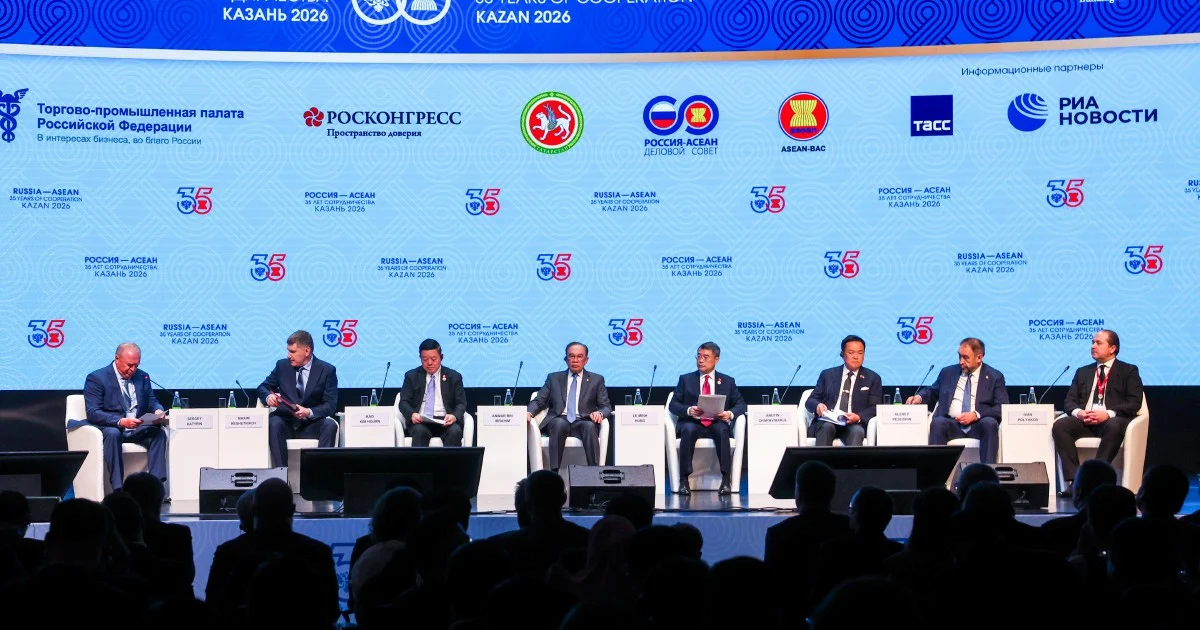
Prime Minister Datuk Seri Anwar Ibrahim has advocated for a substantial expansion of cooperative ties between Asean and Russia, emphasizing the need for deeper engagement across multiple strategic domains. Speaking in Kazan, the Malaysian leader highlighted five priority areas—food security, energy, advanced manufacturing, digital technologies, and education—as critical frontiers where the regional bloc and Moscow should concentrate joint efforts to enhance mutual prosperity and stability.
The timing of Anwar's remarks reflects growing recognition within Southeast Asia that the region's economic resilience depends increasingly on diversified partnerships beyond traditional Western ties. As geopolitical tensions reshape global supply chains and economic relationships, Asean nations face mounting pressures to secure reliable sources of essential commodities and technology. Russia, despite ongoing international sanctions related to its invasion of Ukraine, remains a significant player in energy markets and agricultural production—sectors where Southeast Asian countries maintain substantial import dependencies.
Food security represents perhaps the most immediate concern underpinning Anwar's appeal. Several Asean nations, including Malaysia, rely heavily on imported grains, oils, and other staple foodstuffs. Russia's position as a major global grain exporter means potential cooperation could stabilize supplies and mitigate price volatility that threatens vulnerable populations across the region. Such arrangements might also encompass technology transfer in agricultural innovation, allowing Southeast Asian farmers to boost productivity and reduce import reliance over the longer term.
The energy dimension carries equally significant weight, particularly for industrial economies within Asean like Thailand, Indonesia, and Vietnam. While these nations possess hydrocarbon reserves, many face rising domestic consumption that outpaces production capacity. Russian energy expertise and potential liquefied natural gas supplies offer alternatives to Middle Eastern sources, providing greater supply diversification and bargaining leverage in global energy markets. For Malaysia specifically, expanded Russian cooperation could complement existing regional energy arrangements and strengthen its position as a regional energy hub.
Advanced manufacturing and digital technology cooperation reflects Asean's determined pivot toward higher-value economic activities. The region seeks to attract investment in semiconductors, electronics, and digital infrastructure—sectors where Russian technical expertise, particularly in software development and industrial applications, could complement Chinese and Western capabilities already present across Southeast Asia. Such collaboration would create new employment opportunities and reduce technological dependency on any single source.
Educational partnerships represent a less visible but strategically important avenue for long-term relationship building. Expanded academic exchanges, scholarship programmes, and research collaborations would cultivate deeper understanding between Asean and Russian societies while developing human capital capable of managing increasingly complex technical and business challenges. Malaysian universities and research institutions stand to benefit from enhanced Russian scientific connections, particularly in fields like mathematics, engineering, and natural sciences where Russian academia maintains considerable strength.
Anwar's multilateral framing carries particular significance given Malaysia's current position within Asean affairs and broader regional diplomacy. As the country occupies space between major power blocs, articulating a vision for balanced, pragmatic engagement with Russia demonstrates Asean's commitment to non-alignment principles that have historically guided Southeast Asian foreign policy. This stance proves increasingly valuable as global competition intensifies and smaller nations seek to maximize their strategic options.
The proposal also implicitly addresses persistent imbalances in how Asean engages with various international partners. While the regional bloc maintains extensive mechanisms for cooperation with Western nations and China, its institutional architecture for engagement with Russia remains comparatively underdeveloped. Elevating the relationship through concrete cooperation frameworks in these five sectors would signal that Moscow remains a legitimate and valued actor in regional affairs, regardless of its international isolation on other matters.
Implementing such expanded cooperation will require navigating significant political complexities. Several Asean members maintain closer ties with Western countries and may harbour reservations about deepening Russian engagement, particularly given ongoing concerns about Moscow's international conduct. Additionally, existing international sanctions on Russian entities create legal and practical complications for joint ventures and technology transfer arrangements. Malaysian companies and institutions would need clear regulatory guidance regarding permissible cooperation modes.
The economic potential, however, may outweigh these obstacles. Energy-hungry Southeast Asian economies spend billions annually acquiring fuel and agricultural products from global markets. If Asean could develop reliable, diversified supply relationships with Russia in these sectors, the collective savings and supply stability gains would be substantial. Competition for such trade would also incentivize Russian engagement with Asean matters more broadly, potentially encouraging Moscow to participate more actively in regional development initiatives.
Anwar's intervention suggests that Asean leadership recognizes a moment of opportunity to reshape regional partnerships during a period of global realignment. Rather than accepting binary choices between rival powers, Southeast Asian governments increasingly assert their agency in constructing multi-directional relationships serving their specific development needs. Russia, for its part, faces limited options for meaningful partnerships outside its traditional sphere and may welcome expanded Asean engagement as a counterweight to Western pressure.
Moving forward, concrete outcomes will matter more than rhetorical commitments. Establishing dedicated working groups, feasibility studies for joint ventures in identified sectors, and regularized high-level dialogue mechanisms would transform Anwar's vision into practical reality. Malaysian involvement in facilitating such arrangements could enhance the country's standing as a trusted bridge between Asean and external partners, reinforcing its role as a thoughtful voice advocating for balanced, mutually beneficial regional cooperation.

%22%2F%3E%3C%2Fpattern%3E%3C%2Fdefs%3E%3Crect%20width%3D%22100%25%22%20height%3D%22100%25%22%20fill%3D%22url(%23ph21o2sg)%22%2F%3E%3Crect%20width%3D%22100%25%22%20height%3D%22100%25%22%20fill%3D%22url(%23ph21o2sp)%22%2F%3E%3Ctext%20x%3D%2250%25%22%20y%3D%2250%25%22%20text-anchor%3D%22middle%22%20dominant-baseline%3D%22central%22%20fill%3D%22rgba(255%2C255%2C255%2C0.95)%22%20font-family%3D%22Georgia%2C%20'Times%20New%20Roman'%2C%20serif%22%20font-weight%3D%22700%22%20font-size%3D%22170%22%20letter-spacing%3D%22-0.02em%22%3EGabungan%3C%2Ftext%3E%3C%2Fsvg%3E)