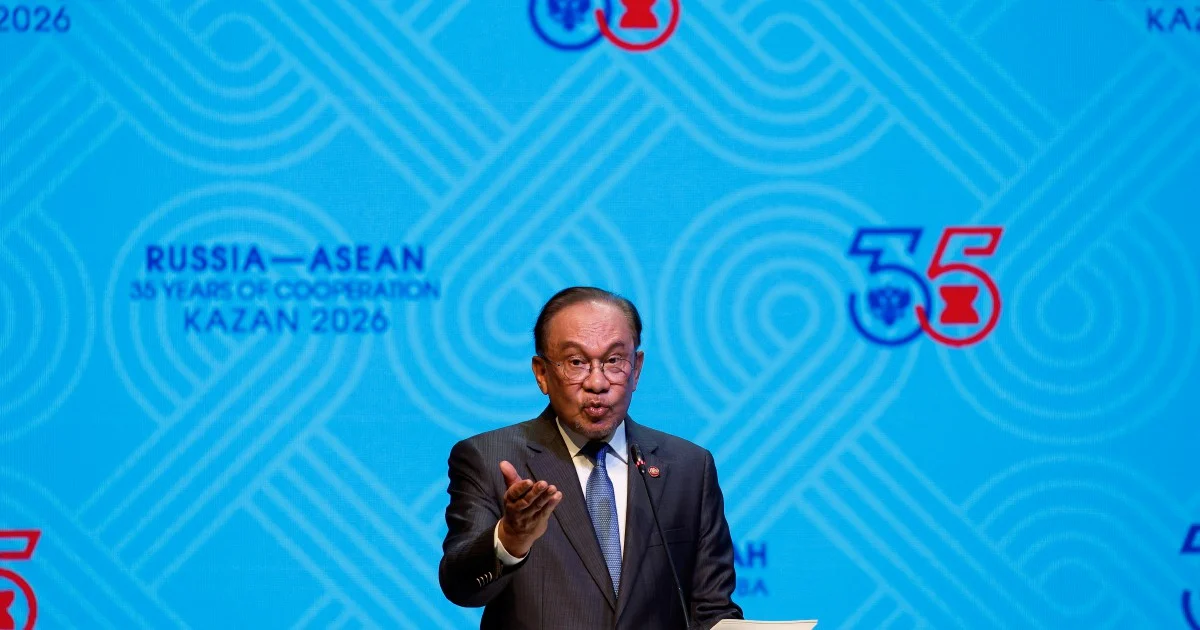
Prime Minister Datuk Seri Anwar Ibrahim has thrown his weight behind the finalisation of the Asean-Russia Strategic Programme on Trade and Investment Cooperation 2026-2035, viewing the completed accord as a pivotal moment for reshaping commercial relations between the regional bloc and Moscow. Speaking in Kazan, the Malaysian leader characterised the conclusion of negotiations as a meaningful catalyst that positions both parties for a significant expansion of bilateral economic engagement over the coming decade. However, Anwar cautioned that signing an agreement represents only the opening chapter; transforming the roadmap's ambitions into tangible commercial outcomes will require far more than diplomatic formality.
The significance of this development extends beyond ceremonial gestures. For a decade, Asean and Russia have worked to establish a coherent framework governing their trade and investment ties, a process that reflects the complexities of aligning the interests of ten Southeast Asian economies with those of a major Eurasian power. The successful completion of this strategic programme demonstrates renewed commitment from both sides to deepen engagement at a moment when geopolitical realignments are reshaping global commerce. For Malaysia, as chair of Asean and a key player in regional diplomacy, the agreement holds particular importance as it signals the bloc's capacity to maintain constructive relations with diverse partners despite international tensions.
Anwar's remarks underscore a critical reality that often escapes public attention: trade frameworks are merely blueprints. The real work lies in the institutional machinery required to execute agreements, resolve disputes, and build trust between trading partners. He identified the creation of what he termed an enabling environment as the essential foundation upon which the 2026-2035 programme must rest. This environment encompasses not only favourable tariff structures and regulatory harmonisation, but also the political will of both Asean governments and the Russian administration to prioritise the relationship and allocate resources to its development.
The timing of this agreement carries significant weight in the contemporary Asian context. Russia's reorientation towards Asia following international sanctions and geopolitical tensions with Western powers has intensified Moscow's efforts to strengthen economic partnerships across the Indo-Pacific region. For Asean nations, including Malaysia, engagement with Russia offers diversification benefits and alternative sources of investment, technology, and trade opportunities. The strategic programme provides a structured pathway through which these complementary interests can be advanced systematically rather than through ad-hoc bilateral arrangements that lack coherence or long-term vision.
Implementation challenges, however, loom large. Asean comprises economies at vastly different development levels with varying sectoral strengths and import-export profiles. Negotiating a framework that accommodates these differences while maximising mutual benefit requires sophisticated institutional coordination. Infrastructure gaps, differing technical standards, and limited existing trade networks between Southeast Asia and Russia present practical hurdles that the agreement itself cannot resolve. Currency volatility and economic sanctions regimes further complicate the commercial environment, necessitating creative financial mechanisms and careful navigation of geopolitical constraints.
For Malaysian businesses specifically, the agreement opens potential avenues in sectors where Southeast Asia possesses competitive advantages. Palm oil, agricultural products, petrochemicals, and manufactured goods represent traditional areas where Asean suppliers can tap Russian demand. Conversely, Russian technological expertise in energy, aerospace, and defence-related manufacturing could attract investment partnerships from regional firms seeking to expand their capabilities. The framework's success will ultimately depend on whether private sector actors can identify and capitalise on these opportunities, supported by government facilitation rather than government-driven directives.
Anwar's emphasis on enabling conditions reflects his administration's pragmatic approach to international engagement. Rather than overselling the agreement as a transformational breakthrough, he acknowledged the hard work ahead. This measured optimism resonates with the Malaysian government's broader philosophy of maintaining pragmatic partnerships across the geopolitical spectrum while managing risks associated with international sanctions and compliance requirements. For Malaysian exporters and investors, the strategic programme provides both opportunity and uncertainty—opportunity in accessing new markets, but uncertainty regarding the durability of the political foundations upon which the agreement rests.
The Asean-Russia Strategic Programme also carries implications for regional architecture and Malaysia's positioning within it. By completing this framework, Asean reinforces its identity as a bloc capable of engaging strategically with multiple global powers on its own terms, neither subordinate to Western interests nor entirely dependent on Beijing. This autonomous approach aligns with Malaysia's historical preference for non-alignment and strategic flexibility, principles that have guided national foreign policy for decades. The agreement thus represents more than commercial mechanics; it embodies Asean's assertion of agency in an increasingly multipolar world.
Looking forward, the success of the 2026-2035 programme will hinge on several critical factors beyond Anwar's stated enabling environment. Market access needs to be genuinely reciprocal, with Russian buyers actively engaging Asean suppliers rather than defaulting to existing partnerships. Financial mechanisms must be robust enough to facilitate transactions despite potential international banking complications. Technical cooperation and capacity-building initiatives, particularly in areas where Russian expertise can enhance Southeast Asian productivity, should be prioritised. Most importantly, the political commitment of both Asean member states and Moscow must remain consistent throughout the decade-long implementation period, weathering inevitable fluctuations in international relations and economic cycles.
For Malaysia and its regional partners, the finalisation of this strategic programme represents a calculated investment in economic diversification and geopolitical flexibility. By opening formal structures for enhanced cooperation with Russia, Asean positions itself to benefit from the multipolar era while maintaining the institutional frameworks and careful diplomacy that have preserved regional stability. Anwar's cautious optimism reflects this realistic assessment: the roadmap provides a foundation, but building something enduring requires far more than signatures on documents.

%22%2F%3E%3C%2Fpattern%3E%3C%2Fdefs%3E%3Crect%20width%3D%22100%25%22%20height%3D%22100%25%22%20fill%3D%22url(%23ph21o2sg)%22%2F%3E%3Crect%20width%3D%22100%25%22%20height%3D%22100%25%22%20fill%3D%22url(%23ph21o2sp)%22%2F%3E%3Ctext%20x%3D%2250%25%22%20y%3D%2250%25%22%20text-anchor%3D%22middle%22%20dominant-baseline%3D%22central%22%20fill%3D%22rgba(255%2C255%2C255%2C0.95)%22%20font-family%3D%22Georgia%2C%20'Times%20New%20Roman'%2C%20serif%22%20font-weight%3D%22700%22%20font-size%3D%22170%22%20letter-spacing%3D%22-0.02em%22%3EGabungan%3C%2Ftext%3E%3C%2Fsvg%3E)