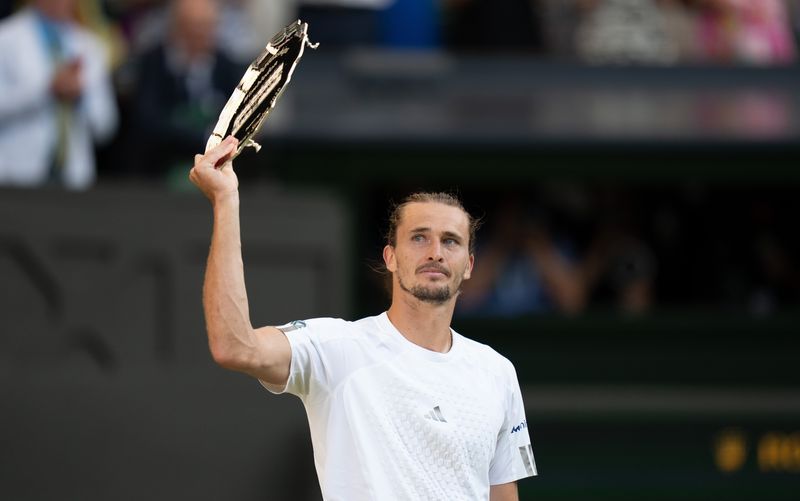
Alexander Zverev will ascend to second place in the ATP world rankings on Monday following his runner-up finish at Wimbledon, where he challenged world number one Jannik Sinner across four sets in the championship match. Though the German ultimately fell short at the All England Club, his performance against the Italian represented a significant turning point in his competitive trajectory. Zverev's loss was not a conventional defeat; rather, it embodied the closest competitive contest between these two rivals in recent memory, offering genuine evidence that the 29-year-old may finally be positioned to compete with tennis's elite tier.
Zverev's appearance in the Wimbledon final constituted a career milestone that underscores the effectiveness of his recent tactical evolution. The German had previously lost 14 consecutive sets to Sinner before this encounter, a run that highlighted the seeming gulf in quality between them. Yet Sunday's match told a different story. Zverev led in the opening set tiebreak and maintained competitive intensity throughout, with the final scoreline of 6-7(7) 7-6(2) 6-3 6-4 concealing how closely contested the opening two sets truly were. A crucial fall at 3-3 in the third set, occurring at his only genuine break point opportunity, fundamentally altered the match's trajectory and may well have cost Zverev his opportunity to become the first German man to claim the Wimbledon singles title since Michael Stich's victory in 1991.
The philosophical shift underpinning Zverev's recent success centers on embracing a markedly more aggressive tactical approach, particularly through his forehand stroke. For much of his career, this forehand was perceived as excessively conservative and insufficient for pressuring elite opponents consistently. However, Zverev has deliberately reconstructed his game to prioritize offensive opportunities whenever available. During his Wimbledon campaign, particularly the final against Sinner, his first serve percentage maintained approximately 80% efficiency, providing the platform from which his aggressive forehand could inflict genuine damage. This combination proved sufficiently potent to make Sinner uncomfortable at critical junctures throughout the match.
Zverev's Grand Slam breakthrough came last month at Roland Garros, when he finally captured his maiden major title at his 41st attempt in Grand Slam competition. That victory held particular significance given the context surrounding it—Sinner exited in the second round whilst reigning champion Carlos Alcaraz remained sidelined with a persistent wrist injury. Such circumstances inevitably invited skepticism from observers who questioned whether Zverev's breakthrough genuinely represented a fundamental improvement or merely a fortunate convergence of circumstances. However, Zverev's subsequent performance at Wimbledon provided compelling evidence that the French Open success reflected genuine progress rather than a statistical anomaly dependent on his rivals' absences.
The psychological confidence derived from winning Roland Garros fundamentally altered Zverev's approach to competition at the grasscourt major. In his media interactions following the Wimbledon final, Zverev articulated clearly that the attacking methodology he had adopted represented his intended tennis identity for the remainder of his career. He acknowledged that earlier in the season he had occasionally struggled to execute this style with consistency, yet he maintained unwavering commitment to the approach regardless of immediate results. Zverev emphasized that consistency in application would yield progressive improvement in execution, suggesting he recognizes that mastering aggressive tennis requires extended periods of deliberate practice and competitive refinement.
Zverev's assessment of his competitive positioning relative to Sinner and Alcaraz warrants particular attention given the implications for professional men's tennis's competitive landscape. The two dominant players jointly possess 12 Grand Slam titles, representing unprecedented consolidation of major championship success within such a narrow cohort. Yet Zverev's trajectory suggests this duopoly may face credible challenge. He noted having pushed both rivals to their competitive limits throughout the season despite failing to defeat either player. His Australian Open encounter with Alcaraz and the Wimbledon final against Sinner both represented matches where margins remained genuinely razor-thin, with outcomes potentially swinging on marginal factors rather than reflecting substantial skill disparities.
Zverev acknowledged the persistent narrative surrounding competitive tennis's search for a genuine third force capable of consistently challenging Sinner and Alcaraz for major titles. For several years, Zverev has occupied this notional third position, though previously at considerable distance from the top two. His current ambition involves narrowing this gap sufficiently to transition from spectator status to active participant in the tournament victories. Should Zverev achieve this progression, it would fundamentally reshape professional tennis's competitive structure and create an authentically three-way competition for major prizes. The implications for other aspirant players like Daniil Medvedev and Taylor Fritz would also be significant, as they would require corresponding elevation to remain competitive.
The physical toll of Sunday's final proved consequential despite Zverev's ultimately unsuccessful challenge to Sinner. Zverev sustained a knee injury during his third-set fall that bore unfortunate similarity to a previous knee issue experienced two years earlier. This injury directly compromised his serving mechanics, causing his serve speed to diminish as he struggled to generate full power from his lower body. Zverev attributed a noticeable dip in overall performance level to the third set, though he recovered considerably in the fourth. The injury's longer-term implications remain uncertain, but any structural concern would represent a significant complication to his ongoing development as he attempts to sustain the aggressive style that has generated recent success.
Zverev's attacking methodology carries particular relevance for Southeast Asian followers of professional tennis given the region's growing influence in the sport. Players like Dominic Thiem and others have demonstrated that stylistic innovation can challenge established hierarchies, suggesting pathways exist for ambitious competitors regardless of their initial ranking position. Zverev's journey from persistent Sinner victim to genuine Wimbledon final contender illustrates how strategic and psychological recalibration can generate rapid competitive gains. For Malaysian and regional tennis enthusiasts, Zverev's emergence as a credible challenger to the Sinner-Alcaraz duopoly promises a more compelling competitive landscape at future major championships.
Moving forward, Zverev's immediate objectives involve consolidating the progress evidenced by his recent performance while extending his ability to compete consistently against the sport's elite. His ranking ascent to world number two reflects this tangible improvement, yet he remains acutely conscious that ranking positions mean comparatively little without corresponding Grand Slam trophy accumulation. The competitive window for Zverev to establish himself among tennis's great champions remains open, but it will require sustained execution of the aggressive principles he has embraced. Should he successfully implement this tactical philosophy while remaining healthy, Zverev possesses genuine potential to claim additional major titles and fundamentally alter the competitive landscape of professional men's tennis.

