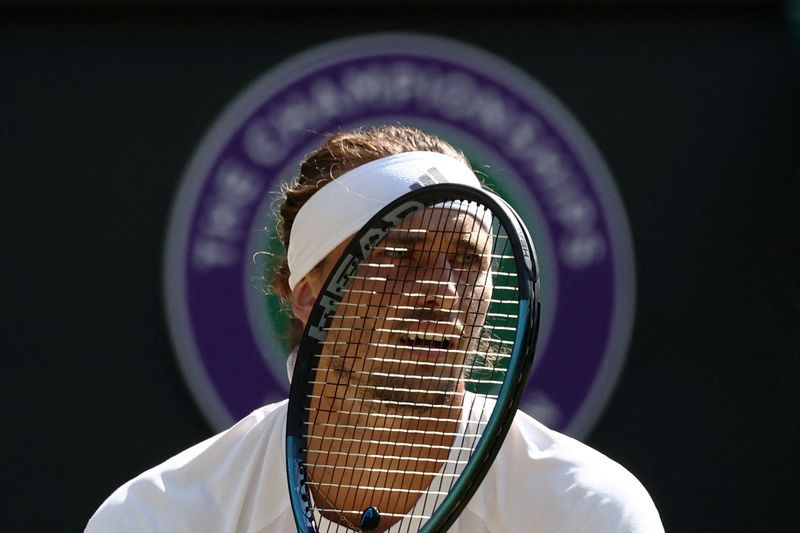
Alexander Zverev has finally conquered his personal nemesis at the All England Club, dismantling Taylor Fritz with a commanding 6-4 6-4 6-2 performance to secure his place in the Wimbledon semi-finals. The German second seed's victory represents far more than a routine quarterfinal triumph—it ends an agonising two-year drought against the American that had threatened to derail his campaign for consecutive Grand Slam titles following his recent French Open success.
The psychological weight of Zverev's seven consecutive defeats to Fritz, including a particularly galling loss at Wimbledon last year, hung over this encounter like a dark cloud. Yet the 29-year-old from Hamburg produced the sort of near-flawless tennis required to overcome such mental baggage, seizing control from the opening moments and never allowing his opponent a genuine foothold in the match. His early service break proved decisive, catapulting him to a 5-4 advantage in the first set before he weathered a determined late-game fightback to claim the opening frame under punishing summer conditions on Court One.
Fritz's prospects deteriorated sharply following a medical timeout for a troublesome right knee complaint early in the second set. This interruption appeared to disrupt his rhythm, and Zverev capitalised with ruthless efficiency, engineering another crucial break and maintaining relentless pressure as his American opponent's resistance crumbled. The German's attacking intent intensified as the match progressed, with his groundstrokes gaining pace and purpose, whilst a series of well-placed serves neutralised Fritz's limited opportunities to mount a comeback. By the third set, the outcome was never in doubt, with Zverev clinching victory through a sublime backhand winner at 4-1 that exemplified the quality he had maintained throughout.
Zverev's achievement carries particular historical significance for German tennis. His progression to a maiden Wimbledon semi-final positions him among an elite cohort of his countrymen who have reached the penultimate stage of the grass-court championship during the professional era. He joins Boris Becker, Michael Stich, Rainer Schuettler, and Tommy Haas as the fifth German man to accomplish this feat since 1968, a testament to the enduring depth of German excellence in professional tennis despite the sport's shifting demographics and economic landscape.
The path to this breakthrough has been characterised by meticulous preparation and mental resilience. Zverev acknowledged the extraordinary demands of overcoming such a prolonged personal losing streak, describing his performance as approaching perfection given the psychological variables in play. He emphasised that from the opening game, when Fritz conjured three break-point opportunities against his serve, he recognised the imperative to maintain absolute concentration and technical discipline. The knowledge that he had not defeated this particular opponent for more than two years created a persistent undercurrent of doubt that required active suppression.
His semi-final opponent will be Arthur Fery, the British home favourite who navigated past Italy's Flavio Cobolli to set up an intriguing all-left-handed clash. This matchup represents unprecedented territory for both players—neither has previously reached the Wimbledon semi-finals, and both will carry the weight of competing in their breakthrough appearance at this stage of the tournament. The configuration of this semi-final underscores how the championship continues to surprise seasoned observers with unexpected pairings and emergent contenders.
For Malaysian and Southeast Asian tennis enthusiasts, Zverev's success embodies the broader significance of German sporting prowess in professional tennis. The continent's players continue to exert disproportionate influence in Grand Slam competitions, and tracking their progress offers valuable insight into evolving patterns of global excellence in the sport. Regional players aspiring to reach the highest echelons of professional tennis can observe how Zverev's technical mastery, tactical flexibility, and mental fortitude combine to generate success against world-class opponents who have previously dominated head-to-head records.
Zverev's potential path to the Wimbledon title now passes through two additional matches, should he prevail against Fery. His stated ambition to capture back-to-back Grand Slam trophies represents an ambitious objective, achieved by relatively few players in the modern game's intensely competitive environment. The French Open crown he captured weeks earlier demonstrated his capacity to sustain excellence across different surface types and tournament formats, yet grass courts remain a specialist domain where consistency and adaptability separate champions from competitors.
The German's demeanour following this victory suggested a player of growing confidence and emotional equilibrium. His self-aware humour regarding the inevitable crowd support for the British finalist Fery demonstrated a psychological maturity absent from his earlier career phases. He recognised that playing Fery at Wimbledon would present a formidable challenge precisely because home advantage creates intangible benefits that extend well beyond the court's boundaries. Yet his willingness to embrace this adversity rather than resent it signals a player who has evolved considerably in managing the complex pressures inherent in pursuing Grand Slam silverware at the sport's most prestigious tournament.
As Zverev proceeds into the semi-finals, the momentum generated by his commanding demolition of Fritz provides substantial psychological currency. He has answered the central question that had lingered following previous losses to the American—whether he possessed sufficient technical range and mental resilience to overcome such a protracted competitive disadvantage. His affirmative response through clinical execution on tennis's most hallowed court strengthens his candidacy for ultimate championship glory.

