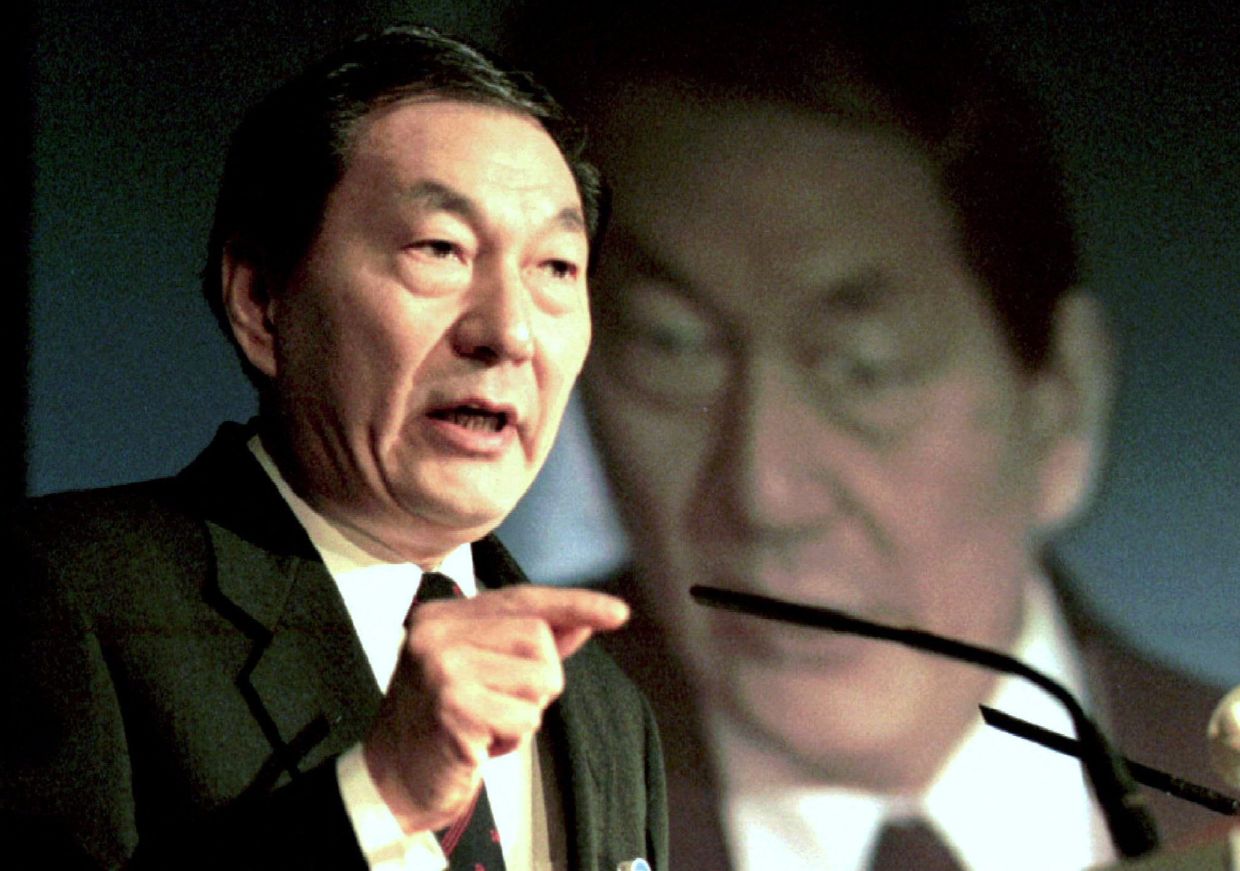
Zhu Rongji, the former Chinese premier whose tenure as the country's top economic official transformed its industrial landscape and opened its doors to global commerce, has passed away at the age of 98. The Beijing-based leader died on Wednesday, August 12, following unsuccessful medical treatment for an undisclosed ailment, according to reports from Xinhua News Agency. His death marks the end of an era for one of modern China's most consequential reformist figures, a man whose legacy remains deeply contested across the political spectrum as Beijing's current leadership pursues fundamentally different economic philosophies.
During his years as China's chief economic strategist before ascending to the premiership in 1998, and throughout his tenure until 2003, Zhu navigated the country through multiple crises that tested both his resolve and his economic acumen. The 1997 Asian financial crisis and the challenge of controlling double-digit inflation demanded swift, sometimes painful interventions. Yet it was his willingness to implement structural reforms that defined his career. He oversaw the closure of tens of thousands of underperforming or debt-laden state-owned enterprises across telecommunications, banking, petroleum, and other sectors, decisions that displaced tens of millions of workers from their positions and fundamentally reshaped China's workforce and social fabric. These were among the most controversial moves of his premiership, yet Zhu viewed them as essential medicine for an economy suffocating under the weight of inefficiency and mounting debt.
The contrast between Zhu's market-oriented approach and the current direction under President Xi Jinping underscores a significant philosophical divergence within China's leadership. Where Zhu championed the reduction and privatization of state enterprises as a path to efficiency and growth, Xi Jinping has advocated for a "stronger, better, and bigger" state-controlled economy designed to serve broader national strategic objectives. This fundamental disagreement about the role of state ownership in China's development reflects competing visions of how best to secure the nation's economic future. Zhu's methods produced undeniable growth metrics—China's GDP has multiplied elevenfold since his era—but they came at substantial social costs that continue to reverberate through Chinese society.
One of Zhu's most significant achievements was engineering China's admission to the World Trade Organization in 2001, a milestone that would reshape global commerce for decades. In 2000, he met with European Union Trade Commissioner Pascal Lamy in Beijing to break a negotiating deadlock that had stalled China's accession process. The breakthrough from that meeting proved instrumental in finalizing the terms that allowed China to join the WTO the following year. This integration into the international trading system accelerated the nation's emergence as a manufacturing powerhouse and opened markets across the world to Chinese goods. Yet this same integration has become a source of international friction, with trading partners consistently accusing Beijing of circumventing WTO principles through subsidies to domestic industries, informal import barriers, and intellectual property violations—issues that remain unresolved today.
Beyond the headlines of mass layoffs and trade negotiations, Zhu demonstrated an unusual grasp of granular economic detail that impressed both domestic and international observers. When Goldman Sachs arranged the October 1997 Hong Kong share sale of what would become China Mobile, Zhu personally monitored meetings on the island of Hainan where Deutsche Telekom experts were teaching the company's executives about structuring finance and marketing operations. John Thornton, who led the Goldman Sachs transaction, recalled that Zhu peppered the gathered executives with questions demonstrating such comprehensive knowledge of operational matters that his queries were more reminiscent of a corporate chief financial officer than a national premier. This meticulous attention to detail extended to his broader economic management, earning him a reputation as someone willing to dig into specifics while maintaining a strategic vision of China's path forward.
As governor of the People's Bank of China from 1993 to 1995, Zhu advanced financial liberalization by establishing pilot programs for foreign financial institutions and orchestrating China's inaugural international bond sale. His most consequential banking sector intervention came in 1999 when he oversaw the creation of asset-management companies designed to absorb 1.4 trillion yuan—approximately US$220 billion at the time—in non-performing loans from China's four largest banks. These institutions had accumulated enormous bad debt portfolios by extending credit to unprofitable state-owned enterprises, and the creation of these bad banks proved essential in allowing the major financial institutions to cleanse their balance sheets and transition toward market-oriented operations. This mechanism enabled China's largest banks to subsequently list on public exchanges beginning in 2005, transforming them into genuinely profitable enterprises that could compete on global financial markets.
Deng Xiaoping, the paramount leader who initiated China's reform and opening-up policies, once described Zhu as a "rare talent" who possessed both economic understanding and the courage necessary to confront difficult challenges and endure hardship in pursuit of reform objectives. This assessment underscored Zhu's standing within the Communist Party hierarchy and his reputation as someone who could translate abstract policy goals into concrete administrative action. During his premiership, Zhu did not limit his efforts to economic restructuring alone. He initiated an anti-corruption campaign and worked systematically to reduce bureaucratic complexity, earning the popular nickname "one-chop Zhu" as a reference to the official seals, or chops, required to authorize government documents—his reforms streamlined the approval process to require fewer signatures and stamps.
Zhu cultivated an international image that contrasted markedly with stereotypes of Chinese officialdom. He was fluent in English and possessed a demonstrated sense of humor that played well with foreign interlocutors. During a 1999 joint press conference with United States President Bill Clinton in Washington, when confronted with allegations that China had funneled political donations to the Democratic Party, Zhu responded with characteristic wit. Noting that if such contributions were truly effective, he could easily allocate portions of China's US$146 billion in foreign exchange reserves toward that purpose, he remarked sardonically that contributing merely US$300,000 would be "too foolish," drawing laughter from the assembled journalists. This combination of economic competence and diplomatic charm made him an unusually effective ambassador for China's integration into international institutions.
Following his transition from the premiership to Wen Jiabao in 2003, Zhu redirected his energies toward elevating his alma mater, Tsinghua University in Beijing. He made substantial donations to rural schools drawn from royalties earned through published books, demonstrating a concern for educational equity that extended beyond his tenure in high office. Zhu was born in October 1928 in Hunan province in south-central China, attending Tsinghua University from 1947 to 1951 where he studied electrical engineering. He joined the Communist Party in October 1949, the very month Chairman Mao Zedong—also a native of Hunan province—proclaimed the establishment of the People's Republic of China.
During the Hundred Flowers Campaign of the mid-1950s, when the Communist Party temporarily encouraged public criticism and debate, Zhu made the fateful decision to voice objections to Mao's economic policies, arguing they prioritized irrational growth metrics without regard to efficiency or sustainability. This candid assessment cost him dearly. He was branded a "rightist" and subjected to demotion, subsequently spending five years during the Cultural Revolution working on a rural farm where he raised pigs and cultivated rice alongside other purged officials. Following his rehabilitation in 1978 after Deng Xiaoping consolidated power, Zhu's political fortunes reversed dramatically. He ascended through successive government positions, becoming Shanghai's mayor in 1987 and a vice premier in 1991 before joining the elite Standing Committee of the Politburo in 1992.
In a 2000 address to the National People's Congress, Zhu articulated his deepest aspiration for his legacy, expressing hope that Chinese citizens would remember him as a clean administrator untainted by corruption, a characterization that would satisfy him completely. With somewhat greater ambition, he added that should people be generous enough to acknowledge that "Zhu Rongji got some real things done," he would "thank heaven and Earth." This modest yet pointed reflection suggested he understood the controversial nature of his tenure while remaining confident that history would ultimately vindicate his methods. Zhu is survived by his wife, Lao An, and two children: his son Levin Zhu, who directed China International Capital Corp from the early 2000s through 2014, and his daughter Zhu Yanlai, who occupied senior management positions at Bank of China (Hong Kong).

