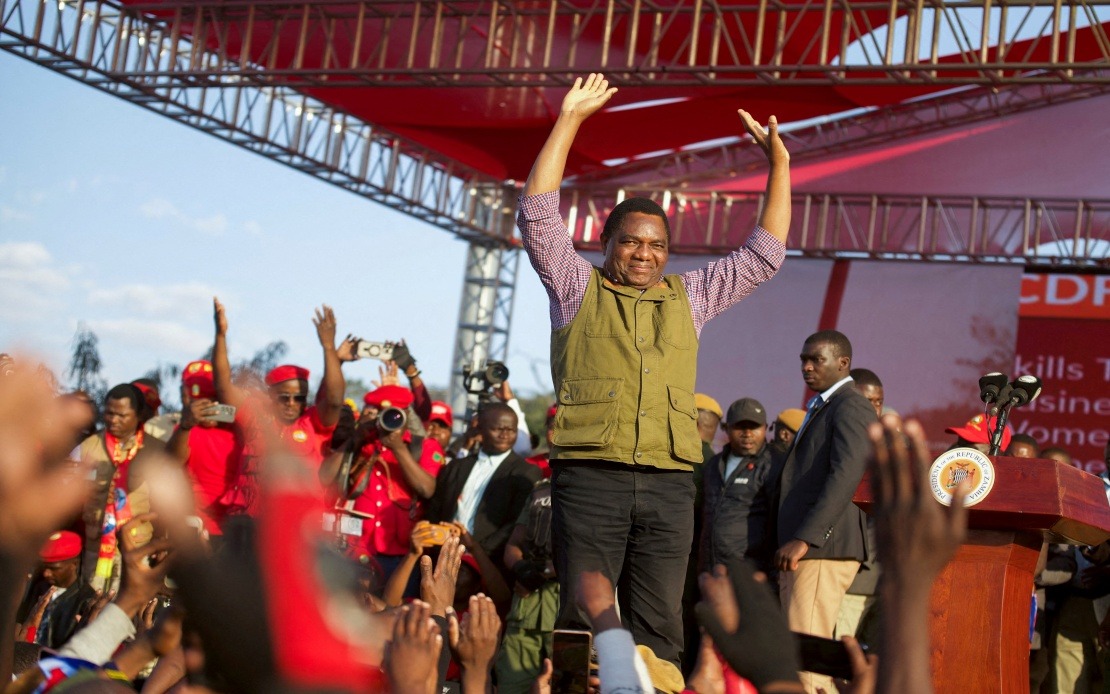
Zambian President Hakainde Hichilema has won a decisive mandate for a second term in office, capturing more than 2.9 million votes in the presidential election held last Thursday. The Electoral Commission of Zambia made the formal announcement early on Tuesday in Lusaka, confirming that the 64-year-old leader has exceeded the constitutionally mandated threshold of 50 per cent plus one vote, positioning him to continue leading the Southern African nation.
Hichilema's triumph represents a significant endorsement by Zambian voters, who have placed their confidence in his administration for another five-year term. His main challenger, Brian Mundubile of the National Restoration Party for Unity and Progress, or NRPUP, finished a distant second with 1.8 million votes, unable to mount a credible challenge to the incumbent's popularity. The margin of victory underscores the strength of Hichilema's political position heading into his second administration, which will face considerable economic and social challenges inherited from his first term.
Electoral Commission chairperson Mwanagala Zaloumis declared Hichilema as president-elect at the national election centre in Lusaka, and notably indicated that the outstanding tallies from a selection of polling stations across five of Zambia's 226 constituencies would prove immaterial to the final outcome. This assessment reflects the commanding lead Hichilema had already established, removing any uncertainty about the election's direction and lending credibility to the process's legitimacy. The decisive nature of his victory margin provides him with a strong mandate to advance his policy agenda without significant parliamentary obstruction.
In his immediate response via social media, Hichilema expressed gratitude to Zambian voters for entrusting him with the presidency once more. His tone struck a balance between humility and confidence, acknowledging the responsibility that accompanies re-election whilst positioning himself as a servant of the nation rather than merely a political victor. Such messaging carries weight in post-election contexts, where leaders must unite constituencies that supported competing candidates and build consensus around national priorities.
The atmosphere in Lusaka itself reflected the celebratory mood among Hichilema's supporters and sections of the broader public. Streets filled with jubilant citizens braving the early morning chill as results were announced, demonstrating palpable enthusiasm for continuity under his leadership. This public manifestation of electoral acceptance carries practical implications for governance, as legitimacy derived from visible popular endorsement strengthens a leader's capacity to implement potentially unpopular but necessary reforms, particularly in economic policy areas.
Collins Maoma, the national chairperson of Hichilema's ruling United Party for National Development, or UPND, told reporters that Zambian citizens had once again demonstrated confidence in the president's leadership capabilities. Maoma's remarks emphasised continuity and the electorate's desire to maintain the incumbent administration's trajectory, suggesting the UPND views its victory as validation of its approach to governance. For Malaysian observers, Zambia's orderly electoral process in an African context offers interesting comparative insights into regional democratic practices.
The victory positions Hichilema to continue addressing Zambia's substantial economic pressures, including managing the aftermath of a sovereign debt crisis that dominated his first term. His re-election suggests voters, despite the country's evident economic difficulties, preferred stability under a known quantity rather than risk an alternative government. This dynamic reflects broader patterns observed across developing democracies, where economic hardship does not automatically translate into incumbent defeat if opposition alternatives appear insufficiently credible or untested.
For Southeast Asian policymakers and observers, the Zambian election offers pertinent lessons about managing electoral legitimacy whilst navigating constrained economic circumstances. Hichilema's ability to retain office despite presiding over a challenging fiscal environment demonstrates that competent crisis management and perceived relative stability can overcome public dissatisfaction with economic conditions. This pattern has parallels in regional politics, where voters have occasionally re-elected governments facing economic headwinds based on assessments of leadership quality and comparative advantage over opposition options.
The breadth of Hichilema's victory, gaining nearly 60 per cent more votes than his nearest competitor, suggests he retained core support whilst potentially winning additional marginal voters. This coalition-building capacity will be essential for his second term, as he must navigate parliamentary dynamics and maintain public confidence whilst implementing measures required by international creditors and structural economic realities. The strong mandate provides political cover for tough decisions that might otherwise invite destabilisation.

