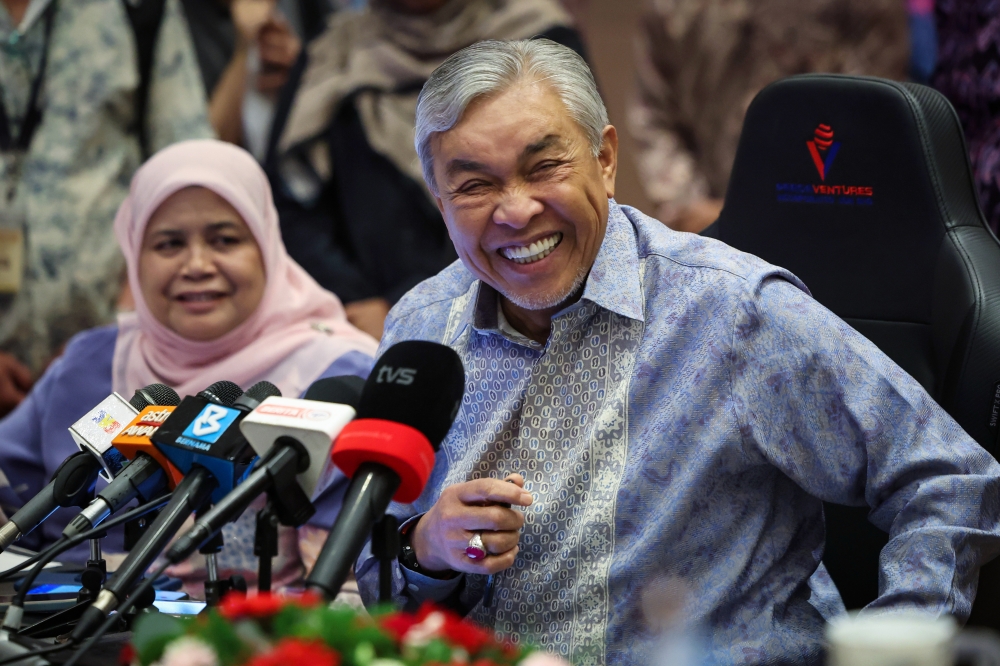
Deputy Prime Minister Zahid Hamidi has moved to quell recurring speculation about political instability by publicly affirming that Barisan Nasional will remain anchored to the Unity Government arrangement for the duration of the current parliamentary term. Speaking in George Town on July 23, Zahid employed emphatic language to dismiss whispers of backroom manoeuvres, declaring that there will be neither a "Bangkok move" nor a "Dubai move"—oblique references to sudden political shifts orchestrated away from public scrutiny or parliamentary channels.
The remarks carry particular significance given Malaysia's recent political turbulence, which saw the collapse of previous administrations and the emergence of the Unity Government in late 2022 as a stabilising mechanism. By invoking these dismissive phrases, Zahid was signalling that BN has consciously rejected the clandestine dealmaking that has characterised Malaysian politics, instead pledging transparency and institutional fidelity. The emphasis on continuity until Parliament dissolves addresses anxieties among coalition partners and the broader electorate about premature elections or sudden coalition ruptures that might derail governance priorities.
The 15th Parliament, which commenced following the 2022 general election, establishes a constitutional endpoint for the current administration's mandate. Zahid's framing of BN's commitment "until the end of Parliament" carries legal and political weight, essentially binding the coalition to complete its legislative term without engineering early dissolution or engineered defections. This temporal boundary provides coalition partners with a defined horizon and reduces uncertainty that might otherwise encourage speculative positioning or strategic party-switching by individual lawmakers seeking advantageous positioning before electoral contests.
Barisan Nasional's centrality to the Unity Government reflects its evolution from an electoral force that has dominated Malaysian politics since independence to a stabilising pillar within a broader multi-party coalition. The BN component—comprising United Malays National Organisation (UMNO), Malaysian Chinese Association (MCA), and Malaysian Indian Congress (MIC)—brings substantial parliamentary numbers and ground organisation, but operates within constraints imposed by collaboration with Pakatan Harapan and other partners. Zahid's statement implicitly acknowledges that BN has internalised this new political reality and accepted power-sharing rather than unilateral control.
The specific invocation of Bangkok and Dubai as locations where untoward political dealings might occur reflects Malaysia's distinct history with cross-border political consultations. Both cities have served as neutral venues where Malaysian political figures have met to negotiate arrangements outside their home jurisdiction. By pre-emptively dismissing such scenarios, Zahid was signalling that BN leadership recognises the reputational and institutional damage caused by perceptions of backroom dealings, and has committed to more institutionalised governance processes.
For Southeast Asian observers, Malaysia's maintenance of stable coalitional governance carries broader implications. The region has experienced democratic backsliding and institutional weakness in several countries, making Malaysia's relatively robust parliamentary institutions and regular electoral cycles a point of reference. A successful completion of the current parliamentary term without coalition collapse would reinforce confidence in Malaysian democratic resilience and potentially contrast favourably with governance challenges elsewhere in ASEAN, particularly where institutional checks on executive power have weakened.
The stability pledge also addresses economic and investor concerns that have historically spiked during periods of political uncertainty in Malaysia. Multinational corporations and regional financial actors monitor Malaysian political developments closely, as instability can trigger capital flight and complicate long-term investment decisions. By explicitly renouncing speculation-inducing behaviour, Zahid was attempting to provide the policy continuity and governmental predictability that international stakeholders require for confident capital deployment.
Domestically, the statement represents BN's attempt to position itself as a mature, responsible political force prioritising national stability over narrow factional advantage. This repositioning is significant given UMNO's historical dominance and the traditional expectation that larger parties would leverage numerical superiority to extract maximum concessions. By accepting constraints inherent in coalition governance, BN is signalling an understanding that contemporary Malaysian politics demands inclusivity and consensus rather than majoritarian imposition.
Yet analysts might note that Zahid's affirmations, while important, remain conditional on continued acceptance by other coalition members and on electoral mathematics remaining relatively stable. Unexpected parliamentary defections, major policy disagreements among coalition partners, or deteriorating public support for the government could still generate pressures contradicting these commitments. The statement therefore functions both as a genuine policy commitment and as an attempt to reinforce coalition discipline by publicly staking BN's credibility on maintaining the Unity Government framework.
The Deputy Prime Minister's comments also carry implications for opposition positioning and electoral strategy. Opposition parties, particularly those critical of the coalition arrangement, must now develop narratives that appeal to voters without merely exploiting coalition fragility—since BN leadership has attempted to inoculate the arrangement against such criticisms by removing the speculative uncertainty that typically fuels opposition momentum during periods of presumed governmental weakness.
Looking forward, Zahid's statement establishes a baseline expectation against which BN's behaviour will be measured. Any subsequent political manoeuvres—whether subtle repositioning on policy matters or attempts to expand BN's parliamentary representation—will face scrutiny against this explicit commitment. The declaration thus represents both a genuine institutional commitment and a strategic narrative designed to project stability while the government completes its constitutional term.

