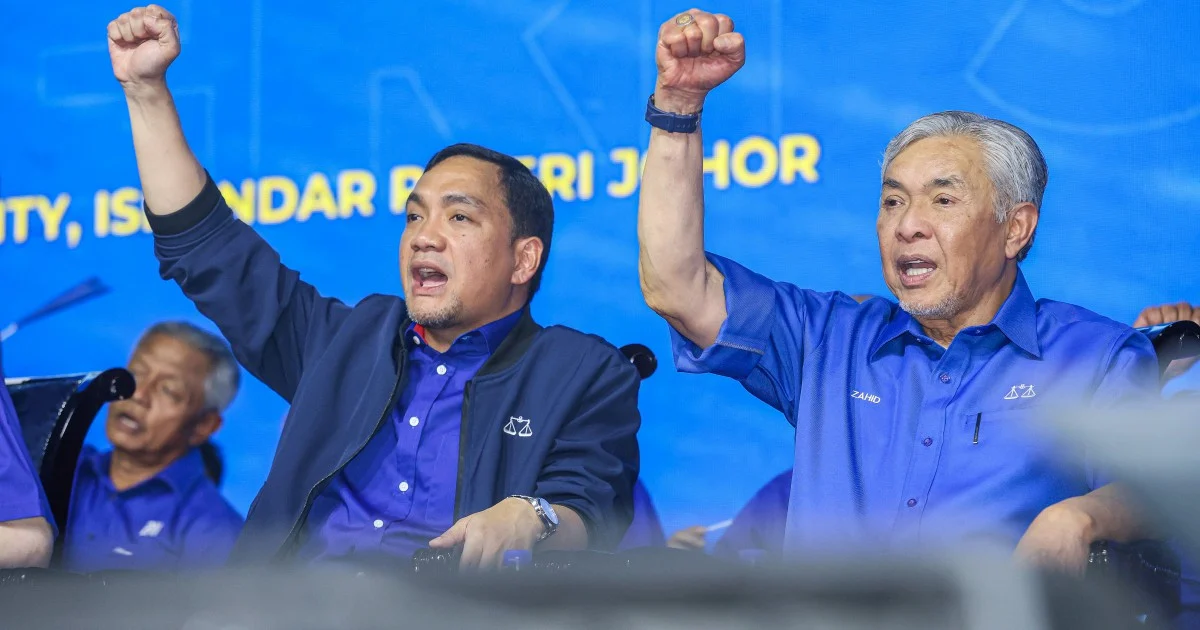
Barisan Nasional chairman Datuk Seri Dr Ahmad Zahid Hamidi has left the possibility open for exploratory conversations at lower organisational levels involving PAS and Parti Wawasan Negara, particularly as the coalition prepares for the Johor state election. Speaking in Simpang Renggam, Zahid suggested that while top-level negotiations may not be formalised, informal discussions between mid-ranking party officials could proceed without prejudicing BN's strategic position.
The statement represents a carefully calibrated approach to coalition-building in Johor, where political alignments have become increasingly fluid since the 2022 general election. Rather than dismissing potential cooperation outright, the BN leader has indicated flexibility in how parties might engage on common interests. This nuance reflects the complex electoral mathematics in the state, where BN's traditional dominance has been challenged by rising competition from both PAS-led Perikatan Nasional and newer players like Wawasan.
PAS's position in Johor politics has undergone significant transformation in recent years. Once primarily an opposition force, the Islamic party has positioned itself as an alternative to BN while also maintaining the possibility of working relationships with other coalitions depending on state-level dynamics. Wawasan Negara, meanwhile, remains a relatively new entrant attempting to carve out political space by positioning itself as a reformist alternative. Both parties represent potential coalition partners or spoilers for BN in crucial Johor seats.
Zahid's measured response acknowledges political reality: in contemporary Malaysian politics, rigid ideological positioning often gives way to pragmatic negotiations when election outcomes are uncertain. Lower-level party discussions—between divisional heads, state assemblymen, and organisational secretaries—serve as testing grounds for broader cooperation without requiring leadership to make binding commitments prematurely. Such exploratory talks allow parties to assess feasibility and voter reception before any official alliance is announced.
The timing of this statement carries significance as Johor moves closer to a state election. BN has governed Johor continuously since independence, but recent federal election results demonstrated cracks in this fortress. Understanding whether PAS and Wawasan might tacitly support BN candidates in certain constituencies, or conversely whether they could work together to contest against BN, remains strategically important. Zahid's openness to discussions suggests BN is preparing multiple scenarios rather than assuming automatic electoral success.
For Malaysian voters and political observers, this represents a broader trend in national politics where monolithic coalition structures have eroded. The days when BN, Pakatan Harapan, and Perikatan Nasional operated as clearly demarcated blocs appear increasingly obsolete. Instead, fluid alliances that shift between federal and state levels, or even between individual constituencies, have become standard practice. This fragmentation creates both opportunities and risks for established parties seeking to maintain electoral dominance.
The approach Zahid has outlined also reflects lessons learned from the 2022 general election, where rigid coalition positioning contributed to hung parliaments in several states and national-level gridlock. Political parties across Malaysia have since become more willing to explore unconventional arrangements, including independent candidates, cross-coalition seat-sharing, and issue-based cooperation. Johor's upcoming election will likely feature similar complexity, with multiple parties seeking advantageous positioning rather than winner-take-all outcomes.
From a Southeast Asian perspective, Malaysia's political evolution mirrors patterns seen in other democracies where declining party loyalty and fragmented voter preferences force coalitions to become more fluid and negotiation-based. Thailand, Indonesia, and the Philippines have all experienced similar shifts toward transactional politics where cooperation is negotiated at multiple levels simultaneously. BN's adaptation to this environment through lower-level talks represents institutional learning in response to changed electoral conditions.
The economic and governance implications of such fluid coalitions warrant consideration. While they may reflect voter demand for greater choice and flexibility, they also create uncertainty for policy implementation and institutional stability. A government built on precarious lower-level agreements between diverse parties faces challenges in pursuing coherent long-term policy agendas, particularly on contentious issues involving religious authority, development priorities, or fiscal management. Johor's state government, should it emerge from such multi-party negotiations, would need robust internal mechanisms to manage competing interests.
Zahid's statement notably avoids committing BN to any specific electoral arrangement, maintaining strategic ambiguity that serves his coalition's negotiating position. By neither rejecting nor formally endorsing cooperation with PAS and Wawasan, he preserves flexibility to adjust tactics based on evolving circumstances. This calculated vagueness has become a hallmark of contemporary Malaysian political leadership, where public statements often contain multiple layers of meaning for different audiences—party loyalists, rival coalitions, and undecided voters.
Looking ahead, the Johor election will test whether BN can recalibrate its political approach to succeed in a more complex, multi-polar environment. The coalition's reliance on informal discussions with potential partners reflects recognition that electoral dominance can no longer be assumed through organisational strength alone. Success will depend on whether BN can leverage these lower-level conversations to prevent vote-splitting among non-Pakatan Harapan constituencies while simultaneously appealing to swing voters demanding fresh political approaches.

