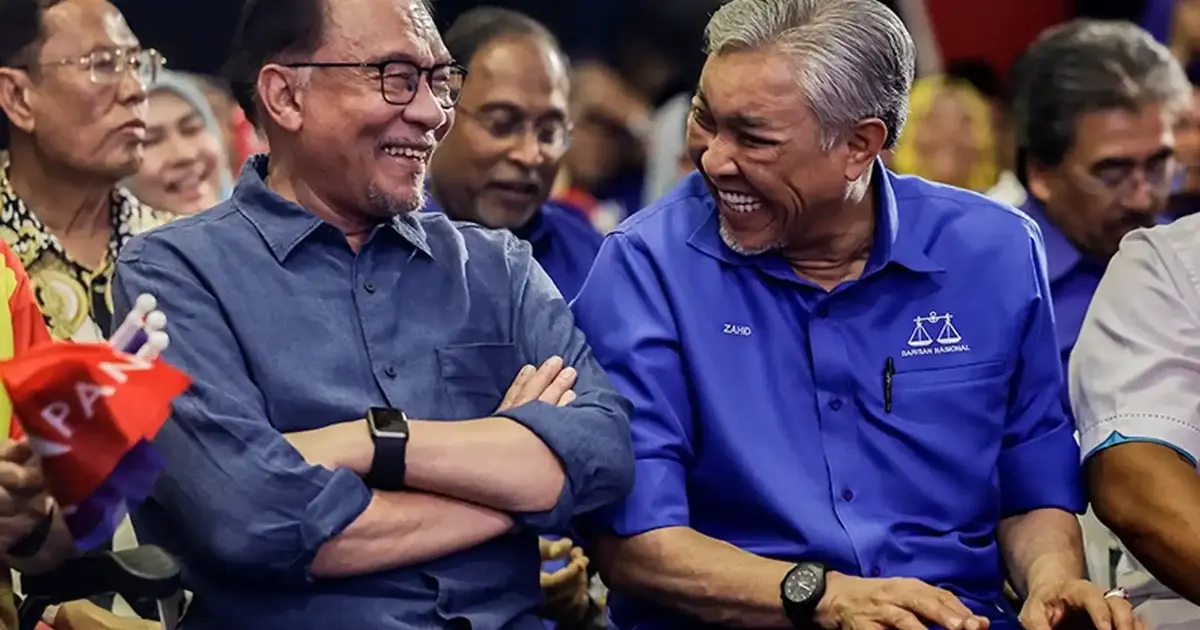
Deputy Prime Minister Zahid Hamidi has chosen an unconventional medium to address Prime Minister Anwar Ibrahim, countering a recent poem with poetic verse of his own while simultaneously underscoring Barisan Nasional's resolute commitment to sustaining Malaysia's ruling coalition. The exchange highlights the intricate political dynamics between the two major power blocks that have together shaped the nation's governance framework since 2022.
The poetic exchange signals a deepening level of political communication at the highest echelons of Malaysia's government, moving beyond traditional parliamentary speeches and official statements. Such interactions, particularly when they employ cultural and literary forms, often carry symbolic weight within Malaysian political discourse, where leaders have historically used creative expression to convey nuanced political positions that might prove more divisive if expressed through conventional governmental channels. Zahid's decision to respond in kind demonstrates an intent to maintain a collegial tone while articulating Barisan Nasional's perspective.
As both chairman of Barisan Nasional and deputy prime minister, Zahid occupies a uniquely pivotal position within Malaysia's political architecture. His dual role necessitates balancing the interests of the 14-party coalition that represents significant constituencies across the nation while simultaneously functioning as second-in-command within the federal government. This balancing act has become increasingly complex as the unity government navigates competing pressures from coalition partners, parliamentary opposition, and the broader Malaysian electorate.
The unity government itself represents an unprecedented political arrangement in recent Malaysian history, bringing together ideological opponents and former adversaries under a shared governance mandate. This coalition includes Pakatan Harapan, Barisan Nasional, and several other smaller parties, creating an inherently fragile political equilibrium that requires constant management and goodwill from all participating factions. The government's survival depends not merely on parliamentary arithmetic but on the willingness of coalition leaders to maintain collaborative relationships despite fundamental political differences.
Barisan Nasional's role within this arrangement has been instrumental in securing the parliamentary numbers necessary to form and maintain a functioning government. The coalition, which previously dominated Malaysian politics for nearly seven decades before its historic 2018 electoral defeat, has effectively repositioned itself as a coalition partner rather than the dominant ruling bloc. This represents a significant recalibration of Barisan Nasional's political strategy and self-perception.
Zahid's explicit reaffirmation of Barisan Nasional's commitment to sustaining the unity government through its complete term addresses lingering concerns within political circles about the stability of the current arrangement. Periodic speculation about potential coalition realignments, defections, or early elections has created an undercurrent of uncertainty that affects investor confidence, policy implementation, and the government's ability to advance long-term initiatives. By explicitly pledging continued support, Zahid seeks to reassure both coalition partners and the broader public about governmental continuity.
The timing of such a declaration carries significance within Malaysia's political calendar. The nation approaches several important administrative and electoral milestones, including state elections in certain jurisdictions and the eventual approach toward general elections. Barisan Nasional's public commitment to coalition stability signals that the party does not view the immediate political landscape as opportune for attempting to renegotiate the balance of power or pursue alternative political arrangements that might yield better electoral positioning.
For regional observers, Malaysia's unity government experiment holds particular relevance as other Southeast Asian democracies grapple with coalition politics and post-election negotiations. The relative success or failure of Malaysia's approach to managing ideological differences within a governing coalition may influence how other nations in the region approach similar political challenges. The willingness of Zahid and Anwar to maintain working relationships despite their parties' historical antagonism demonstrates possibilities for political maturity and institutional stability.
The poetic dimension of this political exchange reflects broader trends in how contemporary political leaders communicate with diverse audiences. While formal policy papers and parliamentary statements reach specialist audiences, poetry and creative expression can resonate more broadly with the general public, particularly in a nation with strong literary traditions. Zahid's choice to respond poetically rather than through a standard political statement suggests an awareness of how messages are received and interpreted across different demographic and educational segments.
Looking forward, the sustainability of Malaysia's unity government will depend on continued efforts by leaders like Zahid to demonstrate commitment to the coalition beyond mere electoral mathematics. As economic challenges, social demands, and political pressures test the resolve of coalition partners, these symbolic expressions of solidarity become increasingly important for maintaining the psychological and political cohesion necessary for effective governance.
The exchange between Zahid and Anwar, conducted through creative expression, ultimately underscores a fundamental reality of Malaysia's contemporary politics: the nation's stability now hinges not on the dominance of a single bloc but on the capacity of rival leaders to work together constructively. Zahid's verse and reaffirmation of coalition commitment represent investments in maintaining the institutional relationships that currently sustain Malaysian democracy, even as political actors continue to position themselves for future electoral contests.

