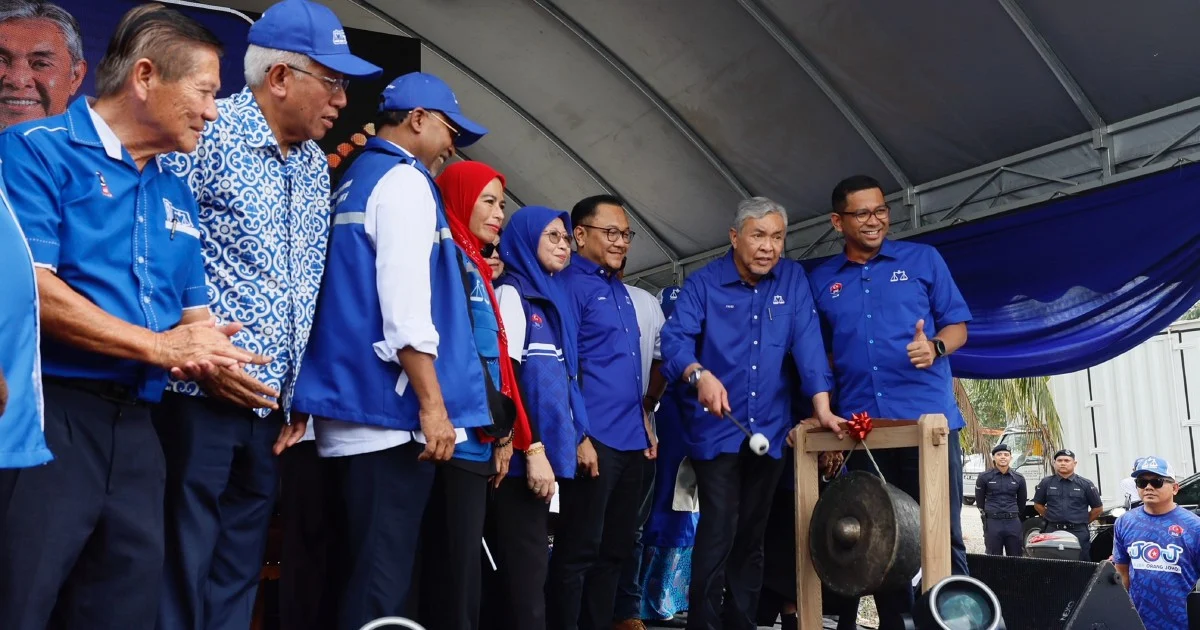
Datuk Seri Dr Ahmad Zahid Hamidi has issued a direct challenge to PAS, demanding that the Islamist party convert its statements of support into tangible electoral victories for Barisan Nasional candidates contesting the Johor state election. Speaking in Batu Pahat, the Deputy Prime Minister implied that public declarations of backing must be matched by actual voting outcomes, signalling potential scepticism within BN leadership about PAS's grassroots mobilisation capacity or genuine commitment to the coalition's efforts in the state.
The appeal reflects deeper strategic concerns within the coalition about translating political alliances into concrete results at the ballot box. Since the 2022 merger of PAS with Perikatan Nasional, the latter's influence in Malaysian politics has grown substantially, yet questions persist about whether such partnerships effectively convert into voter behaviour on polling day. Zahid's remarks suggest that BN strategists are acutely aware that electoral cooperation requires more than symbolic gestures or leadership-level endorsements—it demands disciplined party machinery and grassroots persuasion that can actually shift voting patterns among PAS's traditional supporter base.
The Johor election represents a critical test case for these emerging coalition dynamics in Malaysia's most developed state by GDP and one of its most politically significant. As the gateway to Singapore and a major economic hub, Johor's electoral outcome carries symbolic weight beyond its state boundaries, influencing perceptions about BN's viability and the sustainability of its alliance architecture going forward. Zahid's challenge to PAS occurs against a backdrop of speculation about whether newly forged partnerships genuinely command internal party discipline or whether members and supporters will ultimately vote according to local considerations and traditional affiliations rather than leadership instructions.
The context of this statement matters considerably for understanding Malaysia's broader political trajectory. BN has been rebuilding its electoral machinery since losing federal power in 2018, and Johor is widely regarded as a testing ground for whether the coalition can reassert dominance. However, such dominance increasingly depends on navigating complex multi-party arrangements rather than the relatively straightforward two-coalition politics of the pre-2018 era. PAS's role in this reconfigured landscape remains ambiguous—it can either serve as a force multiplier, bringing its organisational strength and voter loyalty to bear, or simply fragment the non-federal opposition vote without substantially boosting BN's chances.
Zahid's comments also implicitly acknowledge the trust deficit that often characterises cross-party alliances in Malaysian politics. Party leaders may reach accommodation at the national level, but ensuring that mid-tier and grassroots activists subsequently mobilise their respective communities requires sustained communication, shared objectives, and credible enforcement mechanisms. The Deputy Prime Minister's language—effectively asking PAS to prove itself through deeds rather than words—suggests that BN is not taking the Islamist party's commitment for granted and expects to see measurable evidence of cooperation before or shortly after polling day.
For Malaysian political observers, this development underscores how electoral mathematics have become increasingly complicated across the country's states. No single party can reliably command a majority through its own efforts alone, necessitating coalition building and strategic negotiations. Yet such arrangements often harbour tensions between parties with distinct ideological identities, voter bases, and organisational priorities. Zahid's push for concrete results is essentially a demand that PAS subordinate its parochial interests to the broader coalition project—a demand that not all parties necessarily accept or can effectively implement without internal friction.
The timing of such appeals matters as well. The Johor state election follows a period of relative political turbulence at the federal level, with various power-sharing experiments and coalition recalibrations. Voters and party workers alike may harbour fatigue or scepticism about the durability of current arrangements, meaning that enthusiasm for mobilisation efforts cannot be assumed. Zahid's intervention is thus partly about galvanising a coalition that might otherwise suffer from motivational gaps if members perceive the arrangement as temporary or strategically questionable.
From a Southeast Asian perspective, Malaysia's evolving coalition politics offer instructive lessons about managing multiethnic, multireligious democracies where electoral outcomes depend heavily on inter-ethnic and inter-ideological bargaining. The challenges that BN and PAS face—translating elite-level agreements into grassroots action, maintaining party discipline across diverse membership, and navigating voter expectations—resonate across the region. Thailand, the Philippines, and Indonesia have all grappled with analogous dynamics, suggesting that Zahid's intervention reflects common tensions in coalition-based electoral systems where traditional structures and new political forces interact.
The broader implication of this exchange is that coalition politics in Malaysia remains a work in progress, with significant uncertainties about how reliably such arrangements will perform under actual electoral conditions. Zahid's challenge to PAS carries an implicit warning: BN expects tangible returns on any accommodations it offers, and failure to deliver will likely result in recalibration of alliance strategies going forward. For voters and observers, the Johor election will provide crucial data about whether these emerging political arrangements represent a stable, sustainable model for Malaysian governance or a temporary expedient destined for further disruption.

