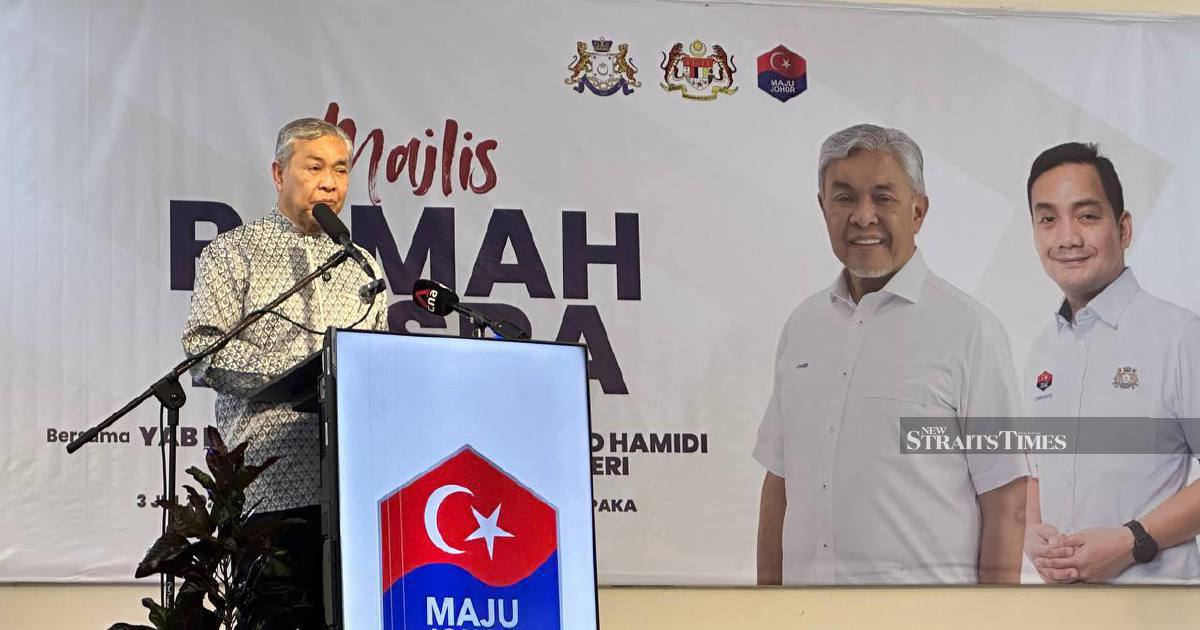
Barisan Nasional chairman Datuk Seri Dr Ahmad Zahid Hamidi has made a direct appeal to members of the unity government coalition to steer clear of resurrecting old grievances against Umno and the broader BN alliance during the current Johor state election campaign. The statement represents a notable effort to maintain stability within the fragile political arrangement that underpins Malaysia's current governing coalition, which has relied on delicate consensus between disparate political factions since the 2022 general election.
The coalition government that emerged after the 2022 general election was widely viewed as a pragmatic compromise designed to prevent political instability following an unprecedented election result that delivered no clear majority. Since then, the unity government has functioned through careful balancing of competing interests and periodic friction between its constituent parties. The Johor election presents a critical test of this arrangement's capacity to withstand internal pressures while presenting a united front to voters.
Historical tensions within Malaysia's political landscape have frequently centred on accusations of corruption, governance failures, and power struggles that predate the current coalition arrangement. For Umno specifically, the party has faced persistent scrutiny over governance issues and internal management questions that have become embedded in public discourse. By urging his coalition partners to avoid raising these matters, Zahid appears intent on compartmentalising campaign rhetoric from the deeper structural problems that have animated Malaysian politics for years.
The timing of this appeal is strategically significant. State elections in Malaysia serve as crucial bellwethers for national political sentiment and often foreshadow shifts in federal politics. A fractious campaign where coalition members openly attack one another would undermine their credibility with voters and potentially weaken their collective standing. Johor, as Malaysia's second-largest state by population and a traditional BN stronghold, carries particular weight in the broader political calculus.
The unity government's coalition partners bring distinct constituencies, ideological orientations, and historical baggage to the arrangement. Some parties entered the coalition with explicit grievances against Umno and BN, making internal cohesion perpetually challenging. The appeal from Zahid suggests that maintaining this coalition requires an implicit agreement to compartmentalise intra-coalition disputes and focus campaign messaging on common policy platforms rather than mutual recriminations.
Malaysian political history demonstrates that coalition governments can either strengthen through collaborative governance or fracture under accumulated internal stress. The unity government has managed to survive for over two years through a combination of pragmatism and mutual recognition that the alternatives might prove worse for all parties involved. However, this arrangement remains conditional and vulnerable to disruption, particularly when individual parties perceive electoral advantage in breaking ranks or challenging established norms.
From Umno's perspective, allowing coalition partners to continuously invoke historical grievances creates an asymmetrical situation where BN becomes a perpetual target while facing restrictions on reciprocal criticism. Zahid's statement implicitly acknowledges this dynamic while attempting to establish ground rules for the campaign that favour the stability of the coalition over the short-term electoral gains individual parties might obtain through aggressive attack politics.
The Johor campaign also occurs within the context of broader questions about Malaysian governance and public trust in political institutions. Voters have become increasingly sophisticated in distinguishing between substantive policy positions and mere tactical maneuvering. A campaign characterised by rehashing old disputes risks reinforcing public cynicism about politics rather than generating genuine engagement with governance questions. Zahid's appeal may thus reflect recognition that voters increasingly reward parties that focus on forward-looking policy platforms rather than backward-looking blame attribution.
The effectiveness of Zahid's appeal will depend considerably on whether coalition partners genuinely perceive mutual benefit in restraint. If some parties calculate that attacking Umno yields electoral advantage, the discipline will inevitably break. The unity government's resilience ultimately hinges on whether its constituent members continue to view coalition participation as more advantageous than alternative arrangements. As the Johor campaign unfolds, adherence to these guidelines will serve as a barometer of coalition stability and provide early signals about whether Malaysia's unity government can sustain itself through subsequent electoral cycles.
For Malaysian voters and observers, the appeal itself underscores the transactional nature of contemporary coalition politics and the mechanisms through which disparate parties attempt to maintain working relationships despite underlying tensions and conflicting interests.

