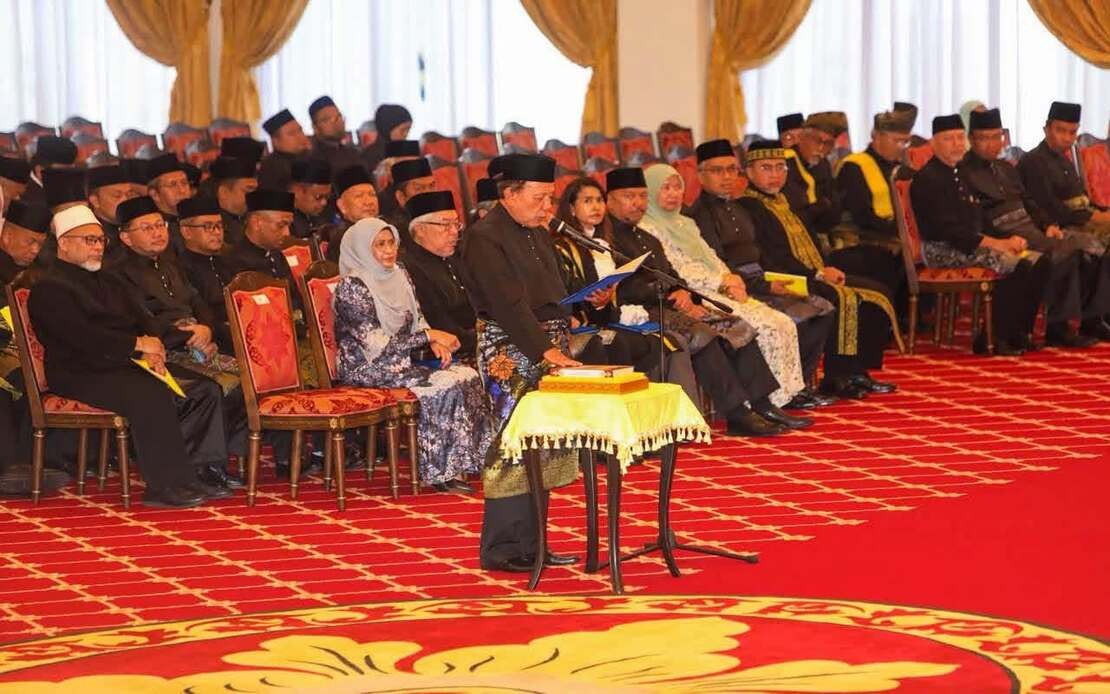
Datuk Ismail Lasim has officially assumed office as Negeri Sembilan's Menteri Besar following his ceremonial swearing-in before the Yang Dipertuan Besar Tuanku Muhriz Tuanku Munawir at Istana Besar Seri Menanti. The milestone appointment has drawn warm public acknowledgement from prominent members of the federal cabinet, underscoring the significance of leadership transitions within Malaysia's state administrations and the broader implications for regional governance.
Deputy Prime Minister Datuk Seri Dr Ahmad Zahid Hamidi, who also holds the Rural and Regional Development portfolio, led the chorus of congratulations by sharing his well-wishes through social media. In his message, Zahid framed the appointment as both an honour and a weighty responsibility, reflecting the conventional expectations placed upon state chief executives to balance developmental ambitions with constituent welfare. His explicit confidence in Ismail's capability to fulfil these obligations suggests federal-level alignment with the appointment and signals continuity in state-federal administrative cooperation.
The explicit religious undertones in Zahid's statement—invoking divine blessing through "Insya-Allah"—reflect the culturally and politically sensitive nature of high-level appointments in Malaysia's Muslim-majority context. The phrase "make Negeri Sembilan great again" echoes development rhetoric commonly employed in Malaysian politics, suggesting a narrative framework centred on economic revitalisation and infrastructure advancement for the state. This positioning indicates that federal leadership views Negeri Sembilan as requiring renewed momentum, potentially reflecting prior governance challenges or unfulfilled development objectives.
Defence Minister Datuk Seri Mohamed Khaled Nordin similarly extended formal congratulations, emphasising the continuity of progress and stability as central themes for the incoming administration. His public statement specifically highlighted the maintenance of existing developmental trajectories rather than advocating transformative change, suggesting a conservative approach to leadership transition. Mohamed Khaled's articulation of hopes for "shared prosperity" reflects the inclusive economic messaging that characterises contemporary Malaysian political discourse, particularly given the state's diverse demographic and economic composition.
Plantation and Commodities Minister Datuk Seri Dr Noraini Ahmad completed the triumvirate of senior cabinet endorsements, characterising Ismail's appointment as opening a new chapter for Negeri Sembilan's governance. Her framing of the transition as a "significant moment" underscores the political weight attached to senior state appointments within Malaysia's federal system. The deliberate invocation of religious guidance and wisdom in her statement demonstrates the intertwining of spiritual and administrative dimensions in Malaysian political culture, where public officials are expected to acknowledge divine providence in their duties.
Ismail brings formidable institutional experience to the position, having maintained a continuous presence in Negeri Sembilan politics for nearly three decades. His initial election as state assemblyman for Jauhasseh in 1999 established him as an electoral survivor through multiple political cycles, a distinction not universally achieved within Malaysia's competitive state politics. His longevity in electoral politics suggests either strong grassroots support within his constituency or effective adaptation to shifting political landscapes.
The appointee's previous tenure as a state executive councillor from 2004 through 2018 provided substantive administrative experience spanning three consecutive terms, an unusually extended period that permitted development of sophisticated governance expertise. His primary responsibility during this extended tenure centred on education policy formulation and implementation, a portfolio of particular significance given education's role in human capital development and long-term economic competitiveness. Managing education policy in a state context requires navigating complex relationships with federal education authorities, local private institutions, and parent communities, suggesting Ismail has developed considerable stakeholder management capabilities.
The appointment assumes heightened significance within Malaysia's broader political context, where state-level positions increasingly serve as springboards for federal advancement or as consolation appointments reflecting factional dynamics within ruling coalitions. Negeri Sembilan's relatively compact electorate and moderate resource base position it as a testing ground for policy innovations before federal-level implementation. Ismail's prior experience in education administration may inform approaches to state-level human resource development, potentially differentiating his administration from predecessors focused on other policy domains.
The congratulatory statements from federal cabinet figures suggest institutional confidence in Ismail's ability to maintain political stability within the state during a potentially volatile period. Malaysia's political environment has experienced significant volatility in recent years, with state-level administrations occasionally shifting allegiances or experiencing internal fragmentation. The visible public support from multiple cabinet ministers may serve a stabilising function, signalling to political actors within Negeri Sembilan that the federal government maintains strong investment in administrative continuity.
For Malaysian observers and Southeast Asian analysts tracking Malaysian governance developments, Ismail's appointment represents a test case for how experience-based leadership functions within contemporary Malaysian federalism. His three decades of accumulated political knowledge contrasts sharply with newer appointments elsewhere, offering empirical evidence regarding whether institutional memory and established networks correlate with effective state administration. The coming months will reveal whether his prior education portfolio experience informs substantive policy departures or whether his tenure emphasises maintenance of existing administrative structures.
The ceremonial and rhetorical dimensions of the appointment transition—featuring formal swearing-in protocols and coordinated cabinet congratulations—reflect Malaysia's commitment to institutional formality and hierarchical political structures despite recent competitive pressures on established power arrangements. These ceremonial elements maintain legitimacy for state institutions and reinforce constitutional frameworks during periods of broader political contestation. Ismail's administration enters office with substantial federal-level backing, a resource asymmetry that will likely influence his ability to secure state-level development funding and implement preferred policy initiatives.

