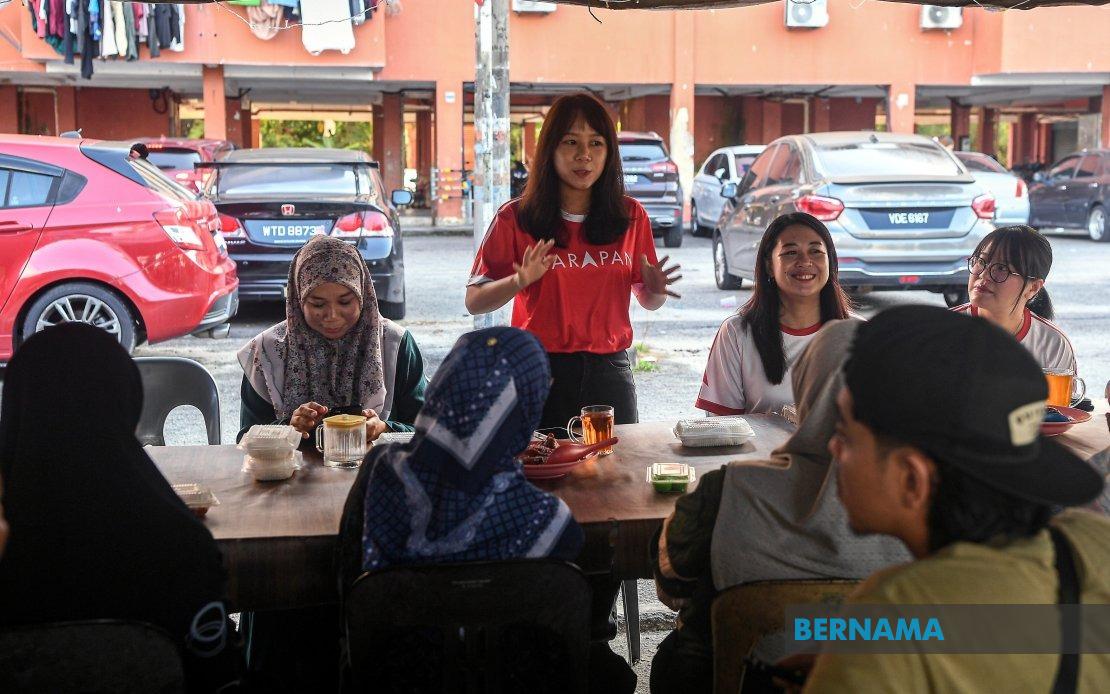
The battle for Johor Jaya represents a microcosm of the broader competition for Malaysia's urban youth vote, with two frontrunning candidates presenting distinctly different blueprints for economic development and community service. Lee Wern Yiing, the 30-year-old Pakatan Harapan standard-bearer, embodies a particular narrative gaining traction among younger Malaysian politicians: the returnee from abroad who chose nation-building over personal prosperity. Having completed her studies in Singapore in 2018, Lee deliberately rejected lucrative career opportunities across the causeway to invest her talents domestically, a decision she frames as rooted in confidence that Malaysia's institutional reform trajectory offered genuine possibilities for positive change.
Lee's political apprenticeship began as a special officer to her predecessor, former assemblyman Liow Cai Tung, providing her with substantive grassroots exposure before ascending to contest the seat. Now serving as Johor DAP Socialist Youth chief, she has cultivated a reputation for understanding millennial and Gen Z political consciousness differently from conventional assumptions. Rather than accepting the widespread narrative that younger citizens remain apathetic toward electoral politics, Lee contends that this cohort conducts sophisticated independent analysis and makes voting decisions grounded in observed reality rather than inherited party loyalty. This interpretation informs her campaign methodology, which integrates digital communication strategies with on-ground activations such as the Johor Jaya Run community programme.
The substantive policy architecture underlying Lee's appeal to younger voters centres on the emerging Johor-Singapore Special Economic Zone development. She articulates a vision wherein this cross-border economic initiative functions not merely as an investment magnet or GDP contributor, but as a mechanism for reversing brain drain and anchoring professional ambitions locally. By positioning the JS-SEZ as capable of generating a self-sustaining employment ecosystem, Lee frames economic development as fundamentally intertwined with quality-of-life questions that resonate powerfully with young families: affordable housing, manageable living costs, and career trajectory possibilities that do not necessitate geographic displacement. Her argument presumes that young voters will return and remain in Johor if economic circumstances permit family stability and professional advancement, making economic development a precondition for demographic retention.
Barisan Nasional's candidate Chan San San approaches the constituency through a markedly different experiential lens. Her campaign capital derives predominantly from decade-plus embeddedness within Johor Jaya's community fabric, combined with institutional credentials accumulated across multiple platforms. Her service as a Johor Bahru City Council member, MCA party official, and volunteer with the MCA Crisis Relief Squad positions her as someone whose engagement with residents extends beyond electoral cycles. Chan emphasizes that sustained community interaction has provided her granular understanding of citizen grievances that transcend abstract policy frameworks, situating these concerns as lived realities demanding responsive action rather than statistical problems amenable to technical solutions.
Chan's development platform bifurcates into economic strengthening and infrastructure modernization. The economic dimension focuses on bolstering the local business environment and supporting existing merchant communities, an approach somewhat distinct from Lee's emphasis on attracting new employment corridors through regional economic zones. Simultaneously, Chan prioritizes Johor Jaya's positioning as an eastern Johor Bahru transportation nexus. This infrastructure focus represents tacit recognition that the constituency's economic competitiveness depends substantially on connectivity improvements, particularly linkages to the Rapid Transit System project, which promises to reconfigure commuting patterns and accessibility for residents. Chan additionally foregrounds traffic congestion mitigation, a particularly salient issue in an urbanizing state where vehicular density continues accelerating.
The contrast between these candidates reflects broader ideological divergence regarding the mechanisms through which regional development occurs. Lee's framework emphasizes state-level strategic economic initiatives capable of generating new employment categories and attracting sectoral investment, imagining development as originating from major infrastructure or special economic zone creation that subsequently distributes benefits throughout surrounding communities. Chan's approach privileges incremental improvements to existing economic foundations and municipal infrastructure, viewing enhanced connectivity and traffic flow as prerequisites enabling resident prosperity rather than development catalysts themselves. Both strategies possess internal coherence and address genuine constituent concerns, yet they embody different assumptions regarding causality between policy interventions and economic outcomes.
The Johor Jaya state seat sits within a significantly larger electoral contest determining Johor's state government composition. With 56 state seats contested among 172 total candidates, the July 11 polling date represents the culmination of competitive campaigns across the state. Early voting commenced on July 7, providing preliminary indicators of mobilization intensity and demographic participation patterns. The four-cornered contest in Johor Jaya itself—encompassing Lee's Pakatan Harapan candidacy, Chan's Barisan Nasional representation, Lau Yi Leong fielded by Parti Bersama Malaysia, and independent candidate Lim Hun Peaw—suggests fragmented opposition to the two major coalitions, potentially rendering incumbent momentum or marginal preference shifts consequential to the outcome.
For Malaysian observers tracking state-level electoral dynamics, the Johor contest carries implications extending beyond local governance questions. Johor occupies particular significance within Malaysia's federal constitutional architecture and economic geography, serving simultaneously as a crucial BN stronghold and emerging opposition testing ground. The state's proximity to Singapore creates distinctive regional economic dynamics, particularly regarding cross-border labour flows, special economic zone development, and infrastructure coordination. How candidates in constituencies like Johor Jaya articulate visions for leveraging this geographic position—whether emphasizing regional integration and special economic corridors or prioritizing intrastate connectivity and local business stability—signals broader orientations toward economic development philosophy.
Young voter mobilization emerges as the implicit meta-theme animating both campaigns, albeit pursued through different strategic frameworks. Lee explicitly identifies youth as constituency-determining demographics warranting targeted outreach through digital channels and community programmes attuned to their perceived priorities. Chan, while not explicitly foregrounding youth, offers credentials suggesting sustained responsiveness to community concerns that younger residents face acutely, including housing affordability and transport accessibility. Neither candidate dismisses younger citizens as electorally irrelevant; rather, both recognize that demographic composition and participation rates among voters under 40 increasingly determine electoral competitiveness in urbanizing constituencies.
The Johor Jaya contest exemplifies how local state elections increasingly function as venues for articulating contrasting visions of economic development, generational engagement, and regional positioning within Malaysia's federal framework. The competition between Lee's emphasis on sectoral economic zone development and Chan's focus on incremental infrastructure improvement illustrates the multiple legitimate pathways through which elected representatives conceptualize their mandates. As the July 11 polling date approaches, these candidates will test whether their particular development formulas, campaign mechanisms, and community engagement approaches successfully translate into electoral support among Johor Jaya residents.

