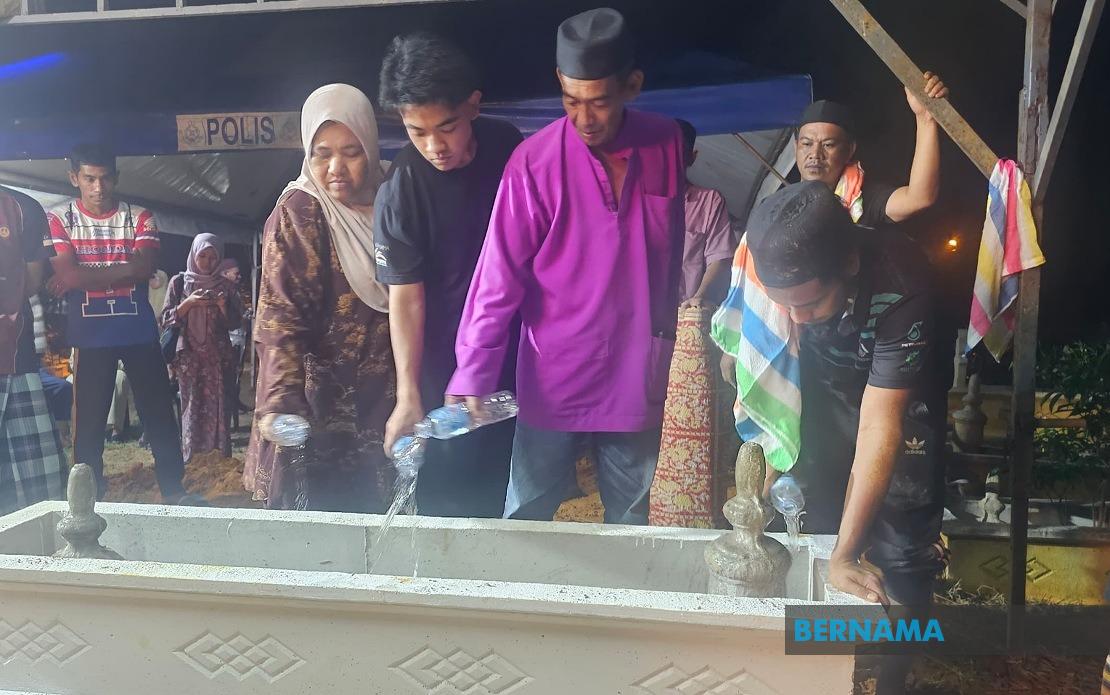
The body of Constable Muhammad Raimi Ismarubee, 24, was committed to earth at the Felda Kerteh 2 Muslim Cemetery in Dungun, Terengganu in the early hours of Thursday morning, concluding the final rites for the young police officer who perished in a tragic electric shock incident in Sabah. The burial service, conducted just over a month into his posting at Weston Police Station, underscores the inherent dangers faced by Malaysia's uniformed personnel in their daily work.
Muhammad Raimi's remains arrived at his family residence in Felda Kerteh 2 late Wednesday evening, where relatives and colleagues gathered to pay their final respects and perform the funeral prayers before the burial took place at 1.15 am Thursday. The solemn procession represented a return home for the young constable, whose service to the nation was cut short by the tragic incident that unfolded some 2,000 kilometres away in the eastern Malaysian state.
The logistics of repatriating the fallen officer's body reflected the respect accorded to those who die in service. A Royal Malaysian Air Force aircraft transported Muhammad Raimi from Kota Kinabalu International Airport in Sabah to Kuantan Air Base in Pahang, from where a hearse conveyed him to his final resting place. This coordinated effort, involving military and police agencies, highlighted the institutional processes in place for honouring officers lost in the line of duty.
The funeral proceedings were conducted under the leadership of Datuk Satiful Bahari Mamat, chairman of the Terengganu State Education, Higher Education, Science, Technology and Human Development Committee, signifying official recognition of the gravity of the loss. The attendance of Dungun District Police Chief Supt Nik Ab Halim Nik Mat alongside approximately 200 police personnel demonstrated the broader police family's solidarity during this period of mourning. Beyond the uniformed contingent, Muhammad Raimi's family members and friends gathered to remember him, reflecting the personal dimensions of a tragedy that extended far beyond official protocol.
Muhammad Raimi's life profile reveals a young man in the early stages of what promised to be a lengthy career. Still unmarried and the second of three siblings, he had commenced his posting at Weston Police Station in Beaufort only in September 2024. His brief tenure underscores how suddenly and unexpectedly operational hazards can strike, claiming lives with little warning and transforming a fresh career into a memorial.
The fatal incident occurred at 5.50 pm on the preceding day at Jalan Weston in Kampung Weston, a location in the Beaufort district of Sabah's interior. The precise circumstances leading to the electrical hazard remain critical to understanding how three serving police officers came to be fatally shocked in what would normally be considered a routine location. The incident claimed not only Muhammad Raimi but also Corporal Chiu Teck Siong, 40, and Corporal Mohamad Nur Hafiz Ibrahim, 29, both colleagues stationed at the same Weston Police Station.
The loss of three officers in a single incident represents a significant blow to operational capacity in a relatively remote police station. Corporal Chiu's four decades of life experience and Corporal Ibrahim's nearly three decades stood in sharp contrast to Muhammad Raimi's youth, yet all three fell victim to the same hazard. The diversity of their ages and service experience suggests that the electrical danger they encountered was indiscriminate in its deadliness, capable of claiming the most experienced and the newest recruits alike.
For the families of these three men, the tragedy represents not merely loss but the intersection of occupational risk with personal devastation. Muhammad Raimi's parents lost a son embarking on his career; Corporal Chiu's family lost a man in his prime; and Corporal Ibrahim's dependents lost a provider in his working years. The ripple effects extend through their extended families and the police stations where they served, affecting morale and operational continuity.
The incident also raises broader questions about workplace safety within law enforcement agencies operating in Malaysia's more remote regions. Sabah, despite its significant development, contains numerous areas where infrastructure maintenance and hazard management may not receive the same attention as more densely populated zones. The circumstances that allowed three trained officers to encounter a fatal electrical hazard simultaneously warrant investigation to prevent similar tragedies.
For Malaysian readers, this tragedy serves as a stark reminder of the occupational perils that police officers accept as part of their service commitment. Unlike other professions, law enforcement officers cannot simply avoid hazards—they must routinely place themselves in potentially dangerous situations to protect public safety. The deaths of Muhammad Raimi, Corporal Chiu Teck Siong, and Corporal Mohamad Nur Hafiz Ibrahim represent the human cost of maintaining social order and security across the nation's breadth.
The funeral of Constable Muhammad Raimi thus becomes not merely a family affair but a national acknowledgment of sacrifice. His burial in Terengganu, attended by police colleagues and officials, marks both an ending and a continuation—the conclusion of a young life but the persistence of the institution he served, now bearing the responsibility to support those he left behind and to learn from the circumstances that took him.

