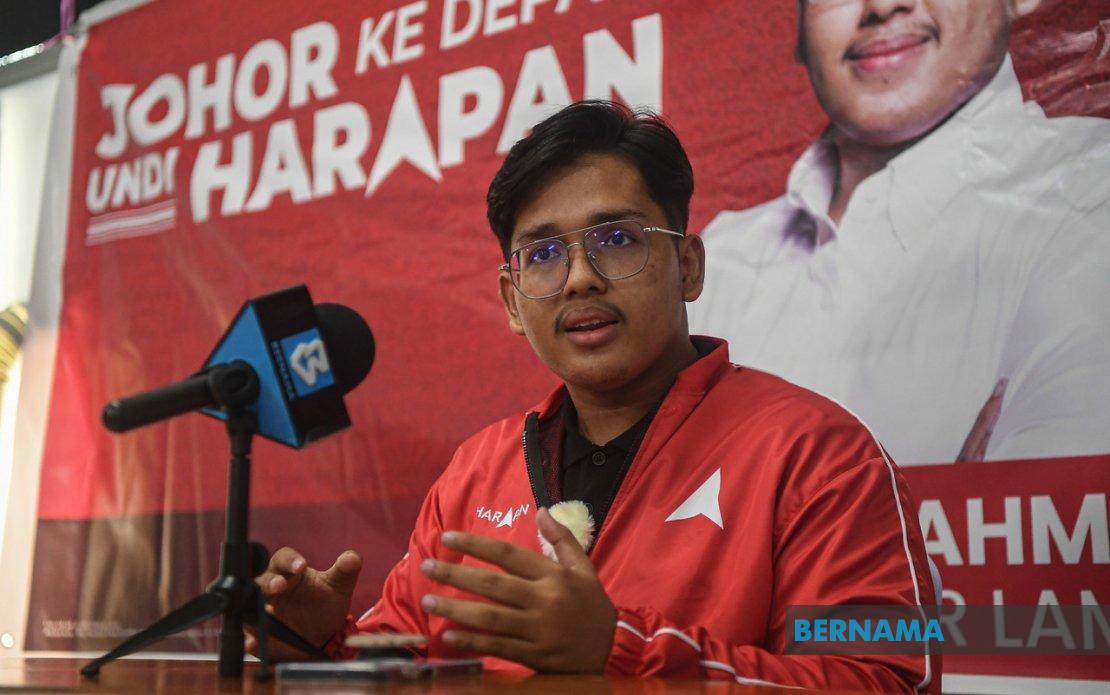
Danish Hossman Abd Rahman, at just 23 years old, represents a generational shift in Malaysia's electoral landscape. The Master of Information Technology student from Universiti Tun Hussein Onn Malaysia (UTHM) is contesting the Johor Lama state constituency as a Pakatan Harapan candidate in the 16th Johor state election, making him the youngest participant in this round of voting. In an interview ahead of polling day scheduled for Saturday, Hossman framed the warm reception he has received throughout his campaign as a decisive catalyst for transforming the constituency, describing it as an "injection of enthusiasm" that reinforces his determination to bring meaningful change to the area.
The campaign trail has proven enlightening for Hossman, whose consistent ground presence across different neighbourhoods has allowed him to directly experience the concerns and aspirations of diverse voter demographics. This hands-on approach appears to be resonating particularly strongly with an unexpected constituency: older voters and war veterans who have grown weary of politicians their own age or older who rarely venture into communities to engage with residents. Hossman attributes this appeal partly to the perception that his youthfulness combined with evident sincerity distinguishes him from established figures perceived as distant from grassroots realities. This intergenerational acceptance suggests a growing appetite among voters for politicians willing to listen directly rather than rely on intermediaries or assumptions about community needs.
Rather than positioning youthfulness as a substitute for experience, Hossman has articulated a more sophisticated political philosophy. He casts himself as a "strategic bridge" connecting the accumulated wisdom of veteran leaders with the fresh perspectives and energy of younger citizens. This framing addresses a perennial tension in Malaysian politics between the need for continuity and institutional knowledge on one hand, and the demand for renewal and responsiveness on the other. By explicitly refusing to dismiss older leaders' experience while simultaneously acknowledging their perceived disconnection from contemporary challenges, Hossman attempts to transcend the generational divide that often characterises electoral contests. This positioning reflects a maturity of thought that belies his relative youth and could appeal to voters seeking alternatives to polarising rhetoric.
Hossman's policy agenda centres on two interconnected challenges afflicting Johor Lama: the scarcity of affordable housing and the paucity of local employment opportunities. These twin deficits have precipitated an exodus of young people from the constituency, draining the area of demographic vitality and economic potential. The candidate has identified economic diversification as the solution, advocating for attraction of investment capital into downstream industries and manufacturing sectors aligned with the constituency's existing comparative advantages. He specifically emphasises agricultural and livestock production as sectors capable of generating sustainable employment while leveraging the area's geographical and climatic attributes. This agricultural focus reflects awareness that not all Malaysian constituencies can realistically compete for high-tech manufacturing investment, and that strategic development must build upon local strengths rather than impose external models.
The employment challenge extends beyond mere job creation statistics. Hossman's stated objective is enabling young people to envision viable futures in their home constituencies rather than necessitating migration to urban centres. This framing reorients the conversation from abstract economic targets to the lived experiences of individual families contemplating whether they can build careers, start families, and establish roots in Johor Lama. For constituencies across Malaysia grappling with urbanisation-driven depopulation, this emphasis on preserving community viability while pursuing economic development represents a substantive policy differentiation. It also suggests recognition that demographic sustainability matters as much as GDP growth for a constituency's long-term health.
Hossman's campaign methodology has emphasised repeated direct engagement with voters across multiple settings, including urban areas, rural villages, and Felda settlements. Rather than relying on single campaign events, he has prioritised sustained visibility and multiple touchpoints with constituents. He has also deliberately targeted outreach toward youth, women, and small business proprietors, recognising these groups as both significant voting blocs and demographic cohorts with distinct policy requirements. This segmented approach acknowledges that generic campaign messaging rarely resonates effectively; different voter groups require tailored engagement reflecting their specific circumstances and concerns. The candidate's willingness to invest time in sustained community presence rather than rapid hit-and-run campaign stops suggests confidence that familiarity and demonstrated commitment matter more than celebrity or media saturation.
Critically, Hossman has explicitly rejected what he characterises as "politics of hatred" and personal attacks, instead insisting that voters judge candidates based on capabilities and policy commitments. This rhetorical stance responds to the increasingly acrimonious tone of Malaysian electoral discourse at state and federal levels. By positioning himself outside personalised mudslinging, he stakes a claim to a different style of politics, though the extent to which this distinction can remain credible throughout the campaign remains to be tested. Nevertheless, the invocation of capability-based evaluation rather than affiliation-based or personality-driven voting represents a refreshing note in Malaysian politics, even if difficult to implement consistently across an entire campaign.
The Johor Lama contest involves a three-cornered fight that mirrors the broader fragmentation of Malaysia's political landscape. Hossman competes against incumbent Norlizah Noh representing Barisan Nasional and Aisah Esa contesting for Perikatan Nasional. This triangular configuration means that victory margins will likely be compressed compared to traditional two-candidate contests, making every vote and every demographic group's turnout decision potentially decisive. The overall election encompasses 172 candidates competing for 56 seats across the state, indicating that Johor Lama represents merely one thread in a broader tapestry of electoral competition playing out across the state during this electoral cycle.
For Malaysian observers tracking the evolution of political leadership and succession, Hossman exemplifies a broader generational transition occurring across multiple parties. His campaign success or failure will offer insights into whether Malaysian voters genuinely desire younger representation and fresh approaches, or whether they ultimately default to established figures and traditional political structures when confronted with electoral choice. The receptivity he has encountered, particularly among older voters, suggests that age alone need not be a disqualifying factor if young candidates combine genuine engagement with substantive policy thinking. Conversely, however, Malaysian electoral history contains numerous examples of promising young candidates whose initial momentum failed to survive the realities of electoral campaigns or the compromises inherent in parliamentary governance.

