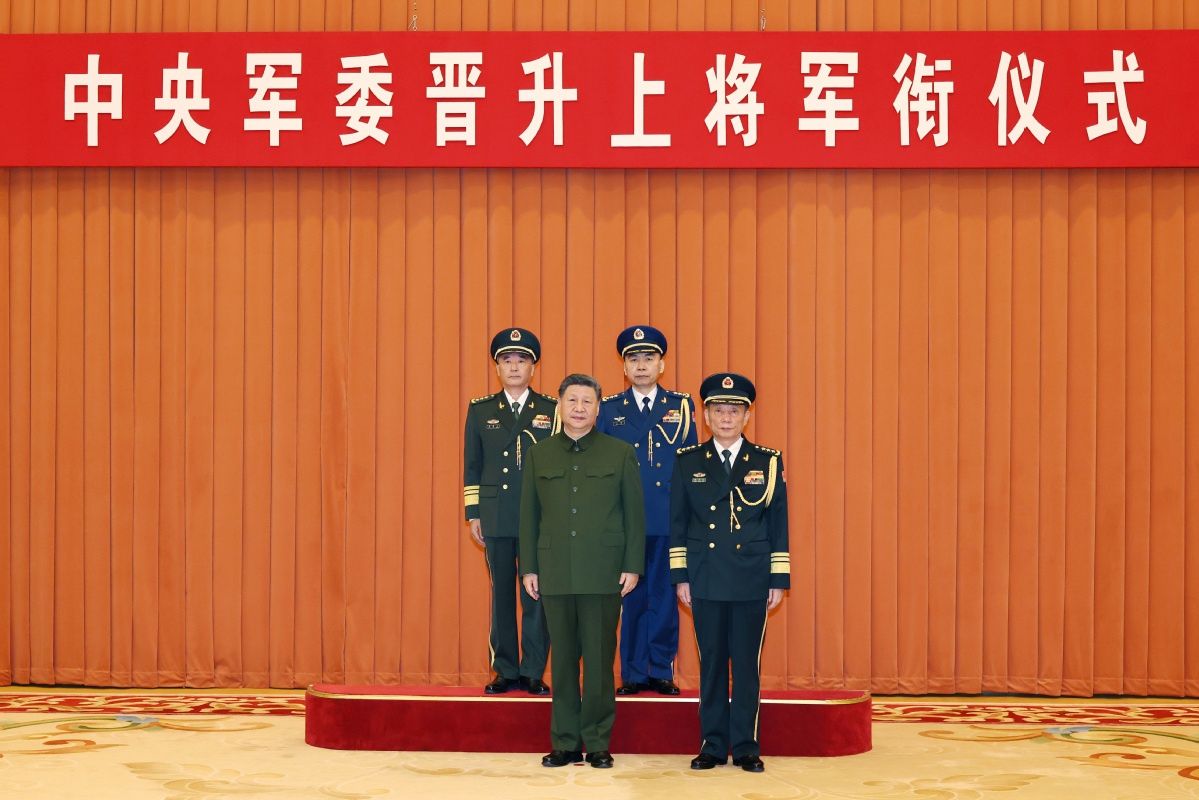
Chinese President Xi Jinping has moved to consolidate control over the military's anti-corruption apparatus by appointing Zhang Shuguang as the new secretary of the Central Military Commission's discipline inspection commission, marking another significant personnel shift in what has become the most extensive overhaul of China's armed forces in more than fifty years. The appointment, made public through state media Xinhua News Agency during a ceremony presided over by Xi in Beijing on Friday, underscores the leadership's determination to maintain firm oversight of the sprawling military establishment as it grapples with widespread graft allegations.
Simultaneously, Wang Gang has assumed command of the People's Liberation Army Air Force, replacing Chang Dingqu whose next assignment remains undisclosed. Both appointees received promotions to the rank of general, China's highest active-service military rank, signalling their elevated status within the defence establishment hierarchy. The dual announcements reflect a broader strategy of advancing loyalists to critical positions within the armed forces while simultaneously removing those perceived as threats to central authority.
Zhang Shengmin, the outgoing anti-corruption chief, has been elevated to serve as vice chairman of the Central Military Commission, a move that appears to reward his tenure overseeing the discipline campaign while removing him from day-to-day management of investigations. This vertical shuffling demonstrates how Xi's leadership is restructuring the military not simply by removing officials but by strategically repositioning them to maintain influence while introducing fresh leadership in active enforcement roles. The shift raises questions about whether Shengmin's elevation signals either completion of major investigative phases or preparation for expanded oversight responsibilities at a higher level.
The personnel changes occur within the context of Xi's sweeping anti-corruption campaign that commenced in mid-2023, shortly after he secured an unprecedented third term as party chairman and military commander—a consolidation of power that broke with decades of Chinese Communist Party succession norms. This campaign has fundamentally reshaped the military's upper echelons, removing from their positions two vice chairmen of the Central Military Commission, three additional commission members, the former defence minister, and approximately twelve or more senior generals commanding key military regions and services. The scale of this purge represents a departure from typical personnel rotation cycles, suggesting systemic concerns about loyalty, competence, or both within the officer corps.
The campaign intensified dramatically earlier this year when Xi initiated a formal investigation into Zhang Youxia, his former ally and one of China's most senior generals, a move that stunned military observers and signalled Xi's willingness to target even those with longstanding personal connections to the leadership. This development indicated that factional considerations and historical relationships offered no protection once officials came under suspicion of misconduct or, more broadly, posed perceived challenges to centralised authority. The investigation's scope and publicity suggested underlying tensions regarding competing power bases within the military hierarchy.
The broader context of these purges reflects Xi's vision for a military subordinate to civilian party leadership and, specifically, to his personal direction. Since assuming power, Xi has prioritised military modernisation and readiness while simultaneously ensuring that security forces remain instruments of party control rather than independent power centres. The anti-corruption campaign, framed in public rhetoric as a morality initiative, simultaneously functions as a mechanism for removing officers who lack demonstrated loyalty or who represent alternative centres of influence. This dual function has been characteristic of Chinese Communist Party governance during internal consolidation phases.
Regionally, these military restructurings carry implications for Southeast Asia and broader Indo-Pacific security dynamics. A purged military under tightened civilian control theoretically enhances strategic predictability, though the short-term uncertainty created by wholesale command changes can itself generate risks. Countries throughout the region, including Malaysia, monitor such developments closely given the People's Liberation Army's increasingly active presence in contested maritime zones and its expanding operational capabilities. Understanding the internal dynamics of Chinese military leadership informs assessments of Beijing's likely strategic intentions and decision-making processes.
The personnel announcement also reflects challenges that Xi's government has acknowledged regarding military discipline and professionalism. Reports of corruption within defence procurement, logistics, and regional military commands have circulated for years, with particular concerns about whether defence spending achieved intended capability improvements or instead enriched individual officers. By elevating new anti-corruption leadership while simultaneously removing dozens of senior commanders, Xi's administration signals resolve to address these systemic issues, whether the underlying problems stem primarily from corruption, factional politics, or both.
The elevation of Wang Gang to air force commander represents continuity of Xi's strategy to place trusted officers in command of critical services. The air force holds particular strategic importance given its role in regional power projection and Taiwan contingency planning. Ensuring reliable leadership in this domain aligns with Xi's broader military modernisation agenda and his emphasis on coordinating air, naval, and ground capabilities for potential conflict scenarios. Similarly, the appointment of Zhang Shuguang to oversee discipline suggests that ongoing investigations into military misconduct will persist and potentially expand, maintaining pressure on the officer corps to demonstrate compliance with central directives.
Last week's action stripping six military lawmakers of seats in the national parliament signalled that the purge extends beyond operational military structures into the political institutions where armed forces maintain formal representation. This multi-institutional approach ensures that removed officers lose influence across both military and civilian governance channels simultaneously. The synchronised removals across defence, anti-corruption, and legislative bodies demonstrate coordination at the highest levels of Chinese governance.
Looking forward, these changes suggest that Xi's consolidation of military control remains incomplete despite years of purges and reforms. The continued appointment of new discipline officials and the rotation of senior commanders indicate that investigations and restructuring will likely continue. Whether this reflects an ongoing need to address systemic corruption, deeper factional struggles within the military establishment, or simply Xi's preference for continuous personnel circulation remains difficult to determine from external observation. What appears certain is that Chinese military leadership will remain in flux for the foreseeable future, with significant implications for military morale, operational effectiveness, and strategic stability throughout the region.

