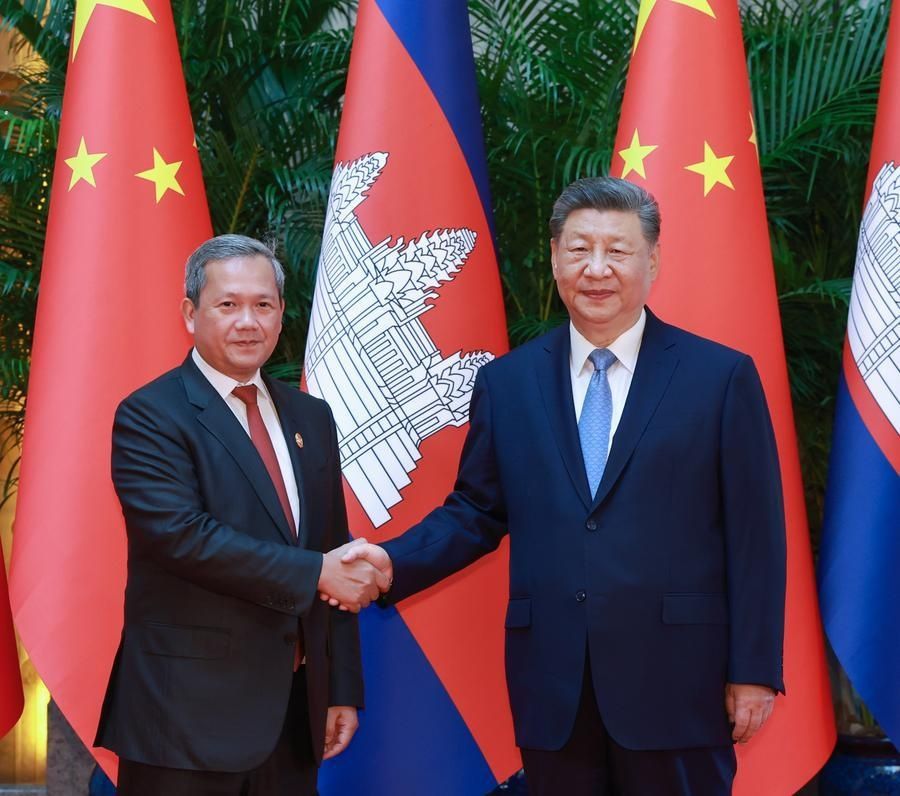
Chinese President Xi Jinping has called for China and Cambodia to strengthen their long-standing partnership during an official meeting with Cambodian Prime Minister Hun Manet in Shanghai on Friday. The encounter, which took place on the sidelines of the 2026 World Artificial Intelligence Conference and High-Level Meeting on Global AI Governance, underscored Beijing's commitment to maintaining its closest Southeast Asian alliance at a time of shifting geopolitical dynamics in the region.
Hun Manet, who arrived in China for both the artificial intelligence conference and a broader working visit, received explicit backing from Xi for Cambodia's development agenda. The Chinese leader emphasised that both nations should build upon decades of cooperation between their governments, framing the relationship as an inheritance from previous generations of leaders that demands careful stewardship. This framing carries particular significance given Cambodia's historical vulnerability to great power competition and its need to balance regional relationships with practical economic benefits.
The centrepiece of the bilateral discussion revolved around what Chinese officials term the "Diamond Hexagon" cooperation framework, a multi-dimensional approach to engagement that extends beyond traditional diplomatic channels. Rather than remaining confined to high-level political dialogue, Xi stressed the importance of enriching this framework to encompass diverse sectors of the Cambodian economy. The Chinese president articulated a vision of an "all-weather China-Cambodia community with a shared future in the new era," terminology that signals Beijing's intention to create bonds resistant to international pressures or shifting circumstances.
Economic development emerged as the primary focus of concrete proposals. Xi highlighted two corridor initiatives designed to knit the two economies together more tightly: the Industrial Development Corridor and the Fish and Rice Corridor. These projects represent China's strategy of embedding Cambodia within its economic ecosystem through infrastructure and trade linkages. By simultaneously modernising traditional sectors such as electricity generation and agricultural production, while fostering entirely new domains including artificial intelligence and digital economy ventures, Beijing aims to position Cambodia as both a stable investment destination and an innovation partner.
For Malaysian policymakers and business observers, the emphasis on emerging industries carries particular relevance. As regional economies compete to attract technology investment and digital economy talent, China's willingness to partner with Cambodia in artificial intelligence development signals Beijing's intent to create technology networks that extend throughout Southeast Asia. This approach may influence how other regional nations, including Malaysia, consider their own technology partnerships and digital infrastructure investments.
Beyond commercial considerations, the two leaders addressed critical security challenges affecting the broader region. Xi and Hun Manet discussed transnational criminal activities that plague the borderlands of Southeast Asia, with particular attention to counterfeiting, smuggling, online gambling, and telecommunications fraud. These crimes not only threaten individual nations but destabilise entire subregions, creating conditions conducive to money laundering, human trafficking, and other organised criminal enterprises. By pledging enhanced cooperation on these fronts, both countries acknowledged that prosperity and security remain inseparable objectives.
The Cambodia-Thailand border dispute featured prominently in the discussions, with Xi indicating China's readiness to support diplomatic resolution. This positioning reflects Beijing's broader regional strategy of presenting itself as a stabilising force capable of mediating between neighbours, even as China maintains deeper strategic relationships with certain parties. Hun Manet's response—emphasizing Cambodia's commitment to dialogue rather than confrontation—suggests that Phnom Penh believes diplomacy offers better prospects than military posturing, despite periodic tensions along the border.
Hun Manet's expressions of gratitude for China's historical support acknowledged a fundamental asymmetry in the bilateral relationship. Cambodia's economy and defence capabilities remain substantially dependent on Chinese investment, infrastructure development, and strategic backing. This dependency, while providing Cambodia with leverage in international negotiations, also constrains its policy flexibility. The prime minister's explicit commitment that Cambodia's policy of pursuing cooperation with China would remain unchanged regardless of international circumstances reflected both pragmatic assessment and diplomatic courtesy.
Cambodia's reaffirmation of the one-China policy holds particular significance as Beijing confronts diplomatic challenges across the region. By explicitly endorsing this position, Hun Manet signalled that Cambodia would not participate in any international initiative perceived as challenging Chinese sovereignty or territorial integrity. This stance, combined with Cambodia's resistance to certain regional security arrangements that might be viewed as anti-Chinese coalitions, underscores Phnom Penh's strategic choice to align closely with Beijing rather than hedge between competing powers.
The bilateral commitment to expand trade and deepen investment cooperation addresses immediate economic priorities for both nations. For Cambodia, Chinese capital remains essential for financing infrastructure projects and industrial development beyond what the kingdom could achieve through regional partners alone. For China, Cambodia represents a strategic foothold in mainland Southeast Asia and a partner through which Beijing can extend influence along critical maritime and land routes.
Security cooperation against telecommunications fraud deserves particular attention given the scale of this regional problem. Criminal networks operating across Southeast Asia have victimised thousands of individuals and diverted billions of dollars through sophisticated scams originating from lawless zones. By pledging enhanced cooperation, China and Cambodia recognised that uncontrolled criminal activity undermines the business confidence and consumer trust necessary for legitimate economic growth. This commitment also reflects growing international pressure on both nations to address these crimes more aggressively.
The Shanghai meeting ultimately demonstrated how traditional great power-small state relationships continue to function within contemporary Southeast Asia. Cambodia gains security assurances, economic partnership, and technological cooperation from its alignment with Beijing, while China secures a reliable regional partner that respects its core interests and supports its diplomatic positions. For observers throughout Southeast Asia, including Malaysia, the episode illustrates the enduring appeal of Chinese partnership despite international criticism of Beijing's governance model or regional ambitions. Understanding these dynamics remains essential for comprehending regional alignments and anticipating how individual Southeast Asian nations might respond to future geopolitical choices.

