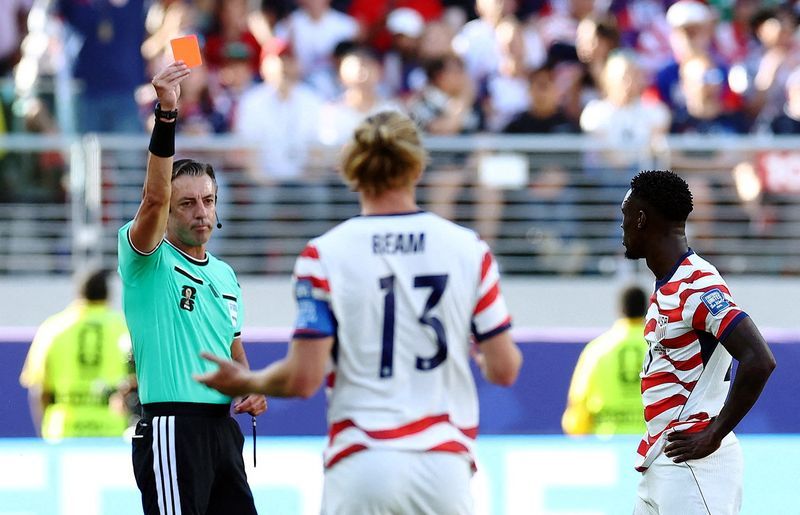
The fallout from FIFA's contentious decision to reverse a World Cup red card against U.S. forward Folarin Balogun threatens to erode confidence in football's officiating processes across the sport, according to Howard Webb, the Premier League's refereeing head, and chief executive Richard Masters. The pair fear that the manner in which the dismissal was handled—particularly following public intervention by U.S. President Donald Trump—has created a damaging precedent that will haunt the domestic game as it enters a new season beginning Friday.
The Balogun case stands as one of the World Cup's most troubling disciplinary episodes, exposing weaknesses in FIFA's governance and raising uncomfortable questions about the sport's susceptibility to political pressure. That a sitting president could openly influence a footballer's eligibility and subsequently see FIFA acquiesce through what observers described as an opaque process represents a watershed moment for football's institutional credibility. The case has provided ammunition to those already inclined to view major sporting decisions with suspicion, potentially poisoning the well for legitimate officiating decisions across all levels of professional football.
Webb, who officiated the 2010 World Cup final and now directs the Premier League's match officials programme, articulated his unease with unusual candour. Rather than fixating on whether the original red card decision itself was correct, Webb's chief concern centres on the broader perception created by events that followed. The acknowledged fact that political pressure from a world leader influenced FIFA's decision-making process, combined with the subsequent reversal through what Webb characterises as a previously non-existent mechanism, signals to the public that footballing integrity can be compromised through channels outside the game's control.
The timing compounds the problem considerably. Webb observed that football already faces a mounting challenge in the social media age, where controversial decisions are routinely seized upon as evidence of systematic corruption. Fans and commentators, increasingly primed to interpret officiating decisions through a lens of mistrust, now possess a concrete example of apparent institutional capitulation to external pressure. This creates a vicious cycle where any contentious future decision—whether in the Premier League or elsewhere—becomes vulnerable to interpretation as part of a broader pattern of compromise, regardless of the actual merits of the case.
Webb's concern extends beyond mere reputational damage to the fundamental question of how referees can maintain credibility when the public believes the system itself lacks integrity. When officials know that their decisions may be scrutinised not just for technical correctness but through a framework that assumes potential corruption, their ability to command respect diminishes. The Balogun episode has handed sceptics what they view as vindication: concrete proof that external forces can override sporting principles, even at football's highest level.
Masters echoed these concerns while simultaneously lamenting the broader cost to the World Cup narrative. Rather than the tournament being remembered for Spain's dominant performances or England's anguishing semi-final loss, discourse has been dominated by institutional failure and political interference. This displacement of attention from footballing matters to administrative dysfunction represents a form of reputational contamination that extends well beyond the specific incident.
Critically, Masters identified a structural vulnerability in FIFA's disciplinary framework that the Balogun affair has exposed. Unlike most domestic competitions, FIFA's regulations contain no provision for reviewing and overturning red cards through legitimate appeal mechanisms. This absence created the perverse situation where the only way to reverse the suspension was to invent an ad-hoc process, lending the decision an air of expediency and exception-making rather than principled governance. Masters characterised this as an unnecessary own goal, converting what might have been resolved through proper channels into an institutional scandal.
The implications for the Premier League are particularly acute. With every VAR decision and contentious refereeing call now likely to face heightened scrutiny, Webb faces a season where officials operate under increased pressure not merely to make correct decisions but to appear above reproach. The Balogun precedent has lowered the bar for questioning official integrity, creating an environment where legitimate decisions may be reinterpreted through suspicion. This psychological burden on match officials could paradoxically degrade decision-making quality by introducing caution and self-consciousness into processes that demand confidence and clarity.
The new season begins with additional complications: the Premier League is implementing an unprecedented suite of law changes aimed at reducing time-wasting and accelerating match tempo. These modifications will require stricter enforcement and less tolerance for minor infractions, meaning referees will penalise more offences than in previous campaigns. Combined with the integrity questions unleashed by the Balogun affair, this represents a significant challenge for Webb's officials. Any season-defining decision that goes against a major club will occur against a backdrop where segments of the fanbase have been primed to view officiating with systemic suspicion.
Webb's assertion that stricter enforcement will eventually see offending behaviour diminish reflects the official position that improved discipline creates better football. Yet this optimistic scenario depends upon referees being granted the trust and authority necessary to implement these changes. The Balogun affair has undermined that foundational trust, potentially making enforcement more contentious and subject to challenge. When the public doubts institutional integrity, even technically correct decisions become battlegrounds where individuals project their broader scepticism about the system.
The European context adds another layer of complexity for Premier League officials observing these dynamics. If the world's most prestigious domestic competition struggles with the fallout from FIFA's handling of a World Cup incident, what does this signal about football governance across all levels and jurisdictions? The Balogun case demonstrates that no competition, no matter how wealthy or prominent, possesses sufficient institutional strength to withstand determined political pressure. This recognition potentially weakens confidence in the integrity frameworks that underpin not just the Premier League but the entire professional football ecosystem.
Webb's perspective, informed by decades of high-level officiating experience, carries particular weight precisely because he speaks from professional frustration rather than conspiracy theory. He acknowledges that controversies over specific decisions are inevitable and, in isolation, manageable. What troubles him is the meta-level corruption: the reality that external political forces can overturn football's disciplinary processes, creating reasonable grounds for public doubt about whether sporting merit alone determines outcomes. This distinction between debating individual decisions and questioning systemic integrity represents the genuine damage inflicted by the Balogun affair.
As the Premier League embarks on a season of stricter enforcement and inevitable controversy, Webb and Masters have effectively warned that the sport now operates under diminished public trust. The Balogun episode has normalised the idea that football's institutions will bend to political pressure, a perception that no amount of technically excellent refereeing can entirely dispel. The challenge confronting English football's officials is therefore not merely to make correct decisions but to rebuild confidence in the very idea that decisions are made according to footballing principles rather than external influence.

