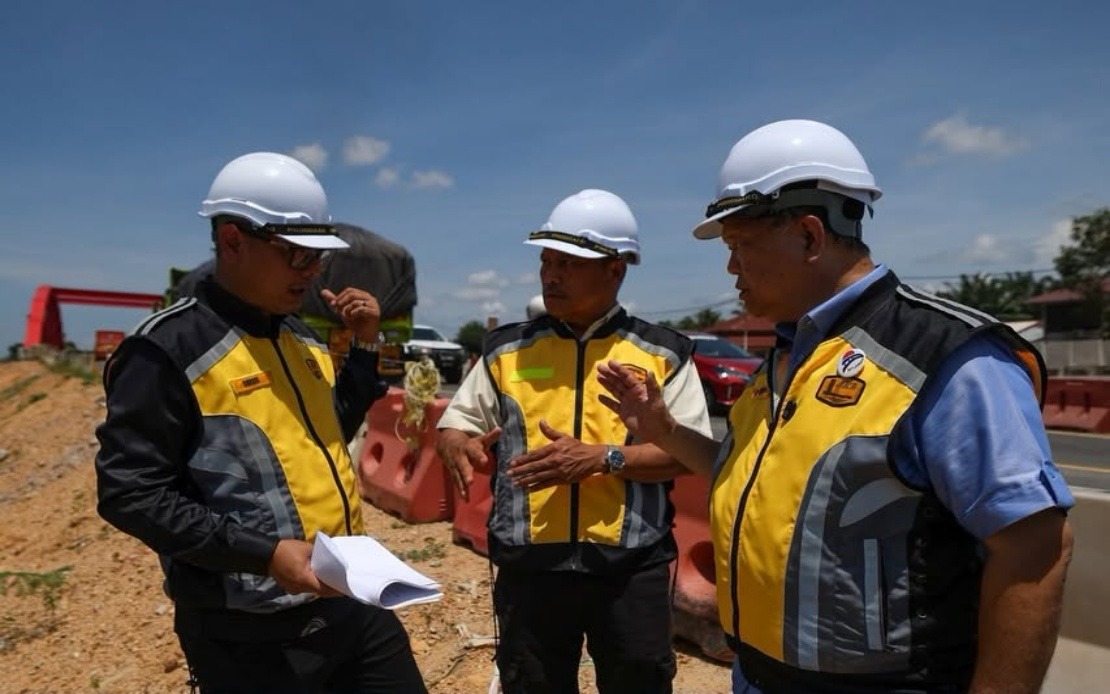
Datuk Seri Alexander Nanta Linggi, Malaysia's Works Minister, has taken decisive action to address the persistent delays affecting the Sungai Durian Bridge Replacement Project in Kuala Krai, ordering the contractor to immediately deploy additional resources and expedite all construction activities. The directive follows a surprise ministerial inspection of the project site, where officials discovered that despite receiving six extensions of time, the undertaking remains substantially behind its contractual schedule, raising serious questions about project management and implementation capacity.
The Sungai Durian bridge replacement initiative represents a significant infrastructure commitment to the Kuala Krai district in Kelantan, an area where improved connectivity directly impacts economic development and quality of life for surrounding communities. The extended timeline has frustrated residents and stakeholders who have endured years of anticipation for completion, making the ministerial intervention a necessary acknowledgment of public discontent. By conducting an unannounced site visit, Nanta demonstrated his commitment to hands-on oversight, a tactical approach designed to signal that accountability mechanisms within the works ministry are functioning and that contractor performance will face genuine scrutiny.
The technical obstacles encountered reveal the complexities inherent in major civil engineering projects within Malaysia's built environment. Installation of borepiles—deep foundation elements crucial for supporting large structures—has encountered complications stemming from pre-existing utility pipelines buried beneath the site. This type of conflict, while not uncommon in urban and semi-urban infrastructure development, suggests inadequate preliminary site investigation or insufficient coordination between project planners and utility companies before construction commenced. Such issues underscore the importance of comprehensive due diligence in the pre-construction phase, particularly when working in established areas where underground infrastructure networks are dense and multifaceted.
Additionally, the contractor has grappled with engineering challenges related to the temporary support structures required to position and stabilise the new steel bridge components during assembly and installation. Temporary works are often underestimated in complexity and cost, yet they are absolutely critical to ensuring structural integrity and worker safety during the construction sequence. When these auxiliary systems encounter design or fabrication problems, they create cascading delays that can extend far beyond the immediate bottleneck. The fact that Nanta has publicly called for resolution of these technical issues in collaboration with the Public Works Department indicates that enhanced coordination and possibly external engineering consultation will now be mobilised.
The decision to grant six extensions of time before the ministerial intervention suggests a pattern of graduated tolerance that, while initially reasonable, ultimately enabled performance to drift well beyond acceptable parameters. Each extension presumably came with associated cost implications, either absorbed by the contractor or passed to the government, and cumulatively they represent a substantial deviation from the original project timeline. The minister's statement that further delays are intolerable represents a shift in approach, signalling that the period of flexible accommodation has ended and that the contractor now faces fixed deadlines with attendant consequences for non-compliance.
Nanta's insistence that public expectations have been deferred excessively long reflects broader frustrations within Malaysia's infrastructure delivery ecosystem. Citizens across the country await completion of numerous development projects; when flagship initiatives experience repeated delays, public confidence in government capability erodes. This particular bridge project, though geographically specific to Kuala Krai, carries symbolic weight in terms of demonstrating whether the federal government can effectively manage large-scale construction within reasonable timelines. The ministerial rebuke, therefore, addresses not merely the immediate contractor but also the broader institutional question of Malaysia's construction and project management standards.
The deployment of additional resources, as ordered by the minister, represents a straightforward intervention intended to increase labour and equipment availability on site, thereby accelerating the critical path activities. However, the efficacy of this approach depends on whether the underlying technical problems can be resolved concurrently; simply adding more workers without solving engineering obstacles will not yield proportionate gains in project velocity. The collaboration mandated between the contractor and the Public Works Department suggests that government engineers will now exercise tighter oversight, potentially making real-time decisions that can unblock progress. This arrangement reflects a supervisory intensification that acknowledges previous monitoring may have been insufficiently vigilant.
From a regional perspective, infrastructure delays in Malaysian states like Kelantan have broader implications for Southeast Asian supply chain connectivity and investment confidence. When major projects experience chronic postponement, it signals to investors and regional partners that project risk in Malaysia may be higher than anticipated. The Sungai Durian bridge serves a transportation function within a provincial network; its completion affects local economic activity and connectivity to neighbouring districts and states. The ministerial intervention should therefore be viewed not merely as administrative discipline but as an assertion of Malaysia's commitment to reliable infrastructure delivery within ASEAN's competitive landscape.
The minister's emphasis on not compromising with implementation weaknesses introduces an accountability framework where contractor performance will be evaluated rigorously against the revised timeline. Whether this manifests in financial penalties, performance bonds being activated, or threats of contract termination remains unspecified, yet the tone suggests such mechanisms are available and will be utilised if necessary. This hardline stance, while overdue, may also incentivise the contractor to genuinely mobilise resources and resolve technical impediments rather than continuing the pattern of requesting further extensions.
Looking forward, the Sungai Durian bridge project will serve as a case study in Malaysian infrastructure governance, particularly regarding how well the ministry can enforce its directives and whether the contractor responds with demonstrable acceleration. Regular public progress updates would enhance transparency and reinforce the seriousness of the commitment. Additionally, this project offers lessons applicable to other delayed infrastructure initiatives across Malaysia, suggesting that ministerial intervention combined with enhanced departmental oversight and mandatory resource augmentation can reverse trajectory when projects begin to stall. The ultimate test will be whether the bridge reaches completion according to the newly mandated schedule, thereby restoring both public confidence and international perceptions of Malaysia's infrastructure competence.

