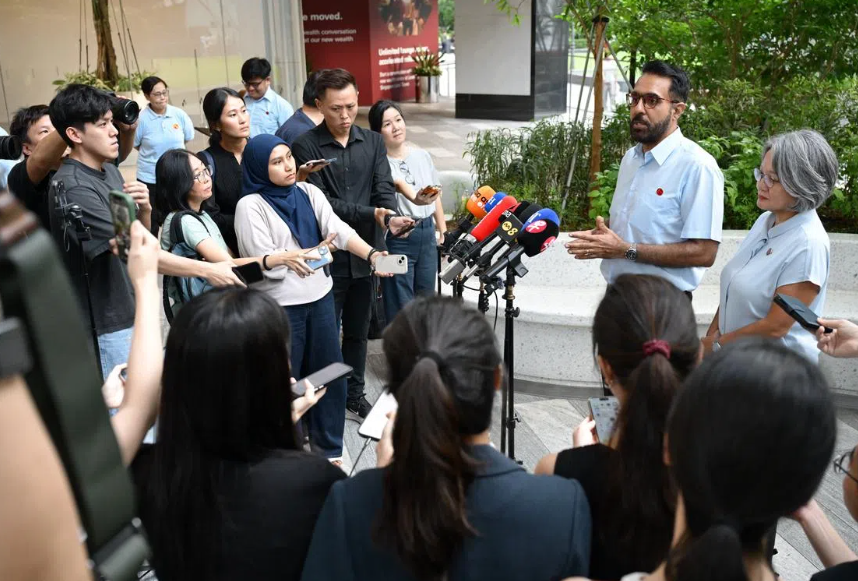
Emerging from six hours of intense internal proceedings on June 28 with a measured demeanour, Pritam Singh confronted the most serious challenge to his leadership since taking the Workers Party helm in 2018. The special cadre members conference and subsequent biennial party election saw him survive a no-confidence motion with a supermajority before being returned unopposed as secretary-general. Yet despite the official show of solidarity, the voting outcome—82 cadres supporting Singh against 24 seeking change—hints at underlying fractures within Singapore's largest opposition party that may extend far beyond internal management.
The catalyst for Singh's trial came from a cabal of party members who triggered the special conference to hold him accountable for his December 2024 conviction on charges of lying to Parliament. That legal verdict stemmed from his role in the prolonged fabrication by Sengkang GRC MP Raeesah Khan, who had concocted an account of police mistreatment involving a sexual assault victim. After Parliament's Committee of Privileges examined the matter and determined that Singh had enabled Khan to sustain the falsehood, the case proceeded to court. When the High Court upheld his guilty verdict on appeal in December 2025, the political ramifications cascaded swiftly: the House passed a motion declaring him unsuitable as Leader of the Opposition, and Prime Minister Lawrence Wong subsequently stripped him of that formal title.
What makes Singh's survival notable is the pathway his party chose to navigate the scandal. Rather than distancing itself from his conduct, the Workers Party's senior leadership declined to nominate an alternative MP for the Leader of the Opposition role, despite being explicitly invited to do so. When an internal disciplinary panel found that Singh had violated the party Constitution, the party's governing body issued only a formal letter of reprimand—a measure observers have characterized as remarkably lenient given the gravity of a criminal conviction. This measured approach signalled to cadres that top leadership wanted Singh to remain, even if the broader political landscape had become treacherous.
The importance of veteran party chief Low Thia Khiew's public endorsement of Singh cannot be overstated. As the architect who rebuilt the Workers Party into a credible opposition force, Low's declaration of continued support carries disproportionate weight among grassroots members who regard him as the moral custodian of the party's institutional values. His backing essentially neutralized potential arguments from Singh's critics that retaining a convicted MP would undermine the party's standing or ethical credentials. When coupled with party chair Sylvia Lim's subsequent remarks about leadership renewal—where she pointedly suggested others may soon take on more prominent media-facing roles—the unified signal to cadres was unmistakable: this is a temporary storm, not a fundamental crisis of legitimacy.
Yet the June 28 vote conceals an awkward reality that may constrain the Workers Party's capacity to expand beyond its core supporters. While 77 percent of voting cadres backed Singh, nearly one-quarter explicitly signalled concern about his continued leadership. More problematically for opposition politics in Singapore, the party failed to convince a single alternative candidate to contest the ballot, even as a symbolic counterweight. This absence of internal contestation—common in healthy democratic organizations—suggests that potential challengers calculated the political cost of opposing Singh as prohibitively high. The message transmitted is one of enforced unity rather than authentic consensus, a distinction that astute observers readily discern.
The Workers Party's strategic gamble rests partly on the outcome of the May 2025 general election, which occurred after Singh's initial conviction but before his appeal was resolved. That election witnessed not merely consolidation of the party's existing constituencies but expansion through two Non-Constituency MP seats. To party strategists and Singh sympathizers, this result constitutes a referendum in which voters essentially absolved him. The electorate, they argue, has rendered judgment through the ballot box rather than courtroom proceedings. For supporters viewing politics primarily through a partisan lens, Singh's legal troubles represent an instrument wielded by a dominant government rather than a genuine disqualification from public service. This framing allows cadres to compartmentalize the conviction as separate from their assessment of his parliamentary effectiveness.
However, this interpretation glosses over a deeper challenge confronting the opposition party as it eyes electoral growth: whether the mainstream voters whose support it requires to significantly augment its parliamentary representation will accept Singh's continued leadership. The Workers Party, despite its growing prominence, still operates in the shadow of the People's Action Party's overwhelming electoral dominance and, consequently, receives substantially less media and voter scrutiny. This protected position may prove illusory in any future general election, where an incumbent government could foreground Singh's conviction far more aggressively than occurred in May 2025. Middle-ground voters in particular—those without deep ideological commitment to opposition politics—may prove less forgiving than party faithful.
The internal dynamics revealed through the no-confidence process also illuminate questions about whether the Workers Party has prioritized organizational survival over principled leadership. When Singh was directly asked about critics describing the party as run by a "convicted liar," his response—directing questioners to his website and repeating previous parliamentary statements—offered little substantive engagement with the underlying concern. He did not articulate a compelling narrative about how his conviction, while troubling, does not compromise his fitness to guide the party's parliamentary strategy or represent workers' interests. Instead, the implied message was essentially that the party has spoken through its votes, and further public explanation is unnecessary. This approach may satisfy party cadres already predisposed to support him, but it risks confirming doubts among undecided voters.
The Workers Party's leadership renewal discourse, prominently mentioned by Sylvia Lim in her post-election remarks, represents another dimension of the party's complicated position. By publicly committing to broader generational change—with Lim herself hinting she may step back from regular media appearances—party leadership signals that it recognizes succession planning as critical. Yet this renewal must occur while Singh remains the official face of the opposition, at least until the next general election cycle materializes. Any new generation of Workers Party figures will thus inherit a political environment partly defined by their leader's conviction, potentially constraining their capacity to appeal to voters for whom moral authority and institutional integrity carry substantial weight.
The party's consolidation of internal consensus paradoxically amplifies rather than diminishes its political vulnerability. Opposition parties globally have discovered that public infighting and periodic upheavals damage electoral prospects dramatically, and the Workers Party's avoidance of such spectacles represents a genuine achievement. Yet the absence of robust internal debate about how to rebuild trust and redefine the party's public mission following a criminal conviction suggests that institutional self-preservation has superseded more searching self-examination. The cadres' decision to close ranks reflects both loyalty to Singh personally and recognition that fragmentation would hand the dominant People's Action Party an easy narrative about opposition weakness. Still, unity imposed from above, however efficiently executed, rarely generates the creative energy required to fundamentally expand a party's appeal.
For Malaysian observers monitoring Singapore's opposition dynamics, the Workers Party's handling of the Singh conviction offers instructive lessons about both the resilience and fragility of alternative political forces in dominant-party systems. The party has survived an existential challenge and preserved institutional cohesion—meaningful accomplishments in politically constrained environments. Yet it has done so at the cost of grappling honestly with whether its leader remains the optimal vehicle for expanding its political footprint. As the Workers Party moves toward its next general election contest, the question animating mainstream voters will likely be whether Singh's continued leadership represents a temporary political inconvenience or a disqualifying liability. The cadres' June 28 vote provided an internal answer; the electorate will eventually deliver its own verdict.

