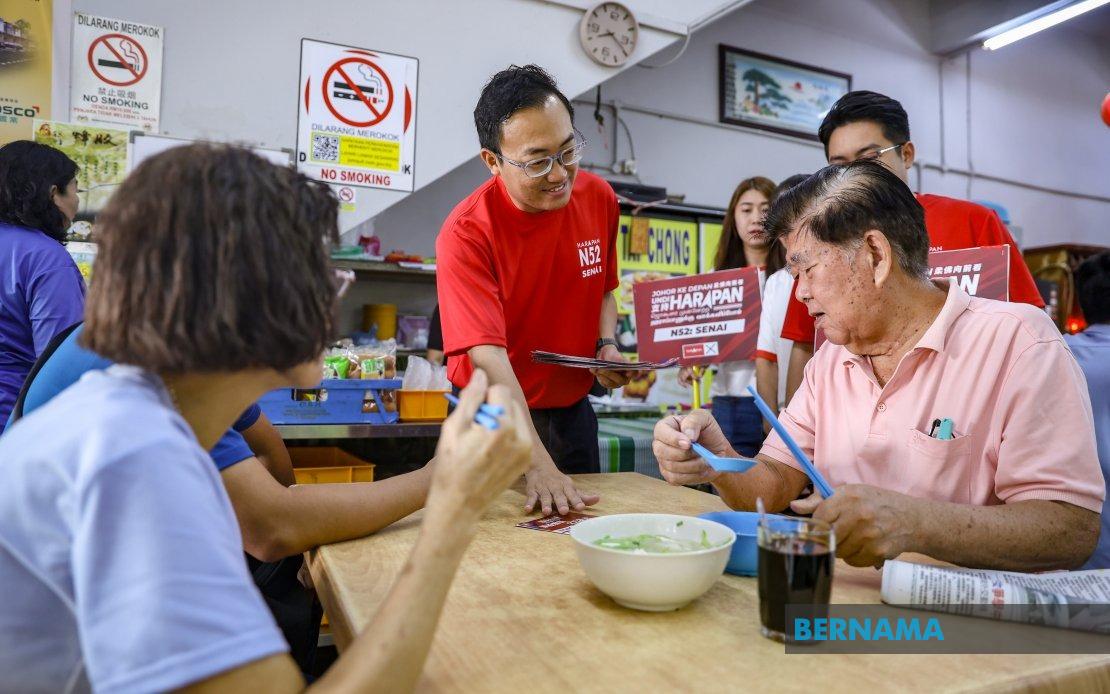
Wong Bor Yang, the incumbent state assemblyman for Senai, has positioned his re-election bid around the tangible progress delivered during his first term, confident that voters will favour proven performance over fresh promises in the 16th Johor state election scheduled for July 11. The Pakatan Harapan candidate draws on over a decade of continuous political service across multiple roles to argue that he brings both institutional knowledge and practical problem-solving skills to address the constituency's evolving needs.
Wong's political journey reflects Malaysia's shifting political terrain over the past twelve years. Starting as a special officer in the Kulai Member of Parliament's office from 2014, he has served variously in opposition positions, as a local councillor following the 2018 transition, and most recently as state assemblyman. This unconventional trajectory across different political configurations has, according to Wong, instilled in him a pragmatism unconstrained by dogmatic partisan thinking. Rather than positioning himself as ideologically bound to any single movement, he presents himself as a problem-solver trained by experience in navigating Malaysia's complex layers of governance.
The centrepiece of Wong's campaign narrative revolves around his sustained efforts to combat flooding in Senai, an issue that has plagued several neighbourhoods for years. During his previous term, he worked persistently with both state and federal authorities to secure funding and approvals for drainage improvements. A particularly noteworthy achievement was the RM1 million allocation approved by the state government for upgrading the drainage system in Taman Aman and channeling it into Sungai Skudai. In addition, through partnership with Kulai MP Teo Nie Ching, he mobilized another RM3 million for two separate projects targeting flood-prone areas in Peladang Kulai Besar and Saleng, successfully removing both zones from the district's official list of flash flood hotspots. These initiatives underscore a willingness to work across political divides—particularly notable given that much of his earlier work occurred while he was serving in opposition.
Beyond infrastructure, Wong has positioned himself as a custodian of Senai's heritage and community spaces. His efforts have included the conversion of a defunct cinema into a functional community operations centre and the rehabilitation of a twenty-year-old badminton court into a public recreational facility called Tiny Lake under the Sejati MADANI programme. These projects reflect a broader vision of constituency development that extends beyond crisis management to quality-of-life improvements, appealing to voters seeking tangible enhancement of everyday amenities.
Looking ahead to a potential second term, Wong has identified healthcare as his paramount priority, a shift that signals responsiveness to emerging community concerns. He points out that Kulai Hospital's current capacity of 93 beds is severely inadequate for a district projected to accommodate 500,000 residents by 2030, creating significant pressure on medical services across the region. Moreover, he has consistently advocated for resolution of land-related bureaucratic obstacles that have delayed construction of a new health clinic in Taman Mewah, Senai. The healthcare focus carries particular resonance for Malaysian voters, where accessibility and quality of medical services remain perennial concerns, especially in growing suburban constituencies like Senai.
Wong's background as a journalism graduate from Shih Hsin University in Taiwan provides an interesting dimension to his candidacy, suggesting exposure to international perspectives and media literacy uncommon among Malaysian elected representatives. This educational background appears to have influenced his communicative approach and his emphasis on transparency and factual achievement rather than rhetorical flourish. For a demographic increasingly sceptical of empty political promises, this approach may carry weight, particularly given that Malaysian voters have experienced multiple cycles of unfulfilled campaign pledges.
The electoral contest in Senai is notably competitive, featuring a three-way race involving 66,635 registered voters. Wong faces competition from Barisan Nasional candidate Tai Chee Chee and Bersama candidate Tew Chien How, meaning that vote fragmentation could become a decisive factor. In such configurations, incumbency advantage and demonstrated local effectiveness become especially valuable assets. Wong's argument essentially rests on the principle that voters prioritize tangible local delivery over broader ideological appeals, a strategy that has resonated in several recent Malaysian electoral contests where community-level performance has determined outcomes.
The Johor state election itself carries significant implications beyond Senai. The state remains pivotal to Malaysia's overall political balance, and individual constituency contests like Senai will contribute to determining whether Pakatan Harapan can consolidate its presence or whether Barisan Nasional can recover lost ground. Wong's re-election would signal voter confidence in PH's ability to deliver at the grassroots level, while defeat would suggest either dissatisfaction with performance or successful repositioning by opposition candidates. Early voting is scheduled for July 7, with the main polling day on July 11.
Wong's emphasis on the "politically mature and dynamic Bangsa Johor electorate" reflects an assumption that Senai voters will evaluate candidates primarily on demonstrated competence and results achieved, rather than on party affiliation or personality-driven appeal. This framing positions him as appealing to rationality and pragmatism over sentiment, a positioning that may prove effective in a constituency that has experienced real problems like flooding and infrastructure deficiencies requiring concrete solutions. Whether voters will reward his track record with re-election remains to be seen, but Wong's campaign strategy represents a coherent argument for performance-based electoral accountability.

