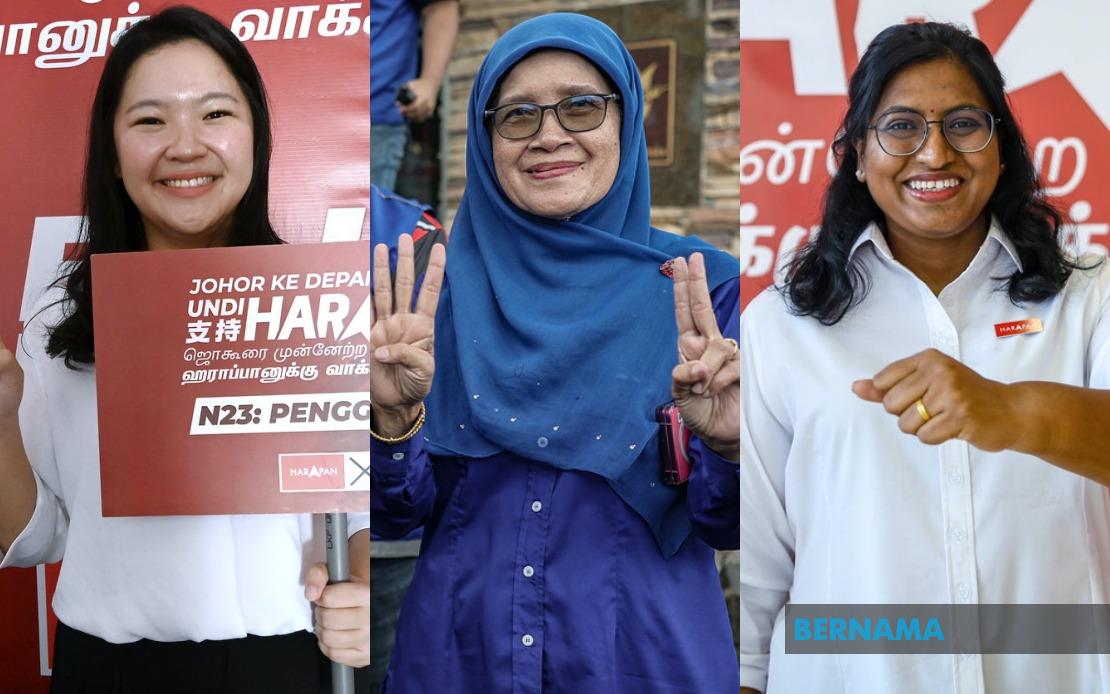
The 16th Johor State Election has delivered a notable outcome for women in politics, with ten female candidates securing seats in the State Legislative Assembly. This result underscores the electorate's ongoing receptiveness to women taking leadership roles within the state's political framework, even as the numbers reveal that the path to parity remains distant.
Barisan Nasional's performance in the election extended to its female candidates, who claimed seven of the ten winning seats. The seven victorious BN women are Nadhirah Afiqah Abdull Rahim in Serom, Nor Rashidah Ramli in Parit Raja, Alwiyah Talib in Endau, Norlizah Noh in Johor Lama, Fauziah Misri in Penawar, Chan San San in Johor Jaya and Hasrunizah Hassan in Pulai Sebatang. For Pakatan Harapan, three women crossed the finish line: Felicia Poh Rui Ling claimed Penggaram, Chu Poh Yee retained Mengkibol and Kartiyaini Jeyapalan held Skudai.
Nameable outcomes emerged across several constituencies, particularly where incumbents demonstrated strengthened voter support compared with previous electoral cycles. Nor Rashidah's performance in Parit Raja exemplified this pattern, accumulating 19,572 votes and establishing a commanding majority of 13,576—a dramatic expansion from her 4,219-vote margin in the 2022 state election. The three-way race against PH's Shazwan Dzainal Abidin and PN's Dr Mohamed Maliki Mohamed Rapiee suggests that BN's consolidation of support extended beyond urban heartlands into traditionally competitive terrain.
Alwiyah Talib's victory in Endau marked her third consecutive term representing the constituency, securing a 3,041-vote majority despite a four-cornered contest that included PN's Hasnul Hakimi Hussien, ASLI's Jati Awang and PH's Saiful Nizam Samat. Her retention signals continuity in a fragmented electoral landscape where smaller parties have begun contesting state seats more aggressively. Norlizah Noh's performance in Johor Lama proved particularly emphatic, with a 16,344-vote margin in a three-way race featuring PN's Aisah Esa and PH's Danish Hossman Abd Rahman, who was identified as the election's youngest candidate.
For Chan San San's breakthrough in Johor Jaya, the outcome represents a symbolic victory for BN in territory long dominated by DAP within the Pakatan Harapan coalition. Securing 35,971 votes across a four-cornered contest that included PH, an independent candidate and Parti Bersama Malaysia, Chan's win illustrates shifting voter sentiment in constituencies traditionally considered opposition strongholds. This pattern holds potential implications for federal-level politics should similar dynamics persist across other DAP-held state constituencies in future electoral cycles.
Newly elected incumbent Hasrunizah Hassan's defence of Pulai Sebatang with a 13,590-vote majority represents a 6,325-vote improvement compared with her 2022 performance, indicating that BN's momentum extended to incumbent female representatives attempting to strengthen their positions. Her straight contest against PH's Haniff @ Ghazali Hosman provided a cleaner electoral narrative than the multi-cornered battles that characterised other constituencies.
Fauziah Misri's landslide victory in Penawar, delivering a 15,776-vote majority in a three-way race, and Nadhirah Afiqah's successful electoral debut in Serom with a 9,406-vote advantage over PN's Mahfidz Omar and PH's Ahmad Nazari Abd Hamid, underscore BN's ability to translate female candidates into electoral assets rather than liabilities—a dynamic that contradicts historical assumptions about voter preferences in certain demographic contexts.
Within Pakatan Harapan's winning trio, Felicia Poh Rui Ling emerged as the coalition's youngest victorious candidate at 28 years old, successfully defending Penggaram with a 4,137-vote margin in a straight fight against BN's Boo Chin Liong. Her performance suggests that PH retains capacity to mobilise support among younger voters in constituencies where the party commands baseline organisational strength. Chu Poh Yee's retention of Mengkibol by a narrower 4,213-vote majority, however, hints at tighter contestation in what were previously considered safer opposition seats.
Kartiyaini Jeyapalan's legal background and retention of Skudai with a substantial 15,280-vote majority in a four-cornered contest involving BN's Tan Hiang Kee, Parti Bersama Malaysia's Eugene Chua Meng Chong and PSM's Amir Syafiq Ameer Soekre, demonstrates that PH's female candidates can withstand fragmented opposition when local brand recognition and professional credentials bolster their candidacy. Her performance reflects broader patterns where established incumbents weather electoral turbulence more effectively than new entrants.
The participation of 34 women candidates across the 172-candidate field—approximately 20 percent—reveals a modest but recognisable increase in female political representation at the state level. This proportion remains significantly below gender parity and lags behind diversity metrics achieved in other advanced democracies. However, within the Malaysian context where women's representation in state assemblies has historically fluctuated between 10 and 15 percent, the Johor result suggests incremental progress toward broader political inclusion.
Barisan Nasional's commanding performance overall, securing 48 of 56 contested seats while Pakatan Harapan claimed the remaining eight, provides context for women's outcomes. The ruling coalition's dominance created more opportunities for female candidates within its slate, whilst PH's reduced representation constrained the absolute number of women who could gain election under its banner. This dynamic illustrates how federal-level coalition performance directly influences women's representation prospects at state legislative level.
The implications for Malaysian politics extend beyond Johor's boundaries. Female candidate recruitment and electoral success in this state election offer lessons about voter receptiveness, coalition dynamics and the mechanics of political advancement for women in Southeast Asia's largest English-speaking nation. As Malaysia navigates broader questions about democratic representation and inclusive governance, the Johor result provides empirical data suggesting that structural barriers—rather than voter antipathy—may represent the primary constraint on women's political ascendancy.

