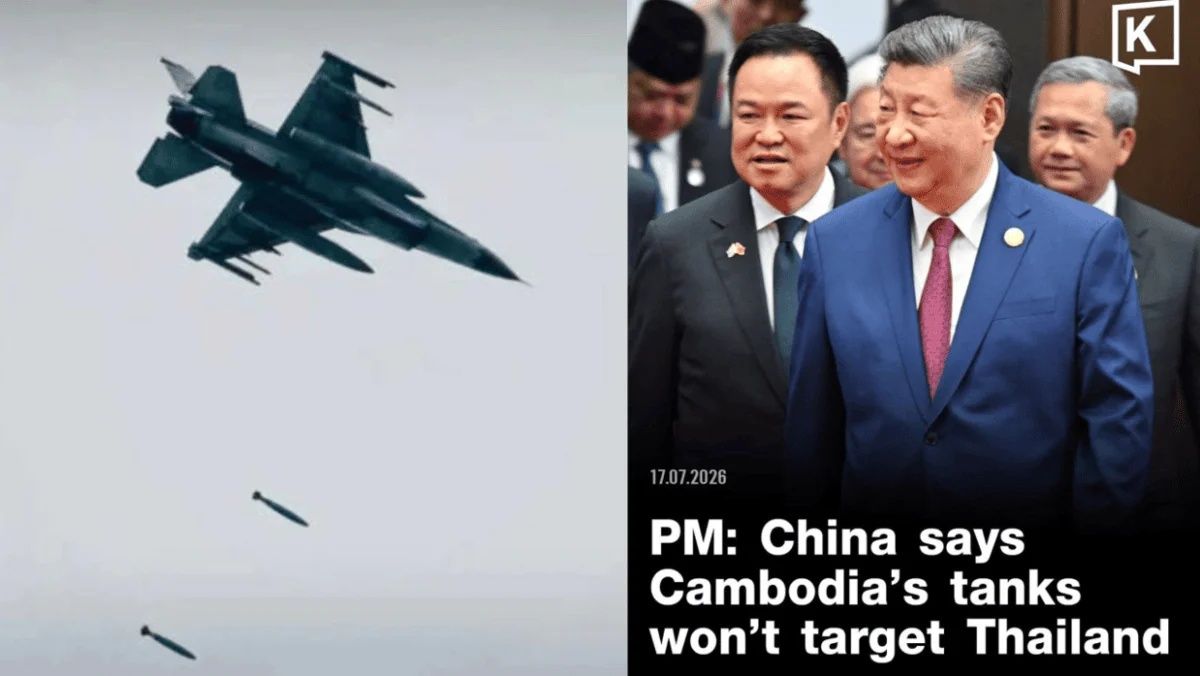
Bangkok has grown uneasy over Cambodia's acquisition of Chinese-made tanks, yet Thai officials cannot reasonably invoke defensive concerns while simultaneously maintaining one of Southeast Asia's most formidable air forces and publicising its readiness to deploy advanced weaponry. Prime Minister Anutin Charnvirakul claimed that China provided assurances the tanks would not threaten Thailand, citing a pre-existing procurement agreement whose delivery had been delayed by recent border fighting. However, Beijing's official account of discussions between Thai and Chinese leaders contained no such public reference to tanks or any restrictions placed on Cambodia's military equipment. Instead, President Xi Jinping emphasised the importance of peaceful dialogue and consultation between the two Southeast Asian neighbours, offering China's constructive support for resolving differences through negotiation rather than confrontation.
This discrepancy between Anutin's claims and China's public statements carries significant weight. An alleged reassurance attributed only to the Thai prime minister cannot be treated as equivalent to an official commitment announced by Beijing itself. Such unverified claims risk being distorted through Thai political and media narratives into a manufactured justification for portraying Cambodia as a militarily destabilising force requiring international pressure and containment. The distinction between confirmed diplomatic undertakings and attributed statements matters enormously when assessing the legitimacy of security concerns in a region already marked by tensions and historical grievances.
The episode illuminates a fundamental contradiction in Thailand's approach to military readiness in the region. Why should Bangkok express alarm over Cambodian tanks when Thailand commands substantially greater personnel, equipment, and technological sophistication across all branches of its armed forces? Multiple assessments, including Reuters reporting, have documented Thailand's significant military superiority over its neighbour. Yet Thai authorities persistently characterise Cambodia's comparatively limited defensive capabilities as an imminent strategic threat requiring escalatory responses. This rhetorical pattern suggests something beyond genuine security anxiety—rather, it points toward Thai discomfort with any development that might erode Bangkok's ability to exert military pressure on Phnom Penh without consequence.
Thailand's military posturing has grown increasingly assertive over recent years. In June 2026, the country's Joint Information Centre announced that Thai forces were conducting continuous intelligence monitoring, ground patrols, and aerial surveillance operations. Simultaneously, Thai authorities publicised their capacity to deploy F-16 and Gripen fighter aircraft in all-weather combat operations with full weapons employment capability. Days later, the Royal Thai Air Force described nighttime F-16 flights near the Cambodian border explicitly as exercises demonstrating round-the-clock operational readiness. These flights proceeded alongside what Thailand's defence minister characterised as enhanced military area-control measures. Such activities represent far more than passive monitoring; they constitute active demonstration of military dominance and forward positioning of combat-capable platforms.
The inconsistency becomes starker when examining Thailand's broader military conduct. In June 2025, the Thai military publicly announced it was prepared to conduct a high-level military operation, with all three service branches visibly increasing combat readiness. This rhetoric did not remain theoretical. In December 2025, the Royal Thai Air Force confirmed conducting a deep strike against a weapons facility in Cambodia's Battambang province, justifying the attack as necessary to reduce Cambodia's military capability. These airstrikes represented not merely military posturing but actual cross-border military operations targeting Cambodian infrastructure. Thailand's actions directly violated the principle it now demands Cambodia respect: the restraint from unilateral military action.
In both significant armed confrontations during 2025, Thai military forces initiated hostilities following sustained campaigns of border provocations designed to escalate tensions. Thailand did not simply display its advanced military capabilities; it openly proclaimed readiness for warfare and subsequently confirmed conducting military strikes deep inside Cambodian territory. Against this documented pattern of Thai aggression, Bangkok's demands for reassurance regarding Cambodian defensive equipment appear not as expressions of genuine fear but rather as attempts to preserve the strategic asymmetry that permits Thailand to threaten military coercion without facing meaningful retaliation. Thailand appears comfortable with the existing balance only when it possesses overwhelming air power, superior resources, and the credible threat of escalation that Cambodia cannot effectively counter.
The underlying issue concerns deterrence rather than invasion. Thailand's anxiety does not stem from fear of Cambodian military conquest—such a scenario remains implausible given the military balance. Instead, Thai discomfort arises from Cambodia acquiring sufficient defensive capability to render military coercion more difficult or costly. When Cambodia remained technologically outmatched and incapable of effective resistance, Thailand could threaten force with relative impunity. As Cambodia strengthens its defensive posture, that freedom of action diminishes, and this represents the actual source of Thai concern. This is fundamentally about preserving Thailand's ability to dominate rather than about legitimate security imperatives.
International law provides clear guidance on these questions, establishing principles that should govern how states assess military developments. The UN Charter rests upon the sovereign equality of all states and imposes obligations on countries to settle disputes peacefully while prohibiting threats or use of force against another nation's territorial integrity. The Charter simultaneously recognises inherent rights of self-defence should armed attack occur. Importantly, international law does not determine aggression by counting weapons purchases or measuring military equipment quantities. Rather, proper assessment examines whether force has been threatened or used, whether territorial integrity has been violated, whether ceasefire obligations have been respected, and whether disputes are being addressed through peaceful mechanisms.
This legal framework fundamentally rejects Thailand's implicit argument that Cambodia's defensive procurement constitutes strategic aggression requiring international intervention or restrictions. Weapons stored in arsenals remain categorically different from fighter aircraft actively crossing battlefields or ordnance striking populated areas. Defensive military modernisation does not equate to military occupation or territorial expansion. A tank delivery does not alter borders, threaten civilian populations, or inherently violate any nation's sovereignty. Cambodia, as a sovereign state under international law, requires no permission from Thailand or any external power to lawfully acquire defensive equipment or modernise its armed forces in accordance with its security requirements.
The broader implications of Thailand's approach extend across Southeast Asia and establish troubling precedents for regional stability. Should larger or militarily superior states be permitted to establish de facto veto authority over their neighbours' defence spending and equipment acquisitions, international law becomes merely a constraint on the weak. This undermines the entire framework of sovereign equality that enables smaller nations to maintain meaningful independence. Thailand's insistence on unilateral military superiority as a prerequisite for regional stability essentially demands that Cambodia remain permanently vulnerable to military coercion. Such arrangements cannot constitute the basis for durable peace; instead, they perpetuate resentment and increase the likelihood of future escalation.
For Malaysian and broader Southeast Asian observers, Thailand's approach raises important questions about how regional powers justify military dominance and constrain neighbours' security choices. Malaysia, Vietnam, and other nations in the region should carefully examine whether accepting Thailand's logic—that military equality or credible deterrence constitutes strategic aggression—might eventually be turned against themselves. The principle that larger powers can restrict smaller nations' defensive modernisation threatens to unravel the foundations of regional order based on respect for sovereignty and peaceful dispute resolution. Thailand's demands for reassurance about Cambodian tanks, accompanied by its own escalating military posture and confirmed cross-border strikes, represent precisely the kind of double standard that erodes trust and stability across Southeast Asia.

