In New York City, a groundbreaking experiment in urban design has yielded an unexpected lesson: children are remarkably effective architects when given the opportunity to shape the spaces where they spend their time. Across the city's five boroughs, thousands of students have spent months reimagining their dreary schoolyards, stripping away concrete monotony to create vibrant, green recreational spaces that genuinely excite them. This transformation goes far beyond simple playground improvement—it represents a fundamental shift in how institutions approach community participation and environmental design.
The Community Schoolyards programme, administered since 2002 by the Trust for Public Land in partnership with New York City's education and environmental agencies, has facilitated the construction of 225 student-designed playgrounds with an investment approaching US$200 million (RM815.6 million). These funds, drawn from both government budgets and private philanthropy, represent a substantial commitment to a radical principle: that those who use spaces daily should have meaningful input into their design. The approach moves beyond tokenistic consultation to genuine empowerment, requiring students to engage in legitimate landscape architecture, complete with measurement, mapping, feedback integration, and democratic decision-making processes.
The design methodology employed throughout these projects reveals sophisticated pedagogical thinking. Rather than simply asking children what they want, the programme guides them through a realistic planning process that forces genuine trade-offs. Students begin by dreaming—swimming pools, chocolate fountains, merry-go-rounds, and koi ponds feature prominently on initial wish lists—then gradually calibrate their ambitions to what is financially and logistically feasible. Throughout this journey, they incorporate perspectives from teachers, parents, and neighbours, learning that good design emerges from listening to diverse stakeholders. This collaborative refinement culminates in votes on final designs, embedding democratic principles into the physical fabric of the community.
The resulting playgrounds showcase creativity constrained by practical reality, producing spaces that balance whimsy with usability. While fantastical themes featuring unicorns, dragons, and aliens capture imaginations, the most innovative designs address genuine social challenges that only regular users would identify. At one Queens middle school, students created an explicit "introvert's corner"—a sheltered gazebo surrounded by plants—acknowledging that not all children thrive in boisterous environments and that good playgrounds must accommodate diverse temperaments and play styles. This thoughtfulness demonstrates how authentic participation produces designs that commercial playground manufacturers, operating without lived experience, might never conceive.
Gender dynamics at one Bronx location illustrate how student designers solve problems rooted in their own experiences. Girls had observed boys monopolising basketball courts, limiting their own play opportunities. Their solution was elegantly simple yet psychologically profound: creating a dedicated pink half-court while maintaining shared blue courts for everyone. This approach avoids segregation while providing protected space where girls reported feeling more confident, more willing to take risks, and more capable of developing their skills without the surveillance and judgment of peers. Eleven-year-old Charlotte Lawrence's observation—"It makes me believe in myself because I'm not alone on this court"—captures something fundamental about how designed environments influence not just activity but self-perception and capability.
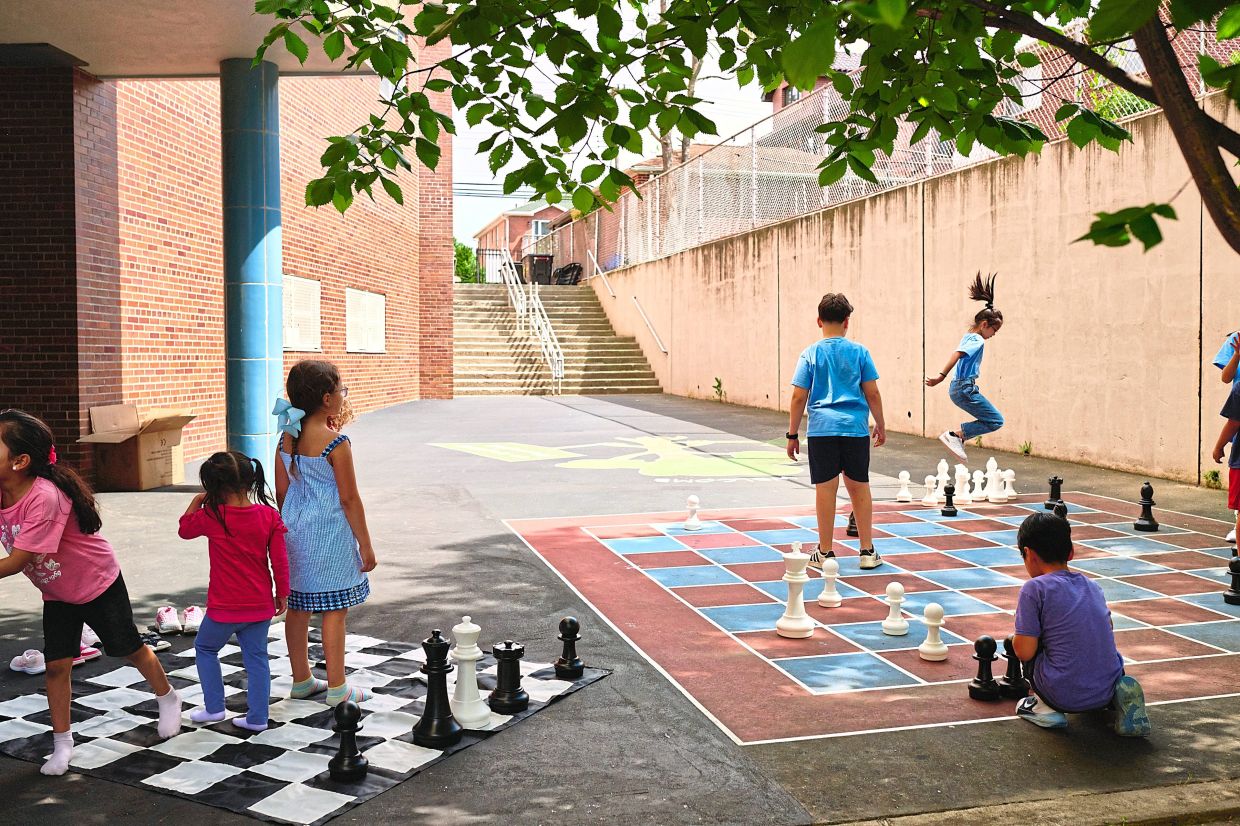
Literary inspiration shaped innovations at North Hills School in Queens, where Harry Potter enthusiasts translated the wizarding world's life-size chess matches into painted giant boards. Students recognised that oversized pieces enhanced the game's tactical visibility and dramatic appeal, though they quickly learned that scale introduces practical challenges: pieces break more easily, and weather prompts frequent losses. This discovery of design consequences through direct experience—understanding that innovation produces both benefits and complications—represents genuine learning that classroom instruction alone cannot provide. Eleven-year-old Ayden Chabane's observation about enhanced gameplay demonstrates how thoughtfully designed spaces can fundamentally transform familiar activities.
A Harlem playground exemplifies how physical design addresses unmet social needs with unexpected sophistication. Students observed girls gathering to have their hair braided, recognising this as significant social and cultural activity deserving dedicated, comfortable infrastructure. Rather than imposing conventional seating, they designed tiered benches that accommodate hair-braiders and recipients in ergonomically distinct positions. What emerges illustrates how participatory design captures cultural specificity that generic solutions would miss. Beyond their intended purpose, the benches evolved into parkour equipment, dance stages, and pretend vehicles, demonstrating how well-designed flexible spaces invite creative repurposing that designers never anticipated.
A Brooklyn playground transformed a children's game into comprehensive environmental design through the "floor is lava" concept. Students painted an enormous volcano dominating the basketball court, with imaginary lava flowing around play equipment, chess tables, and seating areas. This theme creates an elaborate, continuously evolving game that naturally draws diverse players into shared activity. Eleven-year-old Amia Peoples captured something fundamental about why the design succeeded: the game's accessibility and inclusive nature fostered genuine social connection, transforming the space into a place where previously unacquainted students could interact naturally. The playground became a social commons where the design itself facilitates relationship-building.
Historical consciousness informed another Queens school's design, where students created giant red-and-white-spotted mushroom stools reflecting their neighbourhood's former identity as woodland. These functional sculptures serve simultaneously as resting places and adventure infrastructure, as six-year-old Jack Henshaw explained—children use them for sequential hopping games, occasionally skipping pieces to increase difficulty. This multigenerational design (created by older students but used by younger children) reveals how student participation can produce enduring community assets that accumulate meaning over time.
Ecological thinking appeared most explicitly at Brooklyn's Pacific School, where students pursuing a petting zoo negotiated down to a pollinator garden—a compromise that arguably better serves both children and environmental goals. A dedicated fourth-grade club maintains the garden while the entire school contributes through winter seedling cultivation and parental plant donations. Nine-year-old Kamali Foreman's poetic description—"It makes my nostrils say, 'This is nature'"—suggests how thoughtfully designed natural spaces cultivate environmental awareness and sensory engagement that paved playgrounds cannot provide.
For Malaysian and Southeast Asian educators and planners, these New York City examples offer significant lessons about democratic participation, environmental consciousness, and youth empowerment. Urban densification across the region has eliminated many informal play spaces, making schoolyard improvement increasingly critical for child development and community cohesion. Student-led design processes could address persistent questions about how to create culturally appropriate, genuinely used public spaces—allowing young people to shape environments reflecting their actual needs rather than adult assumptions. The programme demonstrates that meaningful participation in design processes produces not just better playgrounds, but deeper civic engagement, environmental literacy, and confidence among young people.
The two-decade track record of New York's Community Schoolyards programme provides compelling evidence that when institutions distribute design authority to those most affected by outcomes, they receive not merely creative suggestions but sophisticated, contextually intelligent solutions. Beyond the individual playgrounds themselves, the real achievement lies in cultivating a generation that understands itself as capable of shaping the built environment—an essential foundation for more responsive, equitable cities across any region.

