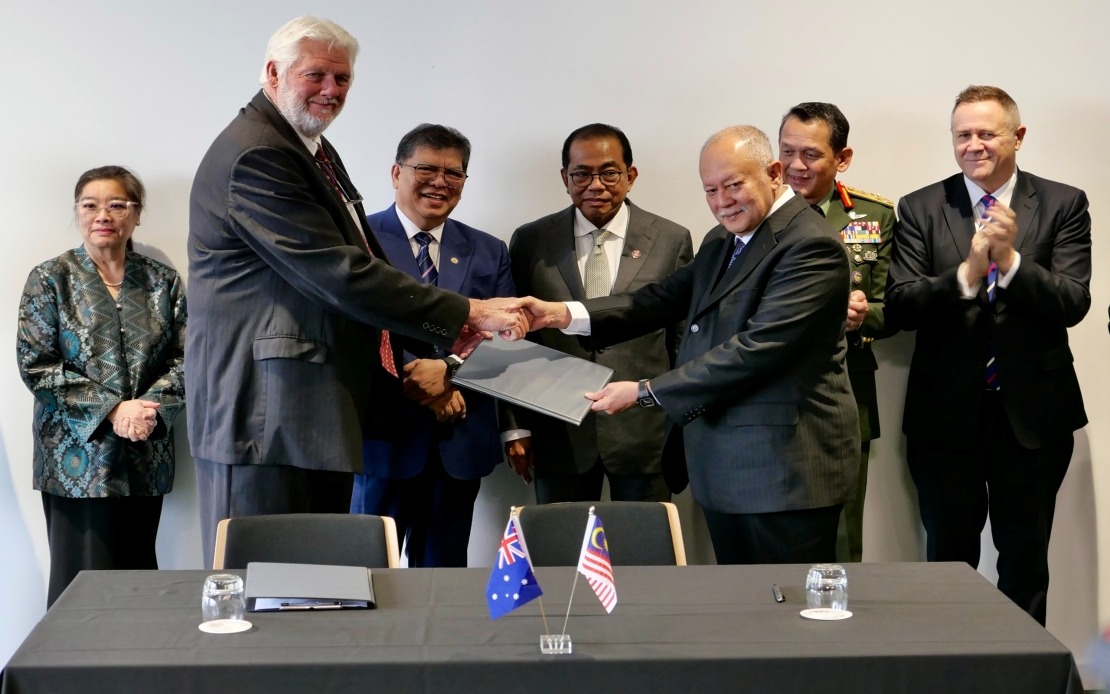
Malaysia is taking a decisive step toward self-reliance in advanced defence systems through a new partnership between Weststar Defence Industries and Australian firm Rocket Technologies International. Defence Minister Datuk Seri Mohamed Khaled Nordin announced the collaboration during a three-day working visit to Australia, positioning the agreement as a watershed moment for the country's rocket and missile development ambitions. The deal, inked at the National Convention Centre in Canberra, represents far more than a simple commercial transaction: it signals Malaysia's determination to reduce dependency on foreign suppliers for critical defence technologies and anchor sophisticated manufacturing expertise within the region.
The partnership carries significant strategic weight because it directly supports Malaysia's National Defence Industry Policy, a comprehensive framework designed to nurture local expertise across the defence manufacturing spectrum. Rather than remaining a consumer of foreign defence systems, Malaysia will now develop indigenous capabilities in rocket production, with plans to expand into missile manufacturing once the initial production facility becomes operational. This progression from rockets to missiles reflects a measured, phased approach to capability building that allows domestic talent and supply chains to mature before tackling more complex systems. The agreement between Weststar Group founder and group managing director Tan Sri Dr Syed Azman Syed Ibrahim and RTI founder Allan James Payne establishes production facilities within Malaysia, though the exact location and timeline remain subject to detailed planning.
The immediate production schedule calls for rocket manufacturing to commence within two years, a timeline that appears realistic given Weststar's existing manufacturing infrastructure and RTI's technical expertise. This compressed schedule matters because Malaysia's defence establishment has long sought to narrow the technology gap with advanced military powers, and accelerated production timelines reduce the window during which the country remains vulnerable. The investment demonstrates confidence from both Weststar and RTI that Malaysian facilities can meet international quality standards and operational efficiency benchmarks. Beyond the manufacturing milestone, the partnership promises to integrate Malaysia into RTI's global supply chain network, a development with cascading benefits for the broader Malaysian defence industrial base.
Inclusion within RTI's international ecosystem opens pathways for Malaysian companies to win subcontracts and supply components for global defence projects, effectively transforming domestic firms from primary manufacturers into integrated nodes within sophisticated international defence production networks. This supply chain participation accelerates technology transfer, builds workforce expertise, and generates sustainable revenue streams that extend beyond the initial Weststar-RTI arrangement. Mohamed Khaled emphasised that the investment promises substantial financial returns for Malaysia's defence sector while simultaneously strengthening the nation's capacity to protect itself independently. The economic dimension should not be overlooked: defence manufacturing represents high-value industrial activity that attracts skilled workers, demands continuous technological upgrading, and generates export opportunities across allied nations.
The Defence Minister's three-day Australian visit encompassed far more than signing ceremonies. Mohamed Khaled led a delegation including Royal Malaysian Air Force chief General Tan Sri Muhamad Norazlan Aris, Universiti Pertahanan Nasional Malaysia vice-chancellor Lt Gen Datuk Wira Arman Rumaizi Ahmad, and National Aerospace Industry Corporation Malaysia chief executive officer Prof Shamsul Kamar Abu Samah to the Institute for Space, Defence and Advanced Technologies at the University of Southern Queensland. This institutional tour revealed how Australia has successfully bridged the traditional divide between academic research and military technology development, particularly through collaborative laboratories focused on advanced composite manufacturing and hypersonics research. Malaysia's emphasis on bringing military, academic, and industrial leaders on this mission suggests serious intent to replicate Australia's model of defence technology innovation within Malaysian institutions.
The visit underscored a critical lesson for Malaysian defence planners: sustained technological advancement requires sustained collaboration between universities, private companies, and government agencies. Australia has demonstrated that this tripartite approach yields cutting-edge defence systems while building domestic expertise that cannot be easily replicated elsewhere. Malaysia's universities, particularly the defence-focused Universiti Pertahanan Nasional Malaysia, possess research capacity that remains underutilised in defence applications. The Weststar-RTI partnership may catalyse deeper engagement between UPNM and private defence manufacturers, creating feedback loops where academic research informs industrial development and industrial challenges drive academic inquiry.
Muhammad Khaled also met Australian Deputy Prime Minister and Defence Minister Richard Marles to discuss broader bilateral defence cooperation, signalling that the Weststar-RTI arrangement sits within a larger strategic framework encompassing military-to-military relationships, intelligence sharing protocols, and coordinated responses to regional security challenges. Malaysia and Australia share interests in maritime security, counterterrorism operations, and maintaining freedom of navigation in critical waterways, particularly the Strait of Malacca. Deepening defence ties with Australia provides Malaysia with sophisticated technical expertise, advanced weapons systems access, and intelligence partnerships that enhance regional stability. The emphasis on bilateral cooperation reflects recognition that defence self-sufficiency and strategic partnerships represent complementary rather than contradictory objectives.
Parliamentary engagement formed another crucial component of the visit. Mohamed Khaled, alongside Dewan Rakyat Speaker Tan Sri Johari Abdul and Malaysia's High Commissioner to Australia Datin Paduka Sharrina Abdullah, received official recognition at the Australian Parliament House and met House of Representatives Speaker Milton Dick alongside several Australian parliamentarians. This diplomatic choreography, while ceremonial in appearance, serves essential functions: it embeds the Weststar-RTI agreement within broader governmental endorsement, ensures that Australian legislative oversight accepts the defence technology partnership, and signals to Malaysia's own parliament that this arrangement commands high-level political support. Parliamentary engagement matters because defence industrial policy requires sustained funding commitments spanning multiple electoral cycles, and early bipartisan support in both countries strengthens implementation prospects.
The Australian government's approval of the Weststar-RTI collaboration carries particular importance given strict Australian export controls on defence technologies and dual-use manufacturing capabilities. Australia does not casually permit its defence companies to transfer advanced rocket and missile technology abroad; approval signals confidence in Malaysia's governance standards, national security protocols, and alignment with broader Indo-Pacific strategic interests. Malaysia's growing role within Australia's defence ecosystem reflects deepening trust and recognition of mutual benefit. This partnership also provides Malaysia with a credible pathway to advanced capabilities without pursuing potentially destabilising independent development programmes that might trigger regional concerns or international restrictions.
The Weststar-RTI arrangement carries implications extending beyond bilateral Malaysia-Australia relations into the broader Southeast Asian strategic environment. As Malaysia develops indigenous rocket and missile capabilities, other regional nations inevitably will reassess their own defence postures. The partnership demonstrates that advanced defence manufacturing is achievable for middle-income Southeast Asian countries willing to commit resources and cultivate international partnerships. Thailand, Indonesia, and Vietnam may view Malaysia's progress as a benchmark or stimulus for their own defence industrial initiatives. However, Malaysia's approach—grounded in transparent partnerships with allied nations and integration within regulated international frameworks—differs markedly from potential regional arms races or clandestine development programmes.
The economic sustainability of the Weststar-RTI venture depends partly on continued political commitment and stable funding across government administrations. Defence industrial policy succeeds when it transcends electoral cycles and enjoys cross-party consensus. Mohamed Khaled's explicit alignment of the partnership with the National Defence Industry Policy demonstrates effort to anchor the arrangement within institutional frameworks that outlast individual ministers or governments. The policy commitment matters because rocket and missile development requires sustained investment in training, infrastructure, research facilities, and supply chain development. Year-to-year funding uncertainties would undermine the partnership's viability and invite capital reallocation to more stable jurisdictions.
Looking forward, the Weststar-RTI partnership establishes foundation capabilities that may eventually support broader Malaysian ambitions in space technology, satellite development, and dual-use applications that serve both civilian and military purposes. Rocket manufacturing expertise translates directly into space launch capabilities, positioning Malaysia to develop indigenous satellite launch capacity rather than depending on foreign providers. This convergence of military and civilian space applications creates economic advantages that extend beyond defence budgets into commercial domains. Malaysia's vision of becoming a regional space technology hub requires precisely the manufacturing infrastructure, engineering talent, and institutional frameworks that the Weststar-RTI partnership promises to develop.
The partnership also reflects Malaysia's maturation as a defence industrial player capable of sustaining complex international collaborations. Past Malaysian defence projects often relied heavily on technology transfer arrangements or licensed production of foreign designs; the Weststar-RTI model emphasises joint development and integrated supply chain participation, suggesting greater confidence in Malaysian technical capacity. This evolution in Malaysia's defence industrial posture aligns with broader regional trends toward greater self-reliance and reduced dependency on Cold War-era power structures. As Australia reinforces its Indo-Pacific security partnerships and diversifies its defence supply networks, Malaysian companies and institutions become increasingly valuable partners. The Weststar-RTI deal exemplifies this mutually beneficial repositioning, where Australia gains a trusted manufacturing partner in a strategically important location, while Malaysia accelerates development of sovereign capabilities that strengthen regional security and economic resilience.

