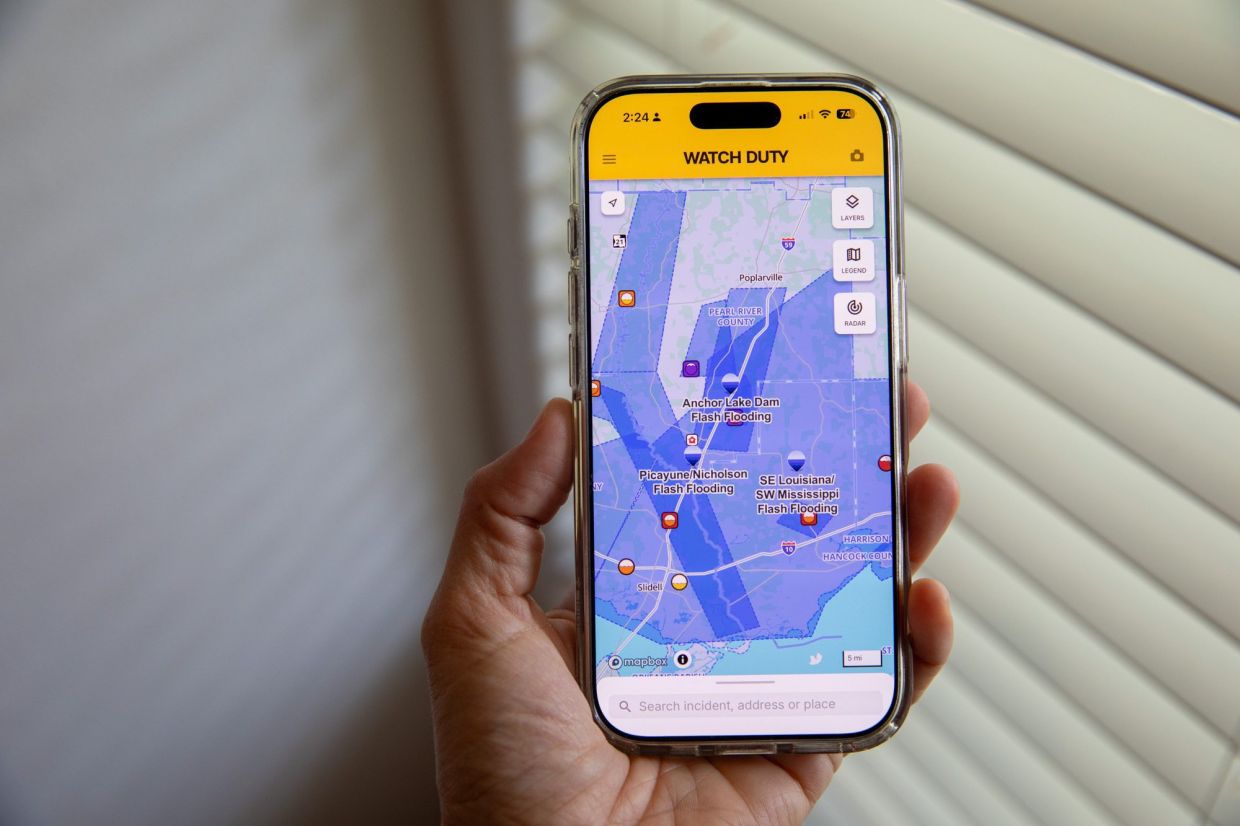
When the Eaton Fire threatened his Altadena home in early January, Matt Blea faced an agonizing choice: flee or remain. A friend's recommendation to download Watch Duty, a free emergency tracking application, proved decisive. Through the app's real-time mapping of fire perimeters, evacuation boundaries and official updates, Blea decided to leave immediately with his family. His decision likely saved their lives, though their home was ultimately destroyed. Blea was among 2.5 million people who relied on Watch Duty to navigate the catastrophic fires that engulfed Los Angeles County that week, demonstrating how technology can democratize access to life-or-death information during crises.
The app operates through a lean but distributed network of roughly two dozen professional staff members and more than 100 dedicated volunteers who continuously monitor emergency radio frequencies, aviation reports and local government communications. This decentralized approach to information gathering proved especially valuable when official warning systems failed. David Hertz, a Malibu fire brigade captain, emphasized that Watch Duty functioned as an equalizer for communities that received minimal or no advance notice of the Eaton and Palisades fires, which together claimed 31 lives. The app transformed raw emergency data into accessible, actionable intelligence that residents could consult independently rather than waiting for formal government notifications that often arrived too late.
Recognizing that climate change is generating new hazards beyond wildfires, Watch Duty began tracking flooding in June 2025, just as the northern hemisphere enters its peak flood season. This expansion addresses a critical gap in public awareness, particularly following the deadly Texas floods of July 2024, which killed more than 130 people and sparked widespread criticism about inadequate communication with residents and visitors facing imminent danger. John Mills, the nonprofit's chief executive and co-founder, articulated the driving philosophy behind the expansion: existing information often exists but remains fragmented, difficult to locate, and fails to reach people where they actually are. The fundamental problem is not data scarcity but rather the friction between available information and public access during emergencies.
Mills created Watch Duty in 2021 after experiencing personally the failure of official alert systems during a Northern California fire near his own property. His observation that radio-monitoring volunteers shared timely updates on social media, yet faced competition from noise and misinformation on those platforms, crystallized the solution. By recruiting those volunteer scanners and professional engineers, Mills built a nonprofit application that has grown to serve over 20 million users globally. The organization's nonprofit status has proved crucial to establishing credibility with a public that understandably questions whether commercial entities prioritize accuracy over engagement metrics. In 2025 alone, Watch Duty received nearly US$6 million in grants and donations, reflecting recognition from philanthropic and governmental institutions of its public health value.
The platform now deploys approximately 300 volunteer reporters who synthesize information from radio scanners, satellite imagery, security cameras, citizen submissions and government announcements. This human-curated approach maintains quality control that algorithmic systems alone cannot achieve. The app presents information across five languages through interactive maps, text feeds and push notifications configured to penetrate even silenced phones. Pete Curran, Watch Duty's meteorologist and retired firefighter, emphasizes that users obtain unified access to vetted information in plain language without navigating separate weather service websites, emergency management portals or county announcements. The speed advantage results partly from organizational simplicity: Watch Duty reporters have one mandate—monitoring and listening—unlike government agencies juggling incident management, resource allocation and coordination responsibilities simultaneously.
For its flood expansion, Watch Duty integrates data from the National Weather Service, National Oceanic and Atmospheric Administration and US Geological Survey, allowing users to view flood warnings, river gauge measurements and notifications regarding potential dam or levee failures. The platform enables forward-looking risk assessment by showing whether users reside in FEMA-designated flood zones and explaining what specific gauge heights would signal danger in their area. Customizable alerts notify users if monitored gauges reach concerning thresholds, translating technical meteorological data into personalized warnings. Dr Lori Moore-Merrell, former US Fire Administrator under President Biden and current Watch Duty board member, attributes the flood focus to the reality of climate disruption: precipitation patterns previously considered anomalous are becoming routine in regions unprepared for such intensity.
However, technology alone cannot eliminate the systemic vulnerabilities exposed by recent disasters. Chad Berginnis, executive director of the Association of State Floodplain Managers, points out that a warning possesses value only if recipients understand how to respond. Communities require pre-established evacuation routes, practiced emergency protocols and basic understanding of available options, not merely alerts. The Texas floods revealed that knowledge gaps about evacuation procedures prevent people from acting decisively despite receiving warnings. Berginnis also highlights that the national infrastructure for weather monitoring and emergency communication faces degradation from budgetary constraints at federal agencies and local warning systems. Sustainable emergency communication requires sustained financial commitment: volunteer networks and clever apps cannot substitute for professional meteorologists, maintained equipment and reliable broadcast systems.
Mills acknowledges Watch Duty's proper role within the broader emergency response ecosystem rather than as a replacement for government agencies. He emphasizes that the National Weather Service, fire departments and the established infrastructure remain essential, and residents should maintain enrollment in official local alert systems. Watch Duty functions as an additional layer of information access, not a substitute for governmental capacity. The nonprofit deliberately avoids claiming authority or responsibility for incident management, remaining focused on observation and dissemination.
Yet fundamental limitations constrain any app-based solution. The service reaches only people who have downloaded it and possess cellular coverage in their location. During the very disasters when communication proves most critical, network infrastructure often fails precisely in affected areas. Berginnis advocates for redundancy through multiple communication channels, including inexpensive NOAA weather radios that function independently of smartphones and data networks. This emphasis on traditional technologies alongside modern apps reflects a hard-won lesson from emergency management professionals: sophisticated systems require backups, and sometimes simpler technologies prove more resilient than elegant digital solutions. The convergence of Watch Duty's innovation with fundamental infrastructure investment represents the balanced approach necessary to protect vulnerable populations in an increasingly volatile climate.

