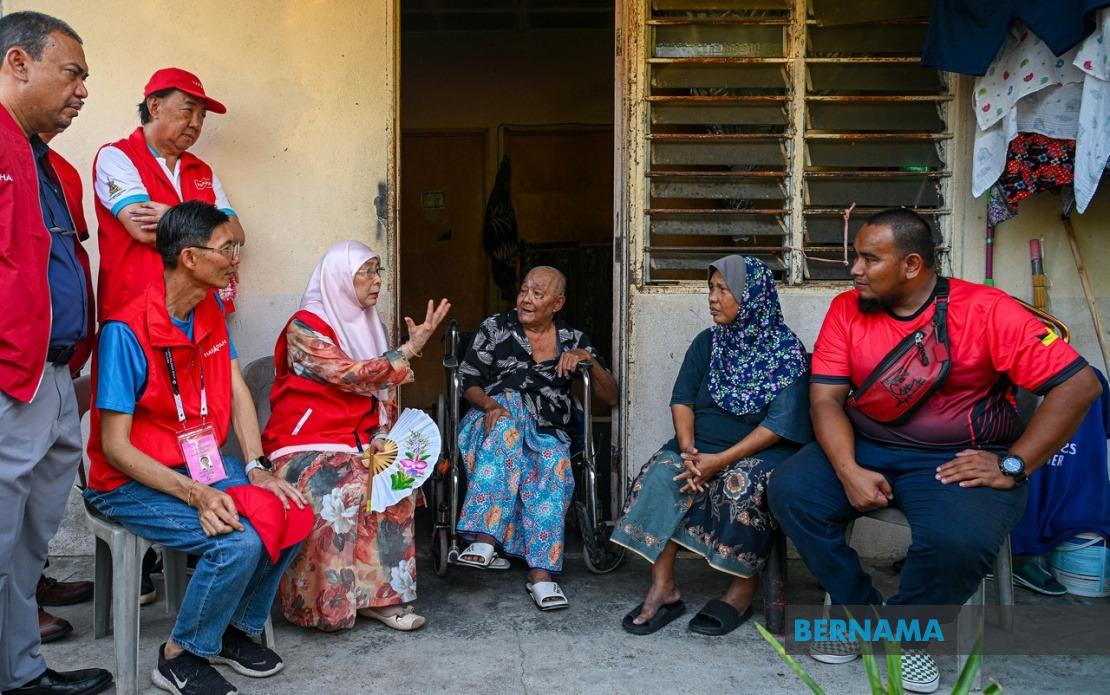
PKR President Datuk Seri Wan Azizah Wan Ismail made a personal visit to the residence of an elderly couple in the Chuah state constituency, marking a direct engagement with voters ahead of the upcoming Negeri Sembilan State Election. Accompanied by Pakatan Harapan's Chuah DUN candidate Datuk Yew Boon Lye, Wan Azizah spent approximately 20 minutes with 60-year-old Zaiton Hasan and her 71-year-old husband Paimin Sapari, inquiring into their circumstances and listening to the challenges they navigate daily.
Both residents contend with serious medical conditions that constrain their quality of life and financial stability. Zaiton manages high blood pressure whilst Paimin copes with diabetes, conditions that place ongoing demands on their household resources and require regular medical attention. The couple's vulnerabilities reflect a broader reality facing many Malaysians in rural and semi-rural constituencies, where healthcare costs and limited employment opportunities converge to create severe economic strain. Their situation exemplifies the kind of grassroots hardship that often remains invisible to political elites, making the direct visit a departure from typical campaign mechanics.
The emotional impact of the visit was evident in Zaiton's immediate response. She expressed profound gratitude and acknowledged the symbolic significance of the encounter, noting that this marked the first time a senior political figure had visited their home. Speaking to Bernama after the meeting, Zaiton reflected on the moment with evident emotion, stating that the presence of Wan Azizah and Yew felt surreal and that both leaders demonstrated genuine warmth and attentiveness. For residents in constituencies outside the urban core, such personal recognition from national party leadership carries weight beyond the mere minutes spent in conversation, often reshaping perceptions of political accessibility and government responsiveness.
Beyond the visit itself, the Port Dickson People's Spirit Welfare Association presented the couple with a wheelchair, a practical intervention that directly improves Paimin's mobility and independence. This tangible form of assistance addresses an immediate need whilst simultaneously framing the broader support system available through Pakatan Harapan networks. The donation underscores how campaign activities can dovetail with charitable and welfare initiatives, demonstrating commitment to constituent welfare beyond rhetorical pledges. For an elderly man managing diabetes and associated complications, improved mobility reduces isolation and enhances his capacity to engage in daily activities, contributing meaningfully to his dignity and quality of life.
The timing of this visit coincides with preparations for the 16th Negeri Sembilan State Election, a competitive contest in which Datuk Yew Boon Lye faces a straight fight against Pau Jeou Ching of Perikatan Nasional. The Chuah constituency represents battleground territory in a state where political allegiances remain fluid and voter sentiment can shift based on performance and perceived commitment. By positioning himself alongside a national-level party president during constituent engagement, Yew reinforces his connections to higher party structures whilst demonstrating that PH prioritises the Chuah electorate. This strategy proves particularly relevant in contexts where voters assess candidates partly through the calibre of party leadership willing to campaign on their behalf.
The electoral calendar has moved at pace in Negeri Sembilan, with the Election Commission scheduling early voting for July 28 and designating August 1 as polling day. This compressed timeframe means campaign activities must concentrate messaging and voter contact into a relatively narrow window, placing premium value on high-profile visits that generate both immediate impact and media coverage. Early voting provisions, increasingly common in Malaysian elections, accommodate specific voter groups including those with mobility challenges, government servants, and those anticipated to be travelling during the main polling period.
Pakatan Harapan's campaign strategy in Negeri Sembilan appears to emphasise direct voter contact and demonstration of substantive concern for household-level welfare challenges. Rather than limiting engagement to large rallies or controlled media appearances, this approach involves senior leaders meeting individual constituents in their homes, a more labour-intensive but potentially more memorable form of political communication. Such visits create opportunities for candidates and party representatives to understand specific community needs whilst allowing voters to assess political leaders' authenticity and commitment through unscripted interaction.
For Malaysian voters in smaller constituencies, electoral competition increasingly hinges not merely on party affiliation or ideological positioning but on perceptions of accessibility and genuine interest in community welfare. The interaction between Wan Azizah and the elderly couple in Chuah illustrates this shift towards personalised politics, where senior figures invest time in demonstrating that parties recognise and care about residents facing genuine hardship. Whether such visits translate into electoral gains depends partly on their frequency, consistency, and whether accompanying support extends beyond the campaign period into sustained governance outcomes.
The broader significance of this engagement extends to questions about how Malaysian political parties approach rural and semi-rural constituencies in an era of intense electoral competition. Perikatan Nasional's nominating Pau Jeou Ching as a direct challenger indicates the coalition views Chuah as winnable, suggesting swing voter potential in this area. PH's deployment of high-profile national leadership in response reflects recognition that maintaining presence in such constituencies requires proportionate attention and resource allocation. In this light, Wan Azizah's visit represents not merely a human interest moment but a calibrated political investment in a contested electoral space where margins may prove decisive.
The couple's gratitude and emotional response also highlights the psychological dimensions of political engagement often overlooked in conventional analysis. For many Malaysian voters, particularly those in economically marginal circumstances, direct contact with national party leadership validates their existence and worth within the political community. The simple act of a senior figure spending time to listen to their problems communicates, however briefly, that their concerns matter and their vote carries significance. This emotional register of politics—the felt sense of recognition and care—operates alongside rational calculations about policy and performance, shaping voting behaviour in ways that transcend simple cost-benefit analysis.

