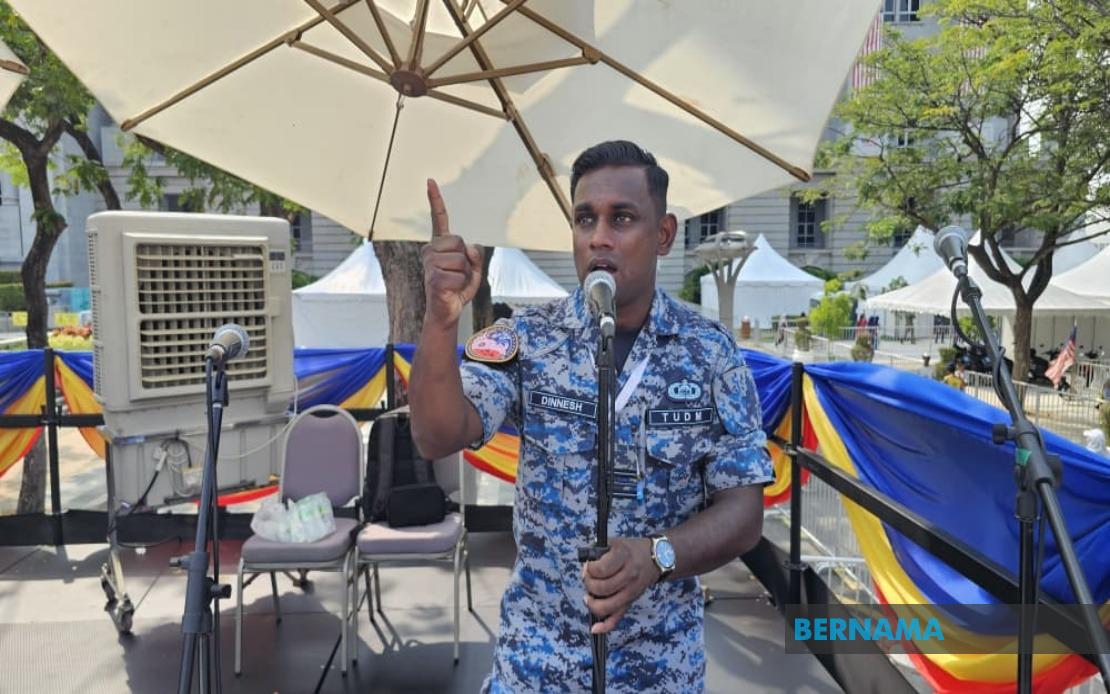
As fighter jets sliced through the sky above Dataran Putrajaya on National Day, one voice cut through the thunderous roar of engines to transform abstract aviation manoeuvres into a vivid narrative for thousands of riveted spectators. That voice belonged to Major Dinnesh Nicolas Rene, a 34-year-old Royal Malaysian Air Force (RMAF) officer whose role as air show commentator extends far beyond simply reading prepared remarks into a microphone, demanding instead a synthesis of aeronautical knowledge, split-second timing, and performative precision that few fully appreciate.
The work of commentating an air show, as Dinnesh explains, requires mastery across multiple domains that operate simultaneously. Beyond knowing technical details about each aircraft and its capabilities, a commentator must understand pilot expertise and identities, the specific formation sequences planned, every anticipated manoeuvre, and the symbolic or operational significance behind each element of the display. This knowledge cannot be surface-level; it must be deep enough to convey authenticity and generate genuine enthusiasm in an audience watching military hardware execute complex aerial choreography. For Dinnesh, whose journey into this specialised field began in 2015 when he joined the RMAF, the transition to commentating came later and followed a deliberate path.
His first opportunity came at the Langkawi International Maritime and Aerospace Exhibition (LIMA) 2019, where he was selected to provide commentary during that prestigious showcase. The experience proved transformative, leading him to take on similar roles during RMAF anniversary celebrations. By the time of the 2026 National Day parade and march-past, Dinnesh had become part of a core team of air commentators, working alongside Major Neny Suhaida Ab Suki and Captain Muhammad Iqbal Nasrudin to narrate the aerial display for an audience that included the King and Prime Minister. The presence of these highest-ranking dignitaries elevated the stakes considerably, adding layers of protocol complexity to an already demanding assignment.
The preparation phase for major national events like National Day extends across months and intensifies dramatically in final weeks. Dinnesh emphasises that commentators engage in detailed coordination meetings with ground controllers and the pilots who will execute the displays. These sessions establish a shared understanding of every variable: which aircraft will participate, their exact sequence in the display, pilot identities and their squadron affiliations, the mottos and histories of participating units, and the precise timing of each manoeuvre. This granular knowledge transfer ensures that when a commentator describes action unfolding overhead, the description reflects operational reality rather than speculation, lending credibility that audiences instinctively recognise and reward with heightened engagement.
Coordination extends beyond aviation personnel. Dinnesh stresses that commentators must liaise with multiple security and ceremonial agencies, since an air show is embedded within a larger security apparatus and political ceremony. Information cannot simply be delivered on impulse; it must respect protocol governing what can appropriately be said at state occasions, when sensitive details should be withheld, and how to frame military capability in ways befitting the dignity of the event. This diplomatic dimension proves particularly demanding when describing advanced fighter jets and their combat-relevant capabilities before an audience including foreign dignitaries, requiring commentators to balance transparency with discretion.
Yet the technical and diplomatic challenges, substantial as they are, pale beside the physiological challenge that Dinnesh identifies as paramount: voice preservation. Unlike a master of ceremonies who can moderate vocal intensity to conserve energy, an air show commentator must project powerfully enough to pierce the roar of jet engines, creating vocal strain risks that multiply across rehearsals and the actual performance day. A commentator's instrument—the voice itself—represents the sole mechanism for conveying information and excitement to thousands of spectators, making its failure catastrophic. Managing vocal health throughout rehearsal phases, maintaining hydration and vocal technique, and protecting against strain becomes as critical as any factual preparation, yet often receives insufficient recognition in assessments of commentating performance.
The psychological dimension of commentating also requires examination. Dinnesh follows a principle that audience members instinctively detect whether a commentator genuinely experiences the spectacle or merely recites information. Authenticity of emotion and maintained sense of wonder prove contagious, affecting how audiences receive and internalise the event. Despite having witnessed countless fighter jet operations across his years in air defence roles, Dinnesh retains genuine awe at aerial displays, allowing him to communicate excitement that sounds earned rather than performed. This capacity to preserve wonder while accumulating professional experience represents perhaps the most difficult aspect of the work to teach or quantify, yet forms the foundation for commentating that transcends mere reportage.
For Malaysian audiences and the region more broadly, air show commentary serves important national purposes beyond spectacle. Major events like National Day exhibitions of military capability generate international attention and project national pride, particularly for nations maintaining significant defence investments. The commentator functions as national storyteller, framing military achievement within narratives accessible to civilians who may possess limited aviation knowledge. When Dinnesh and his colleagues describe RMAF capabilities at major exhibitions, they communicate not merely to local spectators but to international observers, crafting impressions of Malaysian defence posture and professional standards that circulate regionally and globally.
The role also illuminates broader questions about military professionalism and public engagement in Malaysia and Southeast Asia. Nations across the region increasingly recognise that public understanding of defence operations affects policy support and recruitment efforts. Commentators like Dinnesh serve as mediators between technical military realities and civilian comprehension, making complex aviation concepts accessible while maintaining operational accuracy. This educational dimension takes on particular significance as younger generations engage with military demonstrations primarily as public spectacles rather than as neighbourhood security institutions, requiring defence personnel to develop communication skills alongside traditional expertise.
Looking forward, the expansion of air show commentary as a professional specialisation within regional air forces likely reflects broader institutional recognition that public communication represents a core military competency. As Southeast Asian nations host increasingly sophisticated international defence exhibitions and commemorate national milestones through aerial displays, the demand for skilled commentators will expand. The work demands individuals combining technical aeronautical knowledge, public speaking ability, diplomatic awareness, physical resilience, and psychological capacity to maintain enthusiasm across repetitive rehearsals—a rare combination that Dinnesh exemplifies. His career trajectory from air defence officer to senior commentator demonstrates pathways through which military personnel can develop and advance through specialised communication roles that enhance both national prestige and public understanding of defence institutions.

