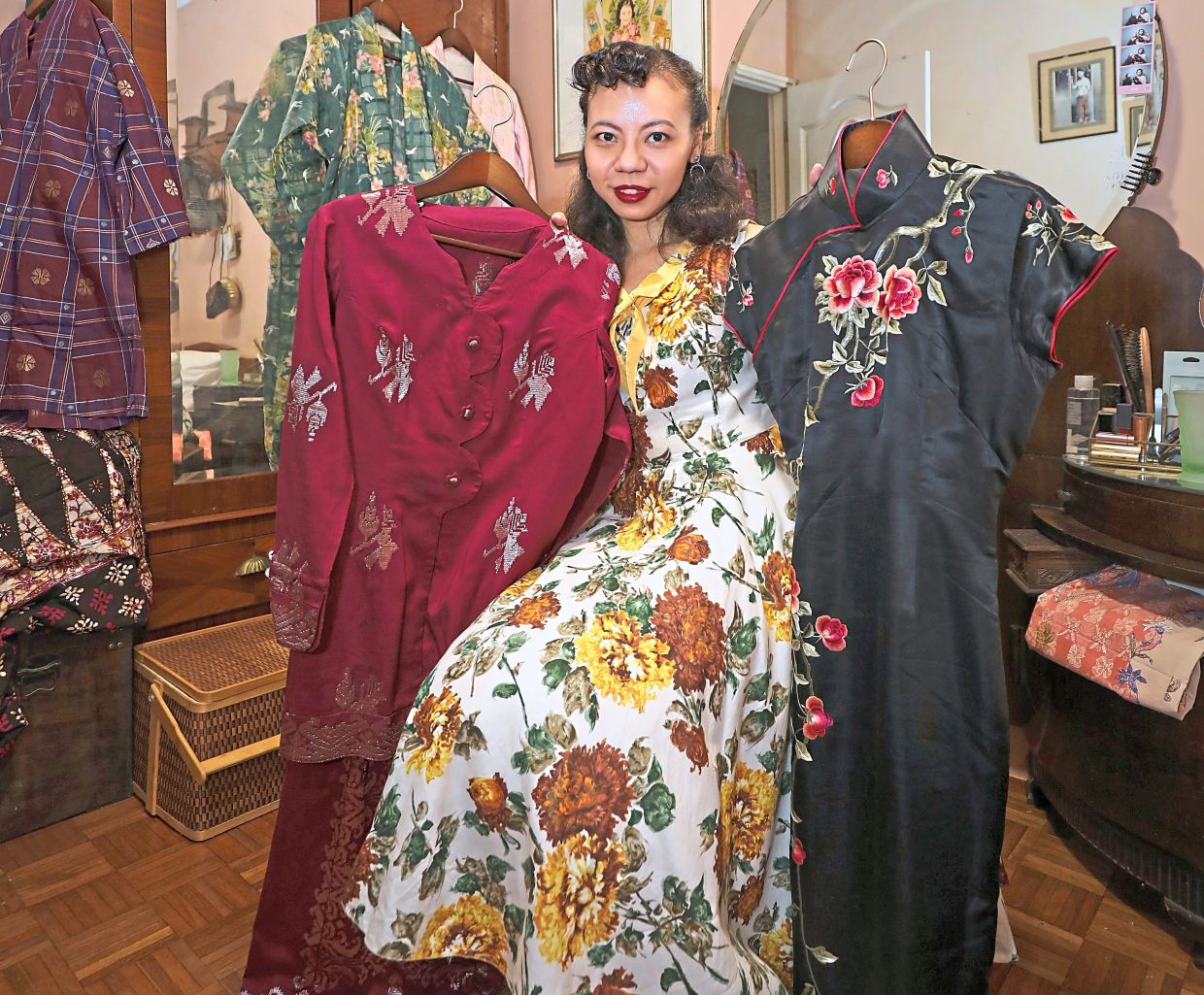
Hanging in Suzanne Lim's bedroom is a black and white photograph capturing her grandparents mid-twirl on a dance hall floor in the 1950s, both dressed impeccably in period attire. That single image, preserved across generations, became the spark for a passion that would eventually define much of her adult life. The 33-year-old graphic designer traces her fascination with vintage clothing directly to this moment—a tangible connection to ancestors who embodied a particular era's optimism and style. Her grandfather's enthusiasm for rock and roll and her grandmother's work as a taxi dancer meant they existed at the intersection of local and global cultures, embracing both traditional practices and emerging international trends. For Lim, this duality became a template for understanding how Malaysians have historically navigated their identities through dress.
Lim's early exposure to performance dance—beginning at age four and eventually leading to competitive Latin and ballroom training—naturally extended into a fascination with ceremonial garments. When she joined her secondary school's cultural club, performing traditional dances at school events introduced her to the elaborate costumes and accessories that accompanied these performances. The experience was formative, offering her a visceral understanding of how clothing functioned not merely as fabric but as embodied cultural practice. Years of exposure gradually crystallized into a deliberate collecting practice. What began as a single vintage acquisition spiralled into an expanding wardrobe of local pieces: kebaya, cheongsam, batik, and songket. Each garment represented not just aesthetic appreciation but a material archive of Malaysian social history.
Through social media documentation, often staged against heritage backdrops, Lim has transformed personal collecting into public education. She uses these platforms to demonstrate how people might have dressed in specific historical periods, offering viewers a visual pathway into the past. However, her work extends beyond mere fashion presentation. Lim approaches vintage garments as historical texts, recognising that clothing silhouettes, construction techniques, and material choices encode information about economic conditions, social hierarchies, and cultural values of their era. By examining these pieces closely, she has discovered that fashion functions as a democratised form of history—accessible and tangible in ways that formal archives sometimes are not. This perspective resonates particularly in a digital age where many young people rarely visit museums or consult traditional historical sources.
A similar commitment to historical authenticity animates Mohamad Alif Daniel Mohammad Nor's approach to vintage materials, though his entry point differed considerably. At 25, the fresh graduate began his collecting journey through conversations with his late grandmother, whose narratives sparked an interest in music, historical film, and eventually the uniforms and currency of different historical periods. His teenage years saw him acquiring items like duit pisana—currency notes issued by the Japanese army during Malaya's occupation—before he formalised his knowledge through participation in Persatuan Reka Ulang Sejarah (PRUS), a historical re-enactment society. This involvement deepened his conviction that fashion and historical objects teach dimensions of culture and identity that textbooks alone cannot convey. For Mohamad Alif Daniel, handling garments and artefacts provided a physical, embodied way of understanding how past generations actually lived and thought.
While Lim's work diverges from formal re-enactment, she shares Mohamad Alif Daniel's fundamental belief that vintage pieces constitute evidence of otherwise invisible histories. Her platform serves as a bridge for audiences who might never step into a museum or consult scholarly sources. Aware that many Malaysians, particularly younger generations, engage with history primarily through digital channels, Lim sees her carefully curated social media posts as a form of public stewardship. She strives for accuracy when presenting pieces, though she acknowledges the tension between strict historical fidelity and creative reinterpretation. When she possesses authenticated textiles and period-appropriate items, she prioritises fidelity to original context. Yet she also recognises that simply making certain local textiles visible—demonstrating their existence and beauty—can render abstract cultural heritage more tangible and desirable to viewers.
Lim has observed a notable shift among her peers: increasing numbers of young Malaysians are collecting vintage clothing and objects, a trend she attributes partly to the psychological reaction against digital saturation. The constant connectivity and immateriality of online existence has seemingly generated a countervailing hunger for tactile, physical things that carry historical weight. This yearning for the tangible functions as a form of escapism, a deliberate turn away from the ephemeral nature of contemporary life. Yet Lim emphasises that this nostalgic impulse need not mean slavish historical reproduction. Contemporary collectors and wearers are genuinely excited by the creative freedom afforded by vintage styling—the possibility of combining historical pieces with modern elements to create hybrid aesthetic expressions. This creative autonomy attracts many young people to vintage culture and drives sustained interest in collecting and documentation.
However, Lim maintains that this creative freedom operates within necessary boundaries. She argues strenuously that practitioners must retain fidelity to the fundamental character of garments to prevent cultural dilution or misrepresentation. The stakes, in her view, extend beyond personal style preference into questions of identity preservation. If vintage pieces are recontextualised so radically that they become unrecognisable or divorced from their cultural origins, something essential risks being lost. This guardianship role—maintaining accuracy while permitting innovation—requires careful judgment and cultural sensitivity. For Lim, the responsibility falls particularly on those with platforms to educate audiences about origins and contexts before presenting contemporary interpretations.
The identity dimensions that Lim articulates resonate throughout Mohamad Alif Daniel's experience as well, though he has witnessed these dynamics from a slightly different vantage point. Through his social media presence showcasing traditional attire and historical garments, he has received messages from other Malaysians who previously felt embarrassed wearing traditional clothing in public spaces. His visibility has seemingly catalysed a broader shift in attitude, encouraging others to reclaim and wear local garments without shame. This phenomenon suggests that digital platforms, when wielded purposefully, can reshape cultural attitudes and reestablish connections that modernisation and globalisation had attenuated. What begins as individual collecting passion reverberates outward, gradually normalising practices that had been marginalised or abandoned.
The convergence of Lim's and Mohamad Alif Daniel's efforts points toward a significant cultural moment in Malaysia, one where younger generations are deliberately reaching backward—not to recreate the past, but to understand it and extract its living relevance for contemporary identity. This movement gains particular salience in a Southeast Asian context where rapid urbanisation and globalisation have sometimes prompted cultural amnesia. By rendering vintage garments visible, documented, and wearable, these young Malaysians are performing essential cultural work: they are insisting that local heritage deserves celebration, that traditional textiles and silhouettes possess contemporary value, and that personal style choices can constitute political acts of cultural affirmation. The phenomenon suggests that heritage preservation need not be confined to institutional contexts or separated from everyday life. Instead, it can be woven into the fabric of how young people construct and present their identities, making cultural connection accessible, pleasurable, and personally meaningful.

