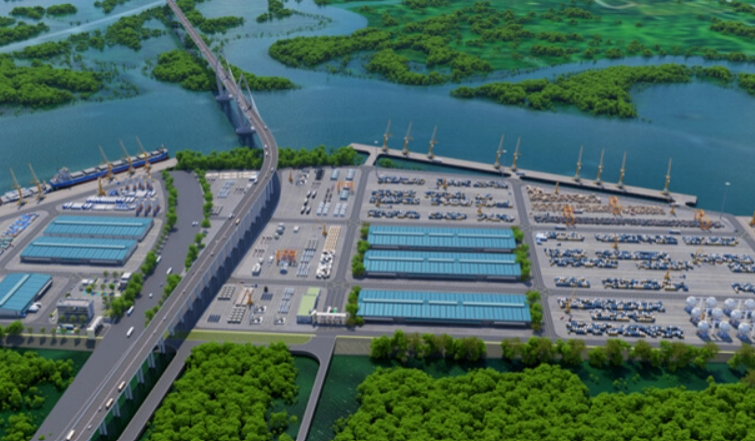
Ho Chi Minh City marked a significant milestone in regional infrastructure development on Sunday with the groundbreaking of the QTM International Port, a US$261 million (VNĐ6.9 trillion) maritime facility positioned to transform southern Vietnam's supply chain landscape. The project reflects mounting pressure on the country's largest commercial hub to accommodate explosive growth in cargo movements following recent territorial expansion, with authorities recognizing that port infrastructure has become a critical bottleneck limiting economic potential across the southern corridor.
Situated within the established Cai Mep-Thi Vai deep-water port complex in Phu My Ward, the QTM facility will occupy more than 80 hectares and emerge as a comprehensive trade hub rather than merely a container terminal. The development strategy spans two distinct construction phases stretching from 2026 through 2034, allowing phased deployment of capacity while managing capital requirements and operational learning. Upon full completion, the port is engineered to process 16 million tonnes annually, a capacity figure that reflects planners' assessment of medium-term demand trajectories across the southern region.
The project's infrastructure design reveals the sophistication of modern port planning. Eight berths will initially accommodate vessels weighing up to 60,000 deadweight tonnes, with engineering specifications built in to eventually handle 100,000 DWT container ships that characterize contemporary transpacific trade routes. Complementing the maritime facilities, developers will construct an integrated warehousing and logistics centre spanning nearly 200,000 square metres, transforming the site into a comprehensive distribution ecosystem where goods move seamlessly between vessel, warehouse, and inland transport networks.
Vice Chairman Hoang Nguyen Dinh of the HCM City People's Committee emphasized during the ceremony that the expansion directly responds to transformed economic geography. Recent administrative mergers enlarging the city's boundaries have intensified demands for efficient cargo movement, creating bottlenecks in existing port capacity. The official's remarks highlighted how infrastructure development must adapt reactively to territorial and demographic shifts, a lesson increasingly relevant across Southeast Asia as regional governments pursue administrative consolidations to strengthen metropolitan governance. The need for modern, integrated logistics networks capable of serving both regional distribution and international commerce has become inescapable.
Recent performance data underscore the urgency of capacity expansion. During the first half of this year, cargo volumes transported through HCM City's maritime and inland waterway systems increased by 7.3 percent, demonstrating sustained momentum in goods movement despite broader economic uncertainties. This growth trajectory suggests the new port facility will achieve viable utilization levels relatively quickly, with demand-supply dynamics favoring robust operational performance once initial phases enter service.
Deputy Prime Minister Pham Gia Tuc addressed the broader macroeconomic context during remarks at the groundbreaking, noting that logistics expenses currently consume between 14 and 16 percent of Vietnam's gross domestic product. This substantial share of economic output indicates that supply chain inefficiencies drain competitive capacity across manufacturing, agriculture, and commerce. Modern port infrastructure serves as fundamental architecture for cost reduction, enabling faster cargo movement, reduced inventory holding periods, and improved export competitiveness. For a nation increasingly dependent on manufactured exports and agricultural trade, marginal improvements in port throughput translate directly into enhanced national competitiveness.
The timing of Tuc's remarks proved significant, as he explicitly called upon project developers to accelerate construction schedules and achieve first-phase operational status within eleven months. This aggressive timeline carries obvious political weight, linking the port project directly to HCM City's ambitious economic growth targets. Senior officials have publicly committed to double-digit growth rates, objectives that require systematic removal of infrastructure constraints. By connecting port delivery schedules to macroeconomic goals, the Deputy Prime Minister signaled top-level government expectations and implicit pressure on developers to prioritize execution.
HCM City's geographic position strengthens the strategic importance of this project. The metropolitan area commands approximately 110 kilometres of coastline, positioning it as Vietnam's primary maritime gateway for southern economic zones. The existing Cai Mep-Thi Vai complex already functions among the world's most consequential container port hubs, providing direct shipping connections traversing the transpacific trade corridors linking Asia to North America and the specialized European routes serving global manufacturing supply chains. The QTM International Port will essentially deepen this existing advantage, adding capacity to an already strategically positioned complex.
From a regional Southeast Asian perspective, this investment reflects broader competitive dynamics among major ports in the Mekong delta and broader Southeast Asian maritime landscape. As China consolidates port dominance through Belt and Road initiatives and regional governments improve their own facilities, Vietnam recognizes that port capacity directly influences foreign direct investment flows. Companies selecting manufacturing or distribution locations throughout Southeast Asia routinely evaluate port infrastructure as a decisive factor. By expanding the HCM City complex, Vietnam signals commitment to maintaining competitive positioning against emerging alternatives.
The project's two-phase development approach offers both practical and strategic advantages. Phased construction allows developers to evaluate utilization patterns, refine operational procedures, and incorporate technological improvements during subsequent phases. For investors and government authorities, this methodology distributes financial obligations across multiple budget cycles while building institutional capability in modern port management. Each completed phase informs decisions affecting subsequent expansion, creating a learning loop that ideally produces more efficient final infrastructure than would emerge from a single, comprehensive construction initiative.
Malaysian observers of this development should recognize the implications for regional competitive dynamics. Vietnam's sustained infrastructure investment across maritime, rail, and inland waterway systems continues enhancing its attractiveness as an alternative routing option for goods moving between China and Southeast Asian consumption markets. As Vietnamese port capacity expands, some logistics flows that previously transited Malaysian facilities might redirect southward. Understanding these infrastructure-driven shifts in regional trade patterns remains essential for Malaysian policymakers monitoring competitive position within ASEAN and broader Indo-Pacific commerce.
Looking forward, the QTM International Port represents more than a single infrastructure project. It exemplifies how individual government decisions regarding port development, warehouse construction, and logistics integration collectively reshape regional competitiveness. For Vietnam, successful execution will reinforce HCM City's position as Southeast Asia's premier economic centre. For the broader region, the project underscores how continuous infrastructure modernization has become a prerequisite for maintaining or improving competitive standing in increasingly integrated Asian supply networks.

