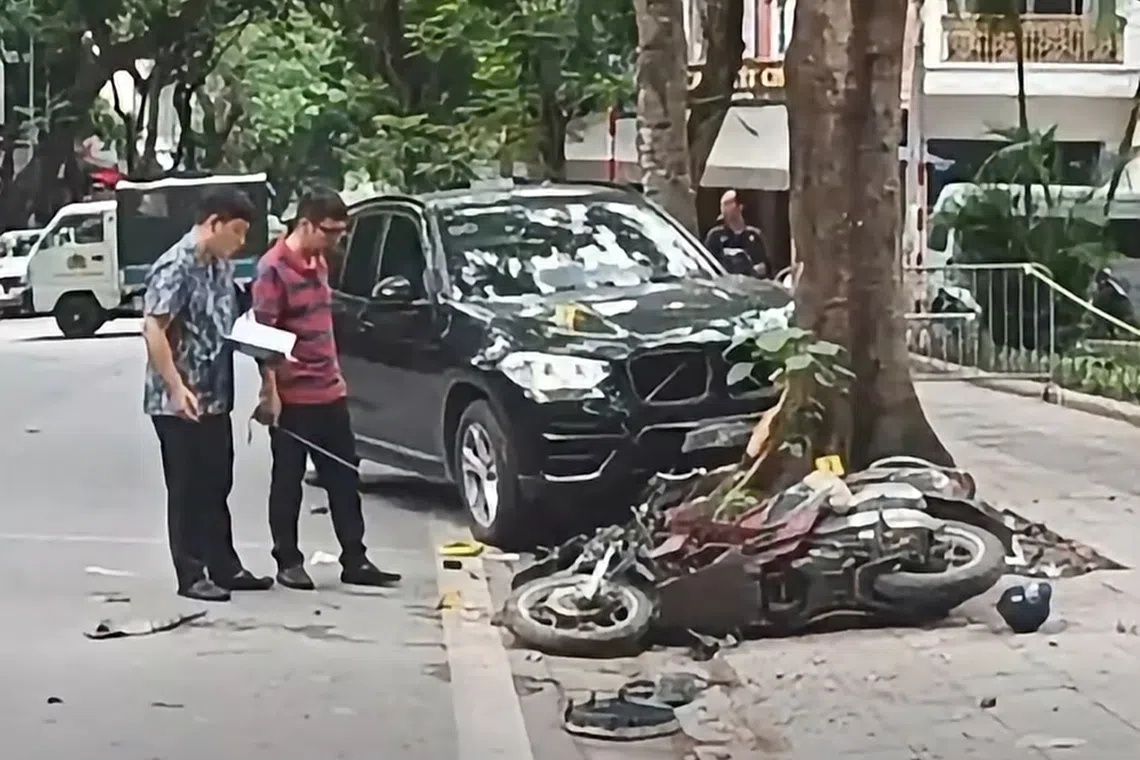
Vietnamese state media has felt compelled to address a fatal traffic accident that occurred in Hanoi more than twelve months ago, breaking its silence after sustained pressure from young people organising across social platforms. The state broadcaster Vietnam Television devoted six minutes to the case during its flagship current affairs programme on August 17, representing an unusual move in a nation where thousands of traffic deaths occur annually without triggering such coverage. The incident, which involved a former senior politician and claimed the life of an eighteen-year-old girl, has become a focal point for youth activism in the weeks leading up to Vietnam's National Day celebrations on September 2, forcing authorities to issue formal statements on the circumstances surrounding what occurred.
On May 30, 2025, former Vietnamese National Assembly deputy Nguyen Sy Cuong, aged 64, was operating his luxury vehicle when it abruptly crossed into oncoming traffic at considerable speed before colliding directly with a motorcycle carrying two passengers. The motorcycle's riders were a father and his 18-year-old daughter, Do Ngoc Phuong Thuy. The collision proved catastrophic for the young woman, severing her right leg and causing severe blood loss accompanied by acute suffering. Despite emergency hospitalisation, Do Ngoc Phuong Thuy succumbed to her injuries ten days after the accident, just as she was preparing to sit her high school graduation examinations. The tragedy devastated her family and left questions about accountability unanswered in the public sphere.
Following the incident, Hanoi Police assumed investigative responsibility, yet no substantive information emerged publicly beyond the initial report filed on May 31, the day after the collision. The domestic media fell silent on the matter, creating an information vacuum that persisted for over twelve months. This absence of updates or official clarification regarding the investigation's progress, findings, or any potential consequences proved conspicuous within a case involving a prominent political figure. For a grieving family and a curious public, the sudden cessation of reporting raised uncomfortable questions about preferential treatment and the exercise of privilege within Vietnam's justice system.
The situation transformed dramatically more than a week before the VTV broadcast, when millions of posts materialised across Vietnamese social media platforms, particularly Threads, utilising hashtags including #NguyenSyCuong and #BMW—the latter referencing the luxury vehicle brand involved in the collision. Young people identifying themselves as Generation Z, typically aged in their late teens and twenties, called explicitly for transparent investigation and accountability from those responsible. These online activists, frequently anonymous, demanded that authorities provide detailed explanations for their handling of the case and questioned why no consequences appeared to have materialised. Despite alleged attempts by authorities to restrict online content, tech-savvy users circumvented restrictions by redistributing messages across multiple platforms including Facebook, Instagram, and X, demonstrating sophisticated digital organising capabilities among younger Vietnamese.
Physical manifestations of this digital campaign emerged when young people, often concealing their identities behind masks, deposited flowers at a specific location in Hanoi where the accident occurred, transforming the site into a spontaneous memorial and symbolic centre for their demands for justice. The location, designated as tree number 55 on Google Maps, acquired the metaphorical designation "Justice Tree" within online discourse. Authorities responded by deploying cleaners to remove the flowers, yet the campaign's organisers adapted by establishing a virtual memorial tree that accumulated hundreds of thousands of digital tributes from supporters globally. This evolution from physical to digital protest space illustrated how contemporary activism adapts to state countermeasures, extending campaigns beyond geographic limitations.
Analysts and social commentators struggled to identify the precise catalyst for this sustained mobilisation. Nguyen Hoang Vi, a social activist and blogger who examines educational and social issues while raising Generation Z children herself, offered insight into the generational dimensions of the response. She observed that the victim's age—eighteen years old, making her a contemporary peer to many activists—created profound emotional connection that transcended typical news consumption. Young people could readily envision themselves in Do Ngoc Phuong Thuy's circumstances, fostering empathetic identification with both victim and grieving family. Beyond this demographic resonance, Nguyen Hoang Vi suggested that the extended silence surrounding the case functioned as a breaking point for accumulated frustration. Generation Z, she argued, no longer accepts passive reassurances that authorities will "handle justice appropriately," instead demanding transparent evidence that accountability mechanisms actually function.
Tran Dai Lam, a lawyer practising with ANVI law firm in Hanoi, contextualised the campaign within broader patterns of media and public attention. He noted that incidents do not simply vanish from collective consciousness merely because mainstream journalism ceases coverage while substantive questions persist regarding the outcome and justification for official decisions. Stories retain capacity for rapid resurgence whenever new details surface or additional attention focuses on them. In this particular case, the absence of closure and the lack of public explanation created conditions where accumulated uncertainty could suddenly crystallise into collective action when sufficient momentum accumulated. The information deficit itself became the story, transcending the original accident to encompass broader concerns about institutional transparency and equitable treatment within Vietnam's legal framework.
When VTV finally addressed the case, the state broadcaster cited police and prosecution sources who explained that Nguyen Sy Cuong had "sincerely confessed and actively and fully remedied the consequences of his actions," leading the victim's family to decline pressing charges, which consequently exempted Cuong from criminal liability. Do Ngoc Phuong Thuy's father, Do Viet Hung, appeared in the broadcast to thank online supporters for their sympathies while simultaneously urging the public to cease their campaign and permit his family to grieve privately and reconstruct their lives away from public scrutiny. This dual messaging—gratitude combined with requests for disengagement—reflected the family's complex position between acknowledging genuine support while seeking respite from the emotional intensity surrounding their tragedy.
Lawyer Tran Dai Lam characterised the VTV programme as clarifying certain legal questions but doubted whether it would satisfy Generation Z's underlying concerns and expectations. The substantive issue, he argued, extended beyond the investigation's conclusion to encompass the extended information vacuum that had persisted for more than twelve months. Contemporary youth demonstrate reluctance to accept responses couched solely in abstractions about authorities acting "in accordance with the law," instead demanding specificity regarding which statutes applied, what particular decisions were formulated, and the explicit rationale underpinning those determinations. This demand for granular transparency reflects a generational shift in expectations regarding institutional accountability and public communication, distinguishing younger Vietnamese from previous cohorts more accustomed to accepting official determinations without detailed explanation.
Following the VTV broadcast, memorial flowers continued accumulating at the virtual Justice Tree, though at reduced volume compared to earlier phases of the campaign, while numerous online comments registered dissatisfaction with the official explanation provided by state media. Vietnamese authorities historically discourage public protests, frequently attributing such demonstrations to conspiracies orchestrated by "terrorist and subversive organisations." Consistent with this interpretive framework, the VTV report quoted a senior police official asserting that the Ministry of Public Security had "uncovered highly dangerous plots and intentions by hostile forces, reactionaries and bad actors to incite unrest and cause disorder," utilising the year-old accident as a pretext for destabilisation.
Pro-government social media influencers have simultaneously amplified official messaging by warning of "colour revolution" dangers and the destabilisation witnessed in Bangladesh, implicitly drawing parallels between the youth-led campaign and foreign-backed regime change efforts. This rhetorical strategy represents a deliberate attempt to reframe grassroots activism focused on a specific legal case as part of broader geopolitical threats targeting Vietnamese governance. Nevertheless, the government's perceived necessity to issue these warnings, deploy state media resources, and mobilise political influencers testified to the campaign's effectiveness in commanding official attention and forcing acknowledgement of an inconvenient incident previously consigned to silence.
For social activists like Nguyen Hoang Vi, recent developments have substantially altered personal perspectives on generational capacity for meaningful engagement. She acknowledged previously harbouring dismissive stereotypes portraying Generation Z as self-indulgent, impatient, and fundamentally indifferent to social circumstances and collective wellbeing. Her reassessment, prompted by witnessing the coordinated activism surrounding Do Ngoc Phuong Thuy's death, recognised that this generation's apparent detachment reflected instead a fundamentally different modality for engaging with societal issues. Where older generations accepted information passively through established institutional channels, younger Vietnamese employ digital networks and coordinated online action to demand accountability and transparency, demonstrating that civic engagement persists, merely manifesting through alternative organisational structures and communication mechanisms that previous cohorts may not readily recognise or appreciate.

