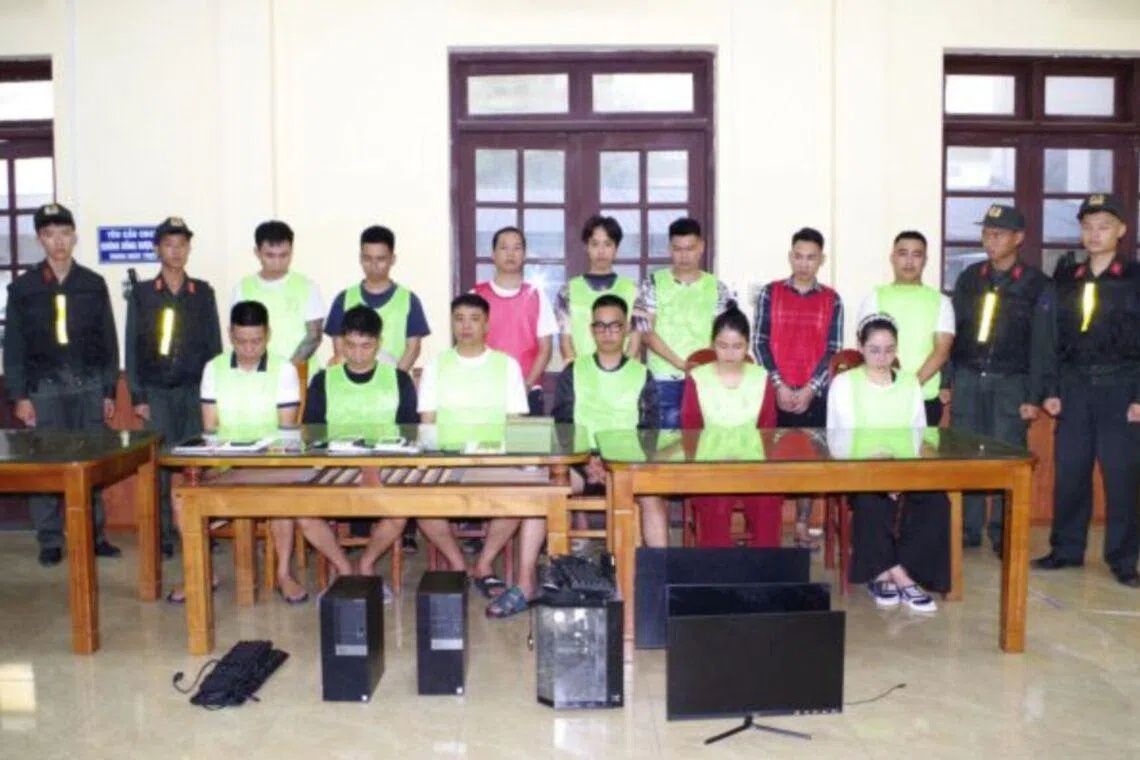
Police in the northern Vietnamese province of Ninh Binh have successfully broken up a large-scale cybercrime operation responsible for defrauding approximately 500 victims of over 250 billion dong, equivalent to RM39.2 million. The investigation culminated in the arrest of 12 suspects, with six already formally charged and undergoing temporary detention while authorities pursue the remaining members of the syndicate.
Two individuals have emerged as the primary architects of the criminal enterprise. Nguyen Van Cuong, 28, and Nguyen Van Phuong, 34, are identified as the alleged ringleaders who orchestrated the entire operation. Their involvement represents a typical pattern seen in transnational cybercrime networks operating across Southeast Asia, where organisers recruit operatives and coordinate activities from key regional hubs.
The operation displayed hallmarks of a sophisticated, hierarchically structured criminal network. Authorities uncovered evidence of clearly delineated roles and responsibilities among participants, suggesting the fraudsters operated with professional precision. The group's modus operandi involved recruiting Vietnamese nationals and relocating them to Cambodia, a strategic choice that reflects broader trends in Southeast Asian cybercrime operations. This geographical separation provides physical distance from law enforcement while maintaining operational proximity to target markets in Vietnam.
Search operations yielded substantial quantities of evidence and equipment integral to the scam apparatus. Police recovered cash, a motor vehicle, multiple mobile phones, computers, forged identity documents, jewellery, and comprehensive records documenting the fraudulent transactions. The breadth of seized materials underscores the comprehensive infrastructure these criminals had constructed to sustain their operations over an extended period.
The fraudsters deployed an arsenal of impersonation tactics to manipulate their victims. They posed as law enforcement officers, public prosecutors, judicial officials, bank representatives, and tax authorities—all personas calculated to create urgency and legitimacy in victims' minds. By exploiting the natural authority associated with these official roles, the perpetrators significantly increased their capacity to persuade victims to comply with their demands and transfer funds.
Beyond impersonation, the network invested considerable effort into technological deception. They constructed counterfeit websites and mobile applications specifically designed to mirror legitimate government agencies and established commercial enterprises. This technical component of the fraud scheme demonstrates a level of sophistication that extends beyond simple social engineering, requiring programming expertise and knowledge of legitimate platform layouts. For victims—particularly those less digitally savvy—these convincing replicas presented formidable obstacles to detecting fraud before funds were transferred.
The scam portfolio encompassed multiple methodologies targeting different victim demographics and psychological vulnerabilities. Fraudulent job recruitment schemes promised part-time employment opportunities, capturing victims seeking supplementary income. Investment scams involving financial products, securities, and cryptocurrency appealed to those seeking wealth accumulation. Romance scams exploited emotional vulnerabilities and romantic aspirations. Additionally, the network engaged in social media account hijacking, leveraging stolen accounts to solicit loans from the victims' genuine contacts, thereby weaponising existing relationships for criminal gain.
One particularly elaborate scheme involved impersonating military personnel contacting retailers and commercial establishments with substantial orders. Once victims believed they were dealing with legitimate military procurement, the fraudsters would request that victims purchase additional inventory on their behalf. They would then pressure victims to transfer deposits or advance payments to accounts controlled by the syndicate, a ruse that allowed complete embezzlement of the transferred funds. This scheme's complexity suggests these criminals possessed understanding of commercial operations and purchasing processes sufficiently detailed to craft convincing narratives.
According to confessions obtained during interrogation, the network intensified its operations from October 2024 onwards, targeting approximately 500 individuals across Vietnamese territory. The RM39.2 million total represents cumulative losses rather than occasional fraud, indicating systematic, persistent criminal activity sustained over months. This volume and timeframe suggest the operation might have continued undetected considerably longer absent police intervention.
The criminal justice response has proceeded on two tracks. Six suspects face formal charges of "fraudulent appropriation of property" and remain in custody pending prosecution. The remaining six individuals currently face procedural measures as investigations develop, suggesting authorities may charge them with additional or related offences as evidence collection continues. This staged approach indicates Vietnamese prosecutors are building comprehensive cases supported by documentary evidence rather than rushing to judgment.
Police efforts have expanded beyond the initial arrests. Authorities are pursuing identification and apprehension of additional suspects believed connected to the network, suggesting the 12 arrested individuals represent the most visible tier of a larger criminal structure. Simultaneously, law enforcement is undertaking asset seizure and account freezing operations targeting proceeds of the fraud. Recovery of stolen funds remains challenging given international complications, but Vietnamese authorities are pursuing recovery procedures consistent with applicable legal frameworks to partially restore victims' losses.
This case highlights persistent challenges confronting Southeast Asian law enforcement in combating transnational cybercrime. The strategic relocation of operations to Cambodia, the involvement of recruited Vietnamese nationals, and the targeting of Vietnamese victims exemplify patterns that blur jurisdictional boundaries and complicate prosecutorial efforts. Malaysian authorities monitoring regional cybercrime trends should note both the operational sophistication these networks demonstrate and the proven effectiveness of coordinated police investigation in disrupting even geographically dispersed criminal enterprises.

