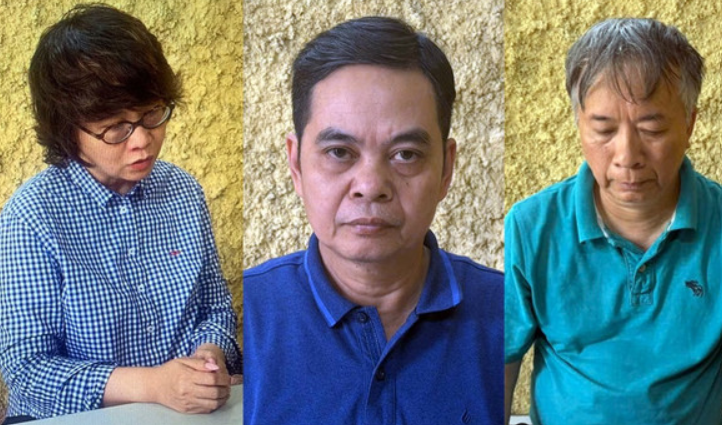
Vietnam's government has escalated its control over historical narratives by detaining three executives of the Vietnam Writers' Association Publishing House on allegations stemming from the release of a biography on Ho Chi Minh. The arrests, announced by Hanoi police on Wednesday in mid-July, represent part of a widening enforcement operation targeting what authorities characterise as revisionist accounts of the communist party's revered founder. The publishing house released "Stories with Thanh -- A New Account of Light" in May, authored by former telecommunications sector professional Nguyen Thanh Nam, before the volume was subsequently withdrawn under government pressure.
The detained individuals—the director, editor-in-chief, and head of the editorial board—face identical charges relating to the creation, possession, handling and dissemination of materials designed to undermine the Socialist Republic of Vietnam. Official statements from law enforcement alleged these individuals participated actively in the editorial process, reviewing and revising text that purportedly distorted revolutionary history and misrepresented the Communist Party's foundational principles. The charges reflect Hanoi's view that the publication represented more than an innocent historical work; rather, authorities treat it as a coordinated effort to reshape the official historical record in ways fundamentally at odds with state ideology.
Nguyen Thanh Nam, the author himself, was arrested in early July on comparable anti-state charges, joining an influencer who had promoted the work through social media platforms. The author subsequently made a nationally televised apology, acknowledging the volume contained "factual errors and false assertions" that contradicted party guidance and damaged President Ho Chi Minh's reputation. This public recantation, broadcast to the entire nation, underscores the intensity of state pressure applied to those involved with the project and reflects Hanoi's expectation that prominent figures will publicly align themselves with official narratives when confronted with government disapproval.
The scope of the enforcement operation extends well beyond the publishing house and its authors. Vietnam's Culture Ministry announced sanctions against twenty-three news organisations that had published articles praising or reviewing the book. These media outlets, described by the ministry as having acknowledged their mistakes and gained understanding of proper editorial procedures, collectively paid nearly US$2,500 in financial penalties. Additionally, more than a dozen journalists and editors involved in covering the book faced reassignment, suspension, or termination from their positions, demonstrating that downstream media coverage attracted consequences comparable to those facing the original publishers.
The ministry's statement regarding the sanctioned outlets carried particular significance for understanding official thinking. Officials stated these press agencies "acknowledged their errors and gained a profound understanding of the lessons of source verification," language suggesting that journalists failed in their duty to scrutinise the book before offering favourable commentary. This framing transforms what might appear as legitimate book review into a failure of editorial responsibility, implying that proper journalism requires alignment with government interpretations of sensitive historical matters. The messaging reflects an implicit demand that media outlets treat the official historical record not as one version among several, but as the only legitimate framework through which past events may be discussed publicly.
The crackdown illuminates how contemporary Vietnam manages discussion of Ho Chi Minh despite his iconic status as the nation's founding figure. Rather than celebrating all accounts of his life and legacy, Hanoi maintains strict control over which interpretations may circulate. The authorised narrative apparently requires portraying Ho Chi Minh in particular ways that reinforce Communist Party legitimacy and contemporary governance. Any alternative account—regardless of whether it contains scholarship or new perspectives—becomes classified as distortion when it deviates from approved frameworks. This approach suggests that historical authority in Vietnam remains fundamentally a political rather than scholarly matter.
For Southeast Asian observers, the episode demonstrates patterns familiar across several authoritarian systems in the region. Vietnam joins contemporaries including Cambodia and Thailand in viewing historical narratives through the lens of regime stability rather than open intellectual inquiry. The willingness to prosecute publishers, authors, and journalists alongside financial penalties for media outlets suggests a comprehensive information environment managed through multiple enforcement mechanisms. Such multifaceted approaches tend to generate self-censorship throughout publishing, media, and academic sectors, as organisations calculate the risks of any content touching sensitive subjects.
The broader context of political control in Vietnam reinforces the significance of this particular crackdown. Human Rights Watch estimates that more than one hundred sixty political prisoners currently remain incarcerated, and the communist leadership demonstrates consistent intolerance toward dissent across multiple domains. The Ho Chi Minh biography prosecution should therefore be understood not as an isolated incident but as part of an established pattern of suppressing speech and expression deemed threatening to party authority. Whether organised actions involve environmental activism, religious practice, or historical discourse, Vietnamese authorities consistently employ criminal charges, detention, and financial penalties to enforce ideological conformity.
The international implications warrant consideration as well. Vietnam maintains significant economic ties with Western democracies and presents itself as increasingly open and reformist. However, episodes such as the publishing house arrests reveal the limits of liberalisation within authoritarian structures. Foreign investors, academic institutions, and media organisations engaging with Vietnam should recognise that intellectual freedom remains constrained and that private scholarship faces state oversight. This reality affects everything from research collaboration to corporate governance practices to journalistic operations, as international partners must navigate systems where historical and political discourse remain state monopolies.

