Vietnamese authorities in Phu Tho province have moved to prosecute four individuals accused of orchestrating an illegal scheme to transplant a criminal call centre operation from Cambodia into northern Vietnam. The case highlights how transnational fraud networks are adapting their tactics in response to heightened enforcement across Southeast Asia, with criminals now shifting venues to evade crackdowns in their original bases of operation.
The investigation centred on Zhao Wei Zhong, a 37-year-old Chinese national identified as the architect of the relocation plan. According to Vietnamese police, Zhao entered the country on direct orders from an overseas accomplice and was tasked with establishing the foundational infrastructure needed to accommodate an anticipated wave of staff from Cambodia-based fraud operations. His mission encompassed securing residential properties, arranging transportation, and coordinating logistical support systems that would enable the scam centre to commence activities on Vietnamese territory.
Zhao's recruitment network demonstrates how transnational criminal organisations leverage personal connections forged across borders. Vietnamese investigators determined that he had previously participated in Chinese-managed online fraud schemes operating within Cambodia, where he developed working relationships with two Vietnamese nationals. These connections proved instrumental when he sought local assistance for his expansion plans, revealing the deeply networked nature of cross-border cybercriminal activity in the region.
The two Vietnamese recruits brought into the scheme were Tran Thi Thu Huong, 24, and Dình Nam, 27, both from Bac Ninh province in the north. Police records indicate that both individuals were enlisted to provide essential support services including translation between Vietnamese and Chinese, vehicle operation for site reconnaissance, and identification of suitable accommodations for incoming foreign workers anticipated to cross the border from Cambodia. Their participation underscores how local residents can become entangled in transnational criminal enterprises, often through personal relationships rather than ideological commitment to fraud.
A fourth conspirator, Nguyen Thanh Long, 43, a Hanoi resident, was identified as playing a crucial logistical role in advancing the relocation plan. Investigators determined that Long provided essential support in arranging accommodation and other administrative elements required to establish the operation. His involvement suggests a division of labour within the conspiracy, with each member contributing specialised expertise or local knowledge necessary for successful implementation of the scheme.
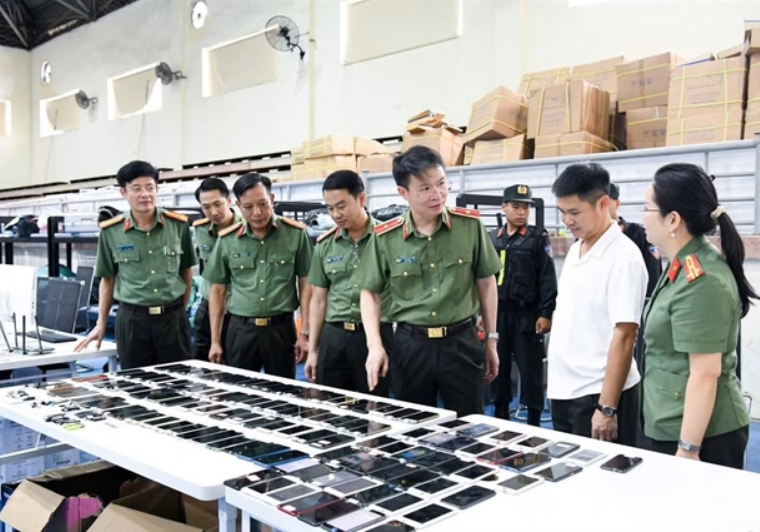
The sophistication of the enterprise became evident when police conducted searches of properties linked to the suspects. Officers recovered an extensive cache of equipment specifically configured for operating a fraud call centre, including 73 computers, 134 mobile phones, 34 USB drives, and 20 Wi-Fi routers. The sheer volume and specificity of this equipment demonstrates that the conspirators had moved well beyond preliminary planning stages and were actively preparing infrastructure for imminent operational deployment.
Vietnamese law enforcement appears to have successfully intercepted the operation at a critical juncture, preventing the transfer of personnel and equipment from Cambodia before the scam centre could commence fraudulent activities on Vietnamese soil. This timing suggests that intelligence gathering and surveillance were sufficiently advanced to provide police with actionable information regarding when and how the relocation would occur, enabling intervention prior to full activation of the criminal enterprise.
The charges levied against the four defendants focus specifically on organising the illegal stay of foreign nationals within Vietnam, a legal framework that prosecutors have determined applies appropriately to the circumstances. On June 17, following completion of evidence collection procedures, authorities in Phu Tho filed formal charges against Zhao, Huong, and Long, with all three remanded into pretrial detention pending further legal proceedings. Dình Nam faced the same accusation but received a less restrictive measure, being placed under a movement restriction order that confines him to his place of residence while the investigation continues.
The case reflects broader challenges confronting Southeast Asian nations as organised cybercriminal networks demonstrate remarkable adaptability and geographic flexibility. Cambodia has become a recognised hub for online fraud operations targeting victims across Asia, generating substantial illegal revenues for criminal enterprises and their foreign sponsors. As Cambodian authorities have intensified enforcement efforts in recent years, these criminal organisations have begun surveying alternative locations, with Vietnam emerging as an attractive option due to proximity, accessibility, and perceived operational advantages.
For Malaysia and other regional nations, this case carries significant implications regarding how transnational fraud networks operate and evolve. The involvement of Chinese nationals directing operations across multiple countries, combined with recruitment of local accomplices, reflects a pattern increasingly observed throughout Southeast Asia. Criminal syndicates are demonstrating sophisticated understanding of legal frameworks, border dynamics, and local vulnerabilities, necessitating enhanced cooperation among regional law enforcement agencies and intelligence services.
The seizure of equipment and apprehension of the conspiracy before operational commencement represents a genuine preventive success for Vietnamese authorities. Had the scam centre become fully functional, it would likely have victimised thousands of individuals across multiple countries, particularly targeting vulnerable populations in China, Taiwan, and other East Asian markets. The operation's prevention thus averts substantial financial harm and protects potential victims from psychological trauma associated with elaborate fraud schemes.
The investigation underscores the necessity for sustained cross-border cooperation in combating transnational crime. Cambodia, Vietnam, and other regional states must maintain intelligence sharing protocols and coordinate enforcement actions to disrupt the movement of criminal operations before they establish roots in new jurisdictions. For Malaysia, heightened vigilance regarding similar schemes attempting to establish footholds remains essential, particularly given the country's established banking infrastructure and technological connectivity.