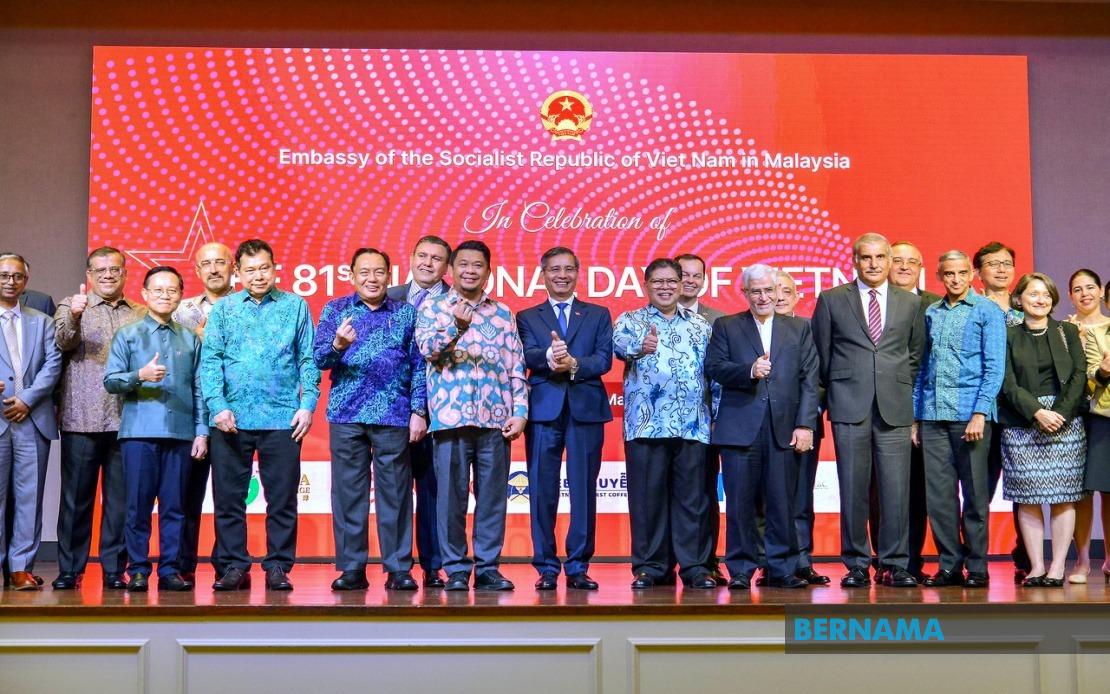
Vietnam's diplomatic envoy to Malaysia has underscored the strengthening bonds between Hanoi and Kuala Lumpur, describing the relationship as entering a new phase characterised by deepening political trust and expanding cooperation across multiple sectors. Speaking at the country's 81st National Day celebration in the Malaysian capital, Ambassador Dinh Ngoc Linh emphasised that the Comprehensive Strategic Partnership framework, formalised in November 2024, reflects a fundamental shift in how the two nations approach their bilateral engagement and regional responsibilities.
The partnership represents the culmination of five decades of diplomatic relations that began in 1973, though meaningful strategic cooperation has accelerated considerably in recent years. The elevation from a standard bilateral relationship to a comprehensive strategic framework signals mutual recognition of each nation's importance to the other in an increasingly unpredictable geopolitical landscape where medium-sized states seek reliable partnerships to navigate competing regional interests and global uncertainties.
Beyond ceremonial declarations, the practical dimensions of this partnership have already begun materialising across diverse sectors. Trade and investment flows have shown momentum, with Vietnamese enterprises finding opportunities in Malaysia's developed markets whilst Malaysian companies explore possibilities in Vietnam's rapidly industrialising economy. Agricultural cooperation has expanded, reflecting Vietnam's strengths in food production and Malaysia's established agribusiness networks. Educational exchanges bring students and academics together, creating generational connections that transcend government-to-government relations. Cultural initiatives and growing tourism movements further weave social bonds that provide resilience to the partnership beyond transient political shifts.
Defence and security cooperation occupies particular significance within this framework. The ambassador specifically highlighted this dimension as contributing to mutual confidence and regional stability, a notably frank acknowledgment in a region traversed by territorial disputes and strategic competition. For Malaysia, engagement with Vietnam on security matters reflects efforts to maintain equidistant relationships across Southeast Asia whilst developing practical cooperation on maritime safety, counterterrorism, and peacekeeping. For Vietnam, security ties with Malaysia represent part of a broader strategy to deepen connections with ASEAN partners and counterbalance excessive dependence on any single ally.
The role of parliamentary exchanges in consolidating the partnership deserves attention as an often-underestimated dimension of bilateral relations. Legislative delegations and formal dialogues between lawmakers create informal channels of communication and mutual understanding that sometimes prove more effective than governmental negotiations. These exchanges expose parliamentarians to contemporary challenges and perspectives from their counterparts, generating informed advocates for closer ties within their respective political systems and contributing to institutional knowledge that endures beyond individual administrations.
Regionally, both nations see their partnership as integral to preserving ASEAN's centrality and cohesion at a time when the bloc faces pressures from great power competition and internal disparities. Vietnam has consistently championed ASEAN unity and rule-based multilateralism, whilst Malaysia's strategic position in the straits and its historical role as an ASEAN founder member give it distinct leverage. Their partnership serves as ballast for ASEAN's institutional arrangements and contributes to the association's capacity to manage regional challenges from transnational crime to climate change without external domination.
The ambassador's personal reflection on completing his tour of duty added an understated but meaningful dimension to his remarks, acknowledging that bilateral relations depend ultimately on sustained commitment across changing personnel and circumstances. His assurance that personal affection for Malaysia and professional investment in the relationship would continue beyond his tenure illustrates how diplomatic relationships rest not merely on state interests but on accumulated goodwill and individual human connections that facilitate smooth transitions and continuity.
Malaysia's Deputy Foreign Minister Datuk Lukanisman Awang Sauni's presence as guest of honour conveyed official recognition of the occasion's significance and reaffirmed governmental commitment to the partnership framework. The attendance of multiple heads of diplomatic missions underscored how the Vietnam-Malaysia relationship exists within a broader context of multilateral Southeast Asian diplomacy, with other regional players observing the trajectory and implications of this partnership.
For Malaysian observers, the deepening Vietnam relationship offers several strategic advantages. Vietnam's manufacturing base and economic dynamism create complementary trade opportunities, whilst its role in regional security architecture provides additional channels for Malaysia to exercise diplomatic influence beyond traditional ASEAN forums. The partnership also helps Malaysia maintain relevance in regional security discussions without excessive alignment with any particular power bloc, a balancing act that has characterised Malaysian foreign policy since independence.
The comprehensive nature of the partnership distinguishes it from transaction-based cooperation agreements that might be narrower in scope or duration. By explicitly encompassing political dialogue, security cooperation, economic integration, cultural exchange, and regional role coordination, the CSP framework creates multiple reinforcing mechanisms that make the relationship more resilient to periodic disagreements or shifting circumstances in individual policy areas. When friction emerges in one domain, other channels remain operative for dialogue and confidence-building.
Looking forward, the trajectory of Vietnam-Malaysia relations will likely mirror broader Southeast Asian patterns where stable, prosperous states with manageable internal challenges can afford to invest in partnership frameworks that enhance collective regional capacity. Both nations face transnational challenges from climate change to pandemics that no single country can address alone, making cooperation not merely diplomatically convenient but practically necessary for national interest advancement.
The emphasis on walking together toward shared prosperity and success, repeated throughout the ambassador's remarks, acknowledges an emerging reality in regional diplomacy: the most successful partnerships frame cooperation not as zero-sum competition but as collective problem-solving where both parties benefit from enhanced stability, economic growth, and institutional capacity. As Vietnam and Malaysia deepen their comprehensive strategic partnership, they model the kind of pragmatic, multilayered engagement that Southeast Asian states increasingly view as essential for thriving in the contemporary international environment.

