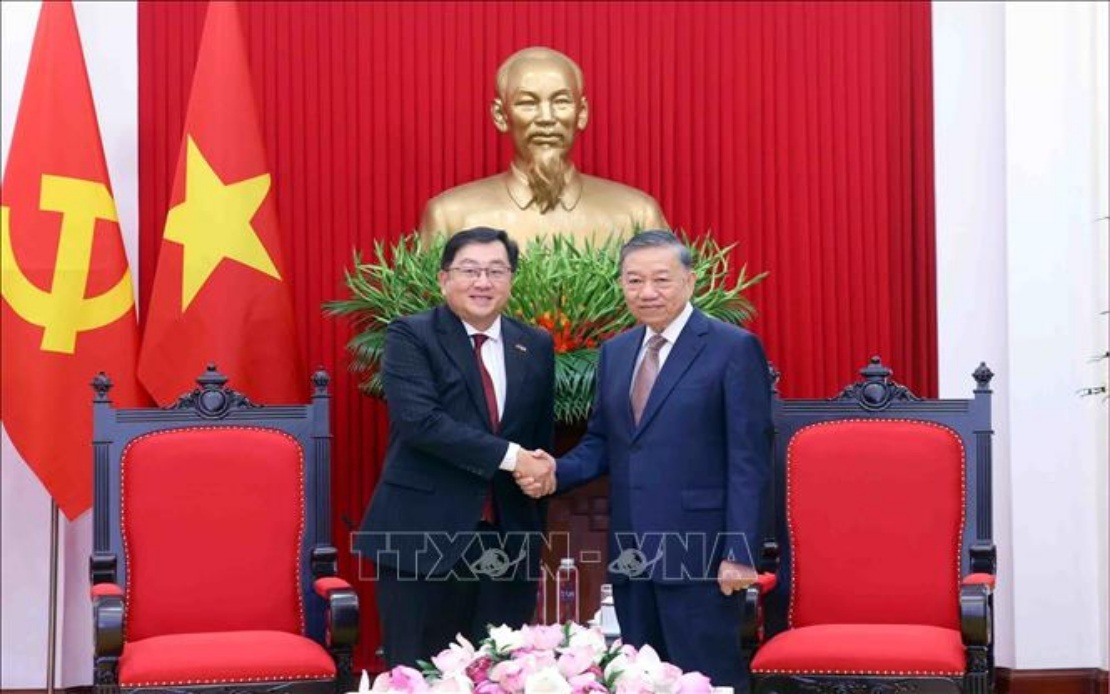
Vietnamese President To Lam has characterized relations with Malaysia as expanding in depth and breadth, representing one of Southeast Asia's most substantive bilateral partnerships. The assessment came during his farewell meeting with outgoing Malaysian Ambassador to Vietnam Datuk Tan Yang Thai on Wednesday, underscoring Hanoi's commitment to sustaining momentum in the relationship even as diplomatic personnel rotate. The remarks reflect a broader regional trend of consolidating ties between major ASEAN economies at a time when the bloc faces mounting external pressures and internal integration challenges.
At the heart of the Vietnamese leader's message was an emphasis on the political foundation underpinning economic and strategic cooperation. President Lam noted that regular exchanges of senior officials across governmental, parliamentary, and ruling party channels have created institutional frameworks that insulate bilateral ties from transient political shifts. This institutional depth proves particularly significant given the region's historically volatile geopolitical landscape, where personality-driven diplomacy can prove fragile. By anchoring the relationship in formal mechanisms and repeated high-level engagement, both countries have signalled their intention to treat the partnership as a long-term strategic asset rather than a convenience born of circumstance.
The economic dimension of Vietnam-Malaysia ties has emerged as the relationship's most dynamic element, with trade figures demonstrating remarkable acceleration. Two-way commerce reached US$10.8 billion during the first half of 2026, representing a 40 per cent year-on-year increase that far exceeds typical regional trade growth rates. This expansion reflects Malaysia's enduring position as Southeast Asia's third-largest investor in Vietnam and the tenth-largest globally among 154 nations and territories with capital commitments. For Malaysian companies, Vietnam represents both a manufacturing hub and a consuming market of 100 million people, making the relationship commercially irreplaceable regardless of broader geopolitical shifts.
Beyond conventional trade metrics, both leaders highlighted emerging areas of cooperation that will shape regional economic competition over the coming decade. Digital economy development and green energy transitions feature prominently in discussions between Hanoi and Kuala Lumpur, reflecting recognition that tomorrow's prosperity depends on technological advancement and environmental sustainability rather than labour-cost arbitrage alone. Malaysia's experience in renewable energy and digital infrastructure, coupled with Vietnam's manufacturing scale and strategic location, creates natural complementarities. Energy and electricity connectivity initiatives specifically mentioned by President Lam hint at deeper grid integration that could eventually span Southeast Asia, enhancing regional resilience while reducing dependence on distant suppliers.
Maritime cooperation represents another frontier gaining traction between the two nations, carrying implications that extend well beyond commercial shipping. Both Vietnam and Malaysia maintain significant coastlines and territorial interests in the South China Sea, where freedom of navigation remains contested and great-power competition has intensified. Enhanced maritime cooperation—whether through coast guard coordination, naval exercises, or joint fisheries management—signals to regional and global audiences that ASEAN members can collectively manage maritime affairs without external arbitration. This dimension of the partnership carries geopolitical weight that economic metrics alone cannot capture, positioning bilateral maritime ties as a microcosm of ASEAN's broader struggle to maintain agency in regional security affairs.
President Lam's invitation to Prime Minister Datuk Seri Anwar Ibrahim and His Majesty Sultan Ibrahim to visit Vietnam represents more than ceremonial courtesy. Such high-level visits serve multiple purposes: they provide opportunities to cement personal relationships among leaders, allow for substantive negotiations on strategic issues beyond the purview of diplomatic staff, and generate domestic political benefits through symbolic displays of international standing. The reciprocal Malaysian invitation to President Lam suggests active diplomatic scheduling that will keep senior officials engaged across the bilateral relationship, maintaining visibility and preventing the relationship from lapsing into bureaucratic routine.
Ambassador Datuk Tan Yang Thai's successful tenure in Hanoi has apparently strengthened interpersonal relationships between the two governments, which explains why both sides took care to publicly acknowledge his contributions during his departure. The diplomat's expressed commitment to leveraging his professional experience and personal affection for Vietnam in future roles signals that Malaysian diplomatic corps maintains institutional memory and emotional investment in the relationship. For Hanoi, ensuring that departing ambassadors depart on positive terms creates goodwill that extends beyond individual postings, as these officials often return to significant positions in their home countries' foreign ministries and remain influential shapers of policy.
The timing of these exchanges merits consideration within Vietnam's broader diplomatic calendar. As a nation simultaneously managing relationships with Washington, Beijing, Moscow, and New Delhi while maintaining regional leadership ambitions within ASEAN, Vietnam benefits from deepening partnerships with mid-sized regional powers like Malaysia. Such relationships provide diplomatic cover, economic diversification, and demonstration of Vietnam's capacity to build substantive ties outside the framework of great-power competition. Malaysia, similarly, uses its Vietnamese relationship to balance its multiple strategic partnerships and maintain relevance within regional architecture.
For Malaysian policymakers and business leaders, the accelerating trajectory of relations with Vietnam carries practical implications across multiple sectors. Investors seeking supply chain diversification have additional assurance of institutional stability and reduced political risk. Companies operating in energy, digital services, and manufacturing can anticipate continued regulatory alignment and market access. The emphasis on digital and green economy cooperation suggests that future trade growth will concentrate in higher-value sectors rather than low-skill manufacturing, potentially creating quality employment opportunities for Malaysian professionals in Vietnam and vice versa.
The Comprehensive Strategic Partnership framework that both leaders referenced provides sufficient flexibility to accommodate expanded cooperation without requiring formal treaty amendments or parliamentary approval. This institutional architecture allows both governments to deepen ties incrementally, testing new areas of cooperation through pilot projects before full-scale implementation. Such gradualism reduces political risk and allows bureaucracies to develop implementation capacity at measured pace, increasing the likelihood that ambitious agreements translate into tangible outcomes rather than remaining aspirational documents.
Regional observers should view strengthening Vietnam-Malaysia ties as a constructive response to broader regional challenges. As geopolitical competition intensifies and great powers seek to divide ASEAN along preferential lines, partnerships like this one demonstrate that ASEAN members retain agency in shaping their own futures. The emphasis on balanced trade, mutual benefit, and respect for sovereignty contrasts with external pressure tactics that implicitly or explicitly seek to subordinate Southeast Asian interests to great-power competition.
Moving forward, the trajectory of Vietnam-Malaysia relations will likely reflect broader patterns of ASEAN integration and economic interdependence. Trade figures suggest commercial momentum will persist regardless of diplomatic challenges. The emphasis on maritime cooperation and energy connectivity indicates both governments recognize that shared prosperity depends on regional stability and cooperation on transnational challenges. Whether this partnership can anchor broader ASEAN unity remains an open question, but the evidence presented in recent diplomatic exchanges suggests both Hanoi and Kuala Lumpur view their relationship as strategically significant and worthy of sustained investment at the highest political levels.

