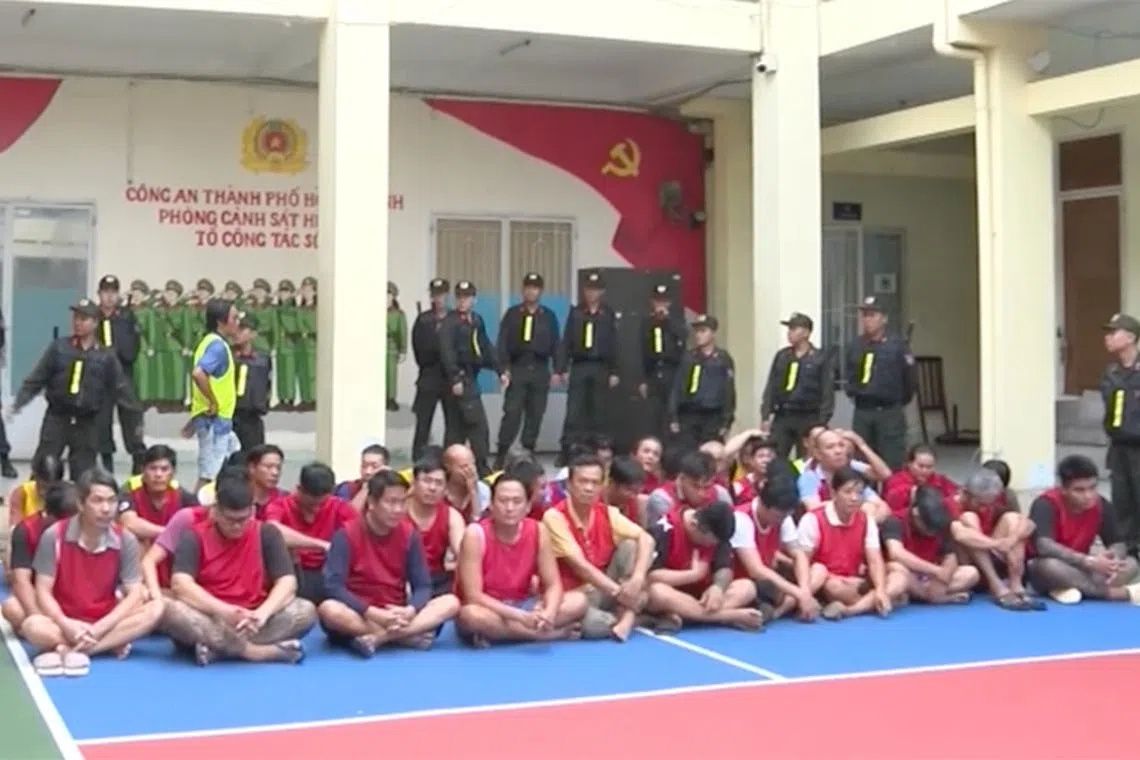
Vietnamese police have moved decisively against underground betting operations, announcing the arrest of 85 individuals connected to two sprawling illegal gambling rings with a combined estimated value of US$133 million, equivalent to RM534 million. The operations, uncovered during raids in late June, represent a significant enforcement action as the government intensifies its campaign against illegal wagering that typically surges during major international sporting events such as the World Cup 2026.
While online gambling remains strictly prohibited across Vietnam's communist system, underground betting networks have become endemic, generating enormous illicit revenues that attract sustained police attention. The periodic crackdowns tend to intensify around high-profile tournaments when gambling activity accelerates dramatically and enforcement resources concentrate on disruption efforts. The Ho Chi Minh City police statement emphasised that both dismantled rings operated with "exceptionally large-scale" infrastructure, displaying sophisticated hierarchical structures and robust control mechanisms characteristic of mature criminal enterprises.
The arrested individuals operated what police described as tightly organised syndicates with well-defined chains of command and operational discipline. Between October 2025 and the discovery, these networks processed an estimated US$133 million in illegal transactions, demonstrating the substantial financial throughput of clandestine gambling operations within Vietnam. The infrastructure was sufficiently complex to warrant classification by authorities as exceptionally organised, suggesting coordination, encryption, and institutional knowledge that extended beyond simple informal betting arrangements.
According to confessions obtained from ring leaders, the operational model involved acquiring "master-level betting accounts" from individuals based in Cambodia, then subdividing these accounts into numerous subsidiary tiers comprising agent and member accounts. This layered structure was subsequently distributed to end-user gamblers through online channels, creating insulation between primary operators and street-level participants. The arrangement reflects transnational integration within Southeast Asia's underground gambling ecosystem, with Cambodia serving as a sourcing point for betting infrastructure that feeds Vietnamese demand.
The broader enforcement context is striking. Vietnam's public security ministry revealed that beyond these two major rings, police had dismantled 73 separate gambling operations nationwide during the initial 20 days of the World Cup tournament. The combined action resulted in 346 arrests of individuals directly involved in illegal gambling and football betting activities. These figures illustrate the endemic scale of underground wagering across Vietnamese territory and the resource intensity required to mount meaningful enforcement responses during peak betting periods.
Colonel Bui Tuan Anh of the public security ministry provided aggregate financial context, noting that transaction volumes across the arrested cases totalled "thousands of billions of dong"—equivalent to hundreds of millions of dollars. This characterisation underscores the financial magnitude of illegal gambling operations throughout the nation, placing the US$133 million figure within a broader ecosystem of underground betting that probably extends into the billions when examining total illicit gaming activity. The sheer financial throughput reflects deeply embedded demand for gambling services and the profitability of meeting that demand through illegal channels where regulation is absent.
For Malaysia and broader Southeast Asia, these developments illustrate persistent vulnerabilities in cross-border enforcement against gambling operations. Cambodia's role as a sourcing point for betting accounts highlights how individual nations' regulatory frameworks create arbitrage opportunities exploited by organised networks. The infrastructure extending from Cambodia through to Vietnamese end-users demonstrates integrated regional criminal operations that transcend national boundaries, presenting challenges to unilateral enforcement approaches and requiring coordinated multilateral responses.
The World Cup 2026, scheduled for Canada, Mexico and the United States with the final match on July 19, generates predictable surges in betting demand across Asia. Vietnam's enforcement actions represent standard government responses to anticipated gambling escalation during major tournaments. However, the sophistication of detected operations suggests that prohibition-based enforcement models may prove insufficient for suppressing deeply rooted demand and supply networks that continually adapt operational methods to evade detection.
The underlying issue reflects structural tensions within Vietnam's gambling policy regime. Complete prohibition of online gambling creates regulatory vacuums filled by criminal enterprises offering services that prohibition cannot eliminate through demand destruction. The periodic crackdown-enforcement cycle, while demonstrating state capacity for large-scale operations, may prove cyclical rather than fundamentally transformative if underlying demand remains unaddressed through alternative policy frameworks.
Regional observers note that Vietnam's experience parallels dynamics across Southeast Asia, where similar prohibition regimes coexist with substantial underground gambling economies servicing persistent consumer demand. The integration of cross-border infrastructure through Cambodia, combined with technological sophistication enabling online delivery, creates enforcement challenges that individual nations struggle to resolve independently. Sustained coordination frameworks addressing transnational operational networks may prove necessary to meaningfully constrain underground gambling economies that continue expanding despite periodic large-scale enforcement actions.

