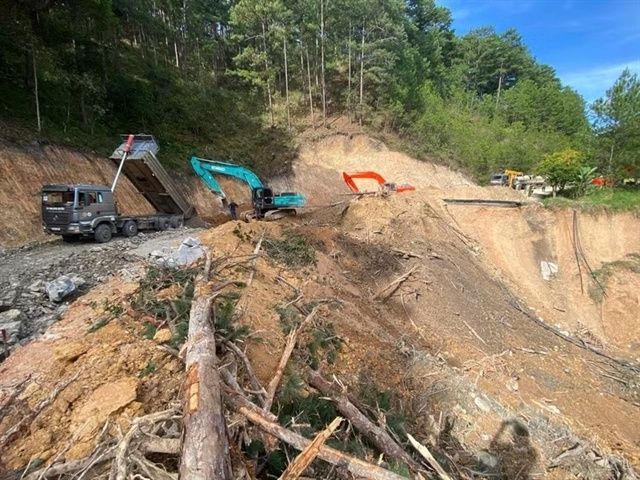
Vietnam's Ministry of Construction has activated emergency protocols following extensive damage to a critical section of Ho Chi Minh Road in Tuyen Quang Province, where successive storms have compromised the structural integrity of major transport infrastructure. The emergency declaration focuses on the Km115+000 position, where the road converges with National Highway 2C, marking a key vulnerability in the country's transport network that requires immediate intervention to restore safe passage for vehicles and commuters.
The damage emerged after an exceptionally wet June, during which the region experienced multiple consecutive downpours between June 1 and June 30. Forecasting data from both the Tuyen Quang Provincial Hydrometeorological Station and the National Centre for Hydrometeorological Forecasting documented the severity and frequency of these rainfall events, which overwhelmed drainage systems and destabilised the road surface. The accumulated moisture and pressure from repeated storms created significant deformation across the affected corridor, rendering sections unsuitable for normal traffic operations without risk of further deterioration or accident.
Road Management Zone I, which oversees this section, has taken the lead in conducting a comprehensive damage assessment to determine the full scope of remedial work required. The Department for Roads of Việt Nam (DRVN) is coordinating with zone administrators to identify the most effective repair solutions, considering both immediate stabilisation needs and longer-term structural rehabilitation. Officials have been directed to issue an Emergency Construction Order that will enable rapid mobilisation of resources and personnel without the usual procurement delays, allowing work to commence swiftly under temporary protocols.
For Malaysian and Southeast Asian observers, this situation underscores the vulnerability of major transport corridors in the region during monsoon seasons. Similar challenges face Malaysia's own extensive road network, particularly in peninsular states prone to intense rainfall. Vietnam's emergency response framework offers instructive parallels for how governments can activate expedited repair mechanisms when critical infrastructure faces weather-related damage. The emphasis on accountability—with senior officials directly responsible for progress reports—reflects a structural approach that prioritises transparent coordination between government tiers.
Beyond the immediate Km115+000 emergency zone, traffic management concerns extend to an adjacent flooded section between Km124+600 and Km128, where Ho Chi Minh Road intersects National Highway 2. This parallel problem illustrates how heavy rainfall affects interconnected transport systems across wider geographical areas. Officials must simultaneously manage congestion along this alternate vulnerable stretch whilst directing primary repair efforts at the most critically damaged location, requiring sophisticated coordination of traffic flows and workforce allocation across multiple problem areas.
The Transport and Road Safety Division of the Ministry of Construction has assumed responsibility for overseeing implementation across all affected agencies, establishing a centralised oversight mechanism to ensure consistent progress and eliminate coordination gaps. This hierarchical approach, with clear delegation of tasks to the DRVN, Road Management Zone I, and local divisions, demonstrates how emergency protocols can establish accountability chains that accelerate decision-making whilst maintaining quality oversight. Regular reporting requirements mean that decision-makers maintain current information for adjusting strategies as circumstances evolve.
The ministry's framework stipulates that emergency construction works must be completed before the department formally concludes the emergency period. This staged approach prevents premature declarations of normalcy while ensuring that temporary solutions transition into permanent repairs. Once DRVN reports completion, the ministry can evaluate whether safety thresholds have been restored and road functionality normalised, providing a clear endpoint to emergency operations rather than leaving the situation in administrative limbo.
For regional road safety and logistics sectors, Vietnam's response illustrates how climate-driven infrastructure challenges increasingly demand rapid, flexible governance mechanisms. The increasing frequency of extreme weather events across Southeast Asia means that traditional repair and maintenance schedules may prove inadequate. Emergency orders and expedited protocols are becoming essential tools for managing transport networks resilient enough to accommodate growing extreme weather risks. Countries reviewing their own disaster response frameworks might consider Vietnam's experience as a case study in activating operational flexibility without compromising safety oversight.
The declaration itself carries implications for transport operators and freight companies relying on Ho Chi Minh Road. Emergency work zones, temporary traffic management, and potential speed restrictions during repairs represent operational challenges for logistics networks spanning Vietnam and its neighbours. Regional supply chains sensitive to transport corridor disruptions will monitor repair progress closely, as the road's role in north-south connectivity makes even temporary degradation economically significant across Southeast Asia's interconnected trade networks.

