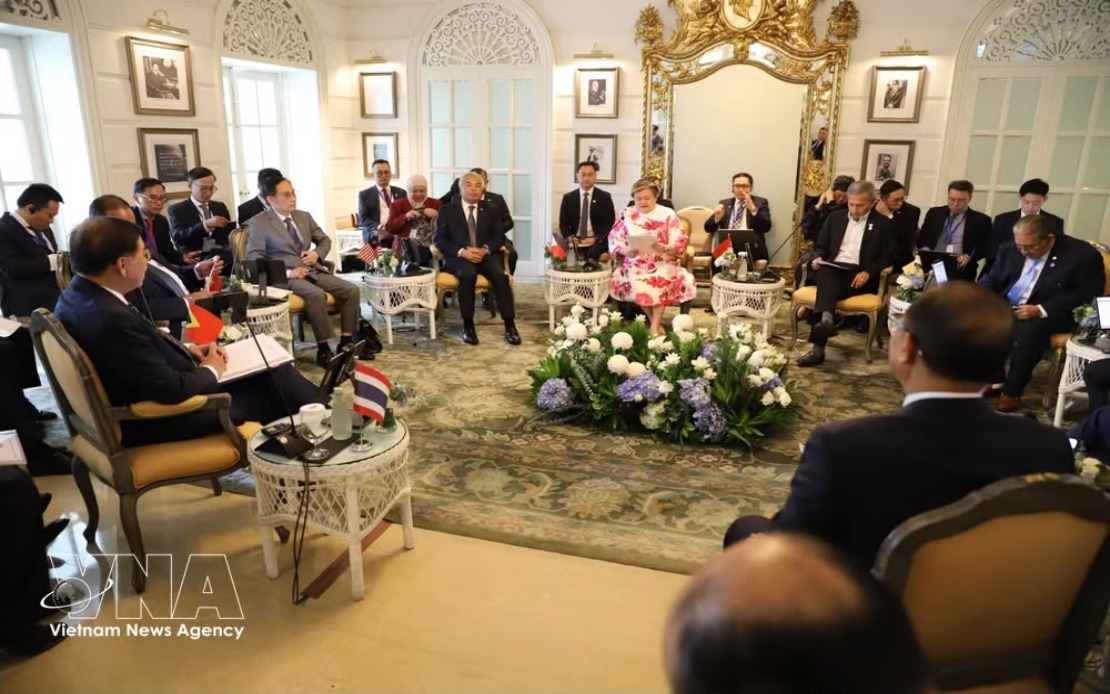
Vietnam has reaffirmed its unwavering commitment to Myanmar as a valued member of the Association of Southeast Asian Nations, signalling that the regional bloc remains unified in supporting the country's path toward political and economic recovery. Speaking at an informal gathering of ASEAN foreign ministers in Bangkok on July 12, Vietnamese Foreign Minister Le Hoai Trung emphasized that the Five-Point Consensus adopted by ASEAN serves as a critical framework guiding the organization's approach to Myanmar's ongoing challenges. His remarks came during what officials are describing as the first in-person meeting of its kind since 2021, underscoring both the significance of the occasion and the length of time that has elapsed since such direct engagement at the ministerial level occurred.
The meeting, chaired by Philippine Foreign Secretary Maria Theresa P. Lazaro—whose country assumes the ASEAN Chairmanship in 2026—brings renewed momentum to ASEAN's diplomatic efforts. Trung's statement reflects a careful balance that the bloc has attempted to maintain: acknowledging Myanmar's internal progress while pressing for continued advancement on governance, stability, and regional cooperation. Vietnam's positioning is particularly noteworthy given that it holds considerable influence within ASEAN's consensus-driven framework and has historically championed pragmatic engagement with challenging regional situations. The timing of these high-level talks also coincides with implementation of directions issued by ASEAN leaders at the 48th ASEAN Summit held in Cebu, Philippines, further demonstrating the bloc's institutional commitment to the Myanmar agenda.
Trung explicitly praised recent steps undertaken by Myanmar's authorities to stabilize the political landscape and revive economic activity. He highlighted the junta's efforts to enhance governance structures, intensify operations against transnational criminal networks including drug trafficking and cybercrime, and strengthen administrative control across border regions—issues that resonate deeply with Southeast Asian nations concerned about spillover effects from Myanmar's internal turmoil. By publicly acknowledging these measures, Vietnam signals that the international community recognizes incremental progress, potentially providing Myanmar's administration with both encouragement and face-saving validation that could facilitate deeper cooperation. However, Trung tempered this acknowledgment with a forward-looking call for sustained momentum, indicating that ASEAN expects continuous demonstration of commitment rather than viewing current achievements as endpoints.
The Vietnamese minister articulated a more substantive approach to ASEAN's Myanmar policy than has been evident in recent years. Beyond merely endorsing the Five-Point Consensus framework—which some critics argue has yielded limited tangible results—Trung advocated for concrete, practical steps grounded in sustained dialogue and regular engagement. This represents an important shift in emphasis, suggesting that ASEAN's major powers are reconsidering whether the existing framework adequately addresses Myanmar's multifaceted challenges or whether supplementary mechanisms are necessary. His call for maintaining direct channels of communication serves a dual purpose: it demonstrates to Myanmar that ASEAN has not abandoned it, while simultaneously allowing the bloc to monitor developments and adjust strategies accordingly. For Malaysia and other Southeast Asian nations concerned about regional instability, this renewed diplomatic intensity offers modest reassurance that ASEAN is not passively observing events but actively seeking pathways to meaningful progress.
Vietnam's explicit commitment to collaborate with the 2026 ASEAN Chair and fellow member states to support Myanmar's economic recovery carries particular significance for regional economic integration. The prospect of coordinated ASEAN backing for Myanmar's development initiatives could help rebuild the country's ravaged economy, which has contracted significantly since the 2021 military takeover. This approach also implicitly addresses the broader question of how ASEAN manages engagement with states experiencing internal conflict or governance crises—a concern relevant to the bloc's long-term cohesion and relevance. By positioning Myanmar's recovery as integral to building the ASEAN Community and advancing regional peace, Vietnam frames support for Myanmar not as charity or political obligation but as enlightened self-interest, which may help sustain political will for the difficult work ahead.
The substance of Myanmar's Foreign Minister Tin Maung Swe's presentation at the meeting centered on a 100-day plan and specific initiatives designed to foster peace, reconciliation, and stability. This signals that Myanmar's junta is attempting to demonstrate responsiveness to international pressure by presenting concrete timelines and measurable objectives rather than vague commitments. The ministers' decision to take note of these briefings in their joint statement suggests tacit acceptance that Myanmar's administration, whatever its origins or international standing, remains the de facto governing authority with which ASEAN must negotiate. This pragmatism reflects the bloc's historical approach of separating principles of non-interference from practical engagement—a distinction that has sometimes drawn criticism but allows for sustained diplomatic presence even during periods of internal instability.
The frank and constructive tenor that ministers reportedly brought to their discussions suggests genuine effort to move beyond statements of principle toward identifying mechanisms for substantive progress. This diplomatic language, while common in official communiqués, takes on deeper meaning when considering the polarized positions various ASEAN members have maintained toward Myanmar since 2021. Thailand's historical sympathies for Myanmar, the Philippines' emphasis on human rights concerns, and Indonesia's desire to maintain consensus have occasionally created tensions within ASEAN deliberations. That ministers could engage in meaningful discussion about concrete measures indicates either that consensus-building efforts have succeeded in finding common ground or that the urgency of Myanmar's regional importance has overridden particular objections. For Malaysian policymakers and observers, this suggests that ASEAN may finally be transitioning from rhetorical support to operational coordination.
The reaffirmation that ASEAN will support Myanmar in pursuing a "Myanmar-owned and Myanmar-led" solution deserves particular scrutiny, as it acknowledges the limits of external pressure while maintaining face-saving language around ASEAN's engagement. This formulation implicitly recognizes that sustainable solutions to Myanmar's internal conflicts must ultimately emerge from within the country itself, even as it leaves room for ASEAN to claim credit should progress occur. The emphasis on national reconciliation, stability, security, and prosperity reflects the shared regional concern that Myanmar's instability could generate refugee flows, drug trafficking, and cross-border militant movements that affect neighboring countries. For Malaysia, which has historically hosted significant Rohingya and other refugee populations and grapples with its own drug trafficking challenges originating from Myanmar, this focus addresses practical national security concerns extending beyond abstract principles of regional cooperation.
Vietnam's positioning within these discussions also reflects broader calculations about its role within ASEAN and its relationships with major powers. As a nation that has historically maintained strong ties to Myanmar and exercises considerable diplomatic influence, Vietnam's explicit commitment to sustained engagement helps ensure that the Myanmar question does not fade from ASEAN's agenda due to competing priorities or fatigue. The explicit mention of bilateral and subregional cooperation suggests that Vietnam itself may be contemplating enhanced economic and security ties with Myanmar that extend beyond the ASEAN-level framework. This could prove significant if Vietnam seeks to develop land-based trade routes through Myanmar or strengthen defense partnerships, adding another dimension to why Hanoi champions continued ASEAN engagement with Naypyidaw.
The broader implications of these Bangkok talks extend to questions about ASEAN's capacity to remain relevant and coherent as a diplomatic actor in an era of great power competition and persistent internal instability among member states. By maintaining focus on Myanmar while the bloc navigates its own internal complexities and external pressures from the United States, China, India, and Japan, ASEAN demonstrates commitment to managing regional affairs through its own institutional mechanisms. Success in facilitating Myanmar's recovery would validate ASEAN's approach; failure to generate tangible progress might reinforce arguments that the bloc lacks the structural tools or political will to address its members' deepest challenges. Vietnam's willingness to invest political capital in this effort suggests Hanoi believes the investment worthwhile—a calculation other member states would presumably be making as well.
Looking forward, the success of ASEAN's Myanmar strategy will depend considerably on whether the concrete measures discussed in Bangkok translate into coordinated action among member states with sometimes divergent interests. The Five-Point Consensus framework, while providing rhetorical unity, has struggled to generate breakthrough results in previous years. Vietnam's call for elevated ambition and practical steps suggests recognition that incremental progress over several more years may prove insufficient to address Myanmar's mounting challenges or prevent further deterioration in regional stability. For Malaysia and other Southeast Asian nations, this evolving ASEAN engagement with Myanmar will continue shaping regional dynamics affecting trade, security, migration, and transnational crime for years to come, making the outcomes of dialogues like those conducted in Bangkok consequential far beyond diplomatic protocol.

