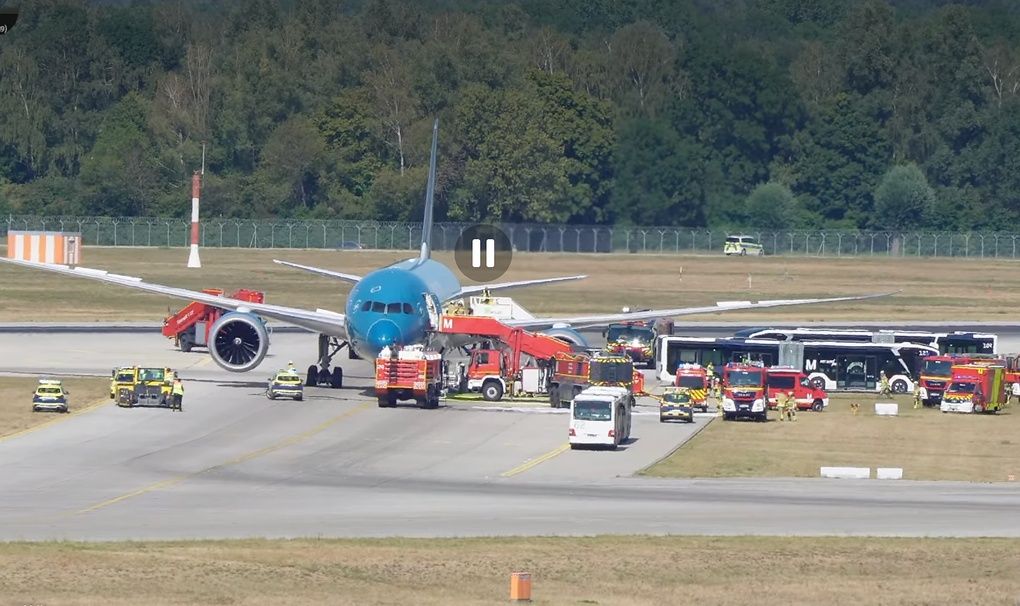
A Vietnam Airlines Boeing 787-9 carrying passengers between Munich and Hanoi encountered an in-flight technical emergency on August 15, forcing the crew to abandon the journey and secure an immediate return to Munich Airport in Germany. The aircraft had barely cleared the runway when complications emerged, triggering a swift response from flight crews who adhered to established emergency protocols and successfully brought the wide-body jet back to the terminal without further incident.
The incident unfolded during the critical phase of departure. Witness footage captured from near the airport documented the Boeing 787 accelerating down the runway and rotating at an unusually late point, with the nose lift occurring dangerously close to the runway threshold. The timing of the rotation proved so marginal that dust visibly erupted as the aircraft struggled into the air, indicating the aircraft's tail section made contact with the pavement during the manoeuvre. This sequence of events set in motion a chain of technical consequences that would necessitate the emergency diversion.
Aviation specialists monitoring the situation reported that the aircraft sustained damage during the critical rotation phase. The Aviation Herald disclosed that the Boeing 787 experienced what specialists term a "late rotation, tailstrike and runway overrun", compounded by subsequent tyre damage to the landing gear. Such contact between the aircraft's fuselage and runway surface represents a serious structural concern requiring thorough investigation and potential airworthiness checks before the jet can resume operations.
Once airborne despite the complications, the flight crew executed a controlled response to the unfolding emergency. The aircraft ascended to approximately 9,000 feet and entered a holding pattern over the Munich airspace, a standard procedure designed to allow flight crews to assess system status and burn excess fuel safely. This measured approach provided ground crews adequate time to position emergency services and prepare for the aircraft's return. Munich Airport placed emergency response units on standby while the situation developed.
Roughly two hours after initial takeoff, the Boeing 787 initiated its descent and approached Munich Airport for the return landing. Upon touching down, the damaged tyres made fresh contact with the runway surface, generating visible smoke and confirming that the aircraft's landing gear had been compromised during the earlier rotation incident. Flight crews brought the jet to a complete stop safely, and all passengers and crew members disembarked without injury or further incident, despite the alarming circumstances.
Vietnam Airlines confirmed in an official statement that every person aboard remained secure throughout the emergency sequence. Passengers and crew members were systematically guided from the aircraft and processed through the terminal facilities. The airline's handling of the incident demonstrated well-rehearsed emergency management, with ground personnel prepared to support stranded travellers and coordinate alternative transportation arrangements.
The investigation into the precise mechanical or operational factors triggering the incident has commenced, with Vietnam Airlines collaborating with German aviation authorities and relevant technical parties to establish definitive causes. Such inquiries typically examine multiple variables including weather conditions, crew actions, aircraft systems performance, and maintenance records. The airline has pledged to furnish comprehensive updates once technical inspections conclude and operational clearance protocols are finalised.
The affected passengers face disruption to their travel plans, yet the airline has undertaken commitments to arrange substitute flights and provide necessary assistance to minimise inconvenience. The resolution of alternative travel options depends partly on the investigation's findings and whether the damaged aircraft requires extensive repairs or replacement of components before returning to service. Such incidents, while uncommon, create cascading effects throughout airline schedules.
Vietnam Airlines maintains scheduled operations linking major Southeast Asian cities with European destinations. The carrier deploys modern wide-body aircraft including the Boeing 787 Dreamliner and Airbus A350 on these long-haul routes, with direct services connecting both Hanoi and Ho Chi Minh City to Munich and Frankfurt. The European network represents a strategically important segment of the airline's international expansion, facilitating business travel and tourism between Vietnam and the European Union.
The Munich incident adds to ongoing scrutiny of aviation safety procedures on international routes. While modern aircraft incorporate multiple redundant systems and crews undergo rigorous training for emergency scenarios, incidents during critical flight phases underscore the inherent risks of aviation operations. The late-rotation event demonstrates how marginal clearances during takeoff can cascade into compound technical challenges, emphasising the critical importance of precise crew performance and aircraft maintenance standards.
Beyond the immediate safety concerns, the incident carries implications for passenger confidence in long-haul Southeast Asian carriers. Fortuitously, Vietnam Airlines' professional handling of the emergency—the crew's decisive action to return safely and the absence of injuries—reinforces faith in the airline's operational competence. However, detailed findings from the investigation will be scrutinised by aviation authorities across the region and globally, potentially influencing regulatory frameworks or maintenance protocols for similar aircraft operating from Asian carriers.

