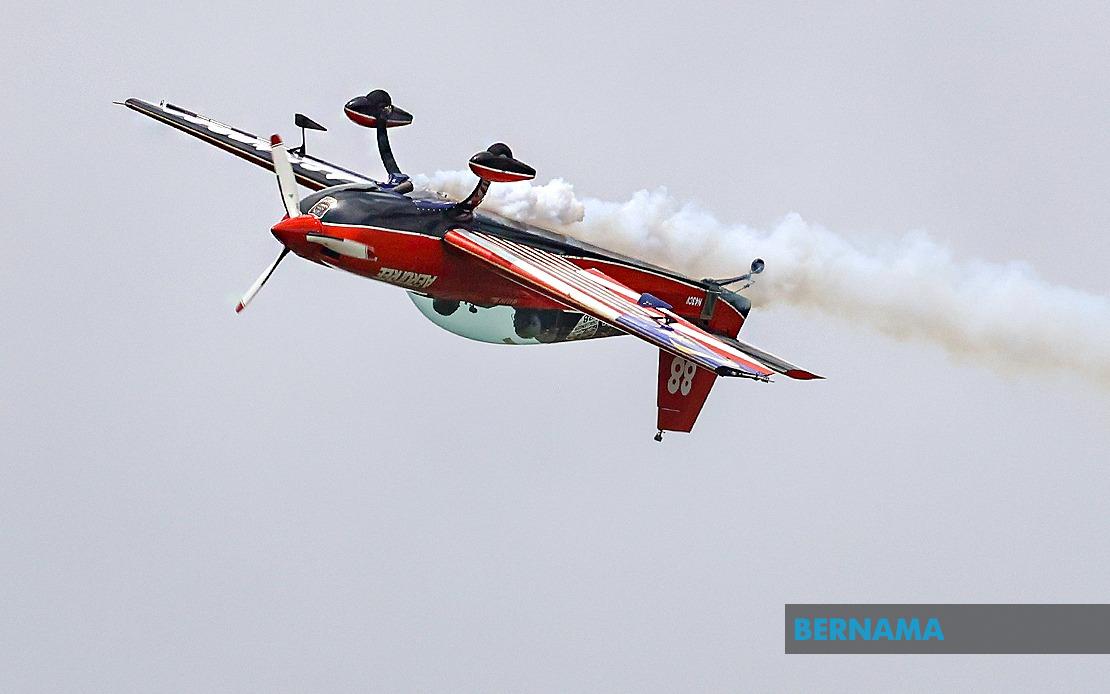
The inaugural 'Merdeka Sunset Show: Melukis Senja' took flight in Putrajaya on August 30 with a commanding solo aerobatic performance by Major (Rtd) Datuk Halim Othman, a 60-year-old retired Royal Malaysian Air Force fighter pilot whose career spanning four decades has established him as one of the nation's most accomplished aviation professionals. The twilight display, scheduled for 7 pm, combined precision aerial manoeuvres with coloured smoke and pyrotechnics against the setting sun, creating a spectacular centrepiece for the country's 69th National Day celebrations and marking a significant moment in Malaysia's aerial display heritage.
Halim's credentials extend well beyond his military service, which began in 1985 when he earned the distinction of 'Top Gun' whilst flying high-performance fighter jets. His progression into competitive aerobatics and international air racing positioned him as a trailblazer in the region—he became the first Malaysian to qualify for the Red Bull Air Race World Championship, competing alongside predominantly European and American pilots who had long dominated the sport. This achievement underscored the competitive parity Malaysia could achieve in demanding aviation disciplines when supported by adequate training, institutional backing, and individual determination.
The concept for 'Melukis Senja,' which translates to 'painting the sunset,' originates from a previous display at Chenang during last year's Langkawi International Maritime and Aerospace Exhibition (LIMA). That initial iteration proved successful enough to warrant expansion into a full National Day programme, demonstrating growing confidence in Malaysia's capacity to stage world-class aerial events. The revival and elevation of this display format reflects broader efforts to position Malaysia as a serious venue for international aerospace showcases and to cultivate domestic interest in aviation disciplines.
Halim's expertise encompasses an extensive repertoire of military and civilian aircraft. During his RMAF tenure, he commanded advanced fighter platforms including the MiG-29N and F/A-18D Hornet, alongside earlier generation jets such as the A-4 Skyhawk and F-5E Tiger. His transition to aerobatic flying introduced the Extra 300L, an aircraft specifically engineered for precision manoeuvre flying. Beyond pure combat jets, his experience extends to corporate transport aircraft including the Learjet 35A and King Air 350i, providing him with a comprehensive understanding of aviation across multiple sectors and performance envelopes.
International recognition came through his participation in Red Bull Air Racing, where Halim demonstrated that Malaysian pilots could compete effectively against seasoned international rivals. In 2014, he secured victories in the Challenger Cup competitions held in Ascot, United Kingdom, and Las Vegas, United States, whilst finishing as runner-up in the Challenger Cup Final at the Red Bull Ring in Austria. These results provided tangible evidence that excellence in aviation transcends geography and that Malaysian talent could flourish on the global stage, challenging the historical perception of Asian underrepresentation in elite aeronautical sports.
Beyond his individual accomplishments, Halim has invested significantly in institutional development of Malaysia's aerobatic capabilities. He founded Aerotree Defence and Services Sdn Bhd and spearheaded the creation of Krisakti, Malaysia's first official aerobatic display team, which debuted publicly at LIMA 2011. This initiative represented a watershed moment for organised aerobatic display in the country, establishing a framework through which Malaysia could field professionally coordinated aerial teams for international exhibitions and national celebrations. The success of Krisakti validated the concept of systematised aerobatic training and performance management within a Southeast Asian context.
Halim emphasises that aerobatic flying transcends mere showmanship or technical display of aircraft capabilities. Rather, he characterises it as a discipline requiring rigorous discipline, continuous skill development, and profound understanding of aircraft performance boundaries and safety margins. This perspective reflects the maturation of aviation as a serious professional domain requiring the same calibre of preparation and risk management applied to military operations or commercial aviation. The emphasis on methodical training rather than reckless daredevilry positions aerobatic flying within acceptable safety parameters whilst maintaining spectacle.
The pilot's motivations extend beyond personal achievement or commercial considerations. In his exclusive interview regarding the Merdeka Sunset Show, Halim articulated a commitment to inspiring younger Malaysians and demonstrating national capability on the international stage. His framing of competitive aviation as a national project rather than an individual pursuit reflects broader aspirations within Malaysia's aerospace sector—the desire to develop homegrown talent, retain skilled professionals, and prove that Malaysian aviation personnel merit recognition alongside international counterparts. This developmental orientation carries particular significance for a nation seeking to strengthen its position within the global aerospace industry.
Looking forward, Halim has unveiled plans to establish a new aerobatic display team comprising six aircraft equipped with integrated coloured smoke systems designed for future National Day celebrations and upcoming LIMA events. This expansion would represent a substantial escalation from the inaugural solo performance, creating a coordinated aerial platform capable of executing complex formation flying and choreographed manoeuvres. The six-aircraft configuration would position Malaysia competitively within the context of regional air shows and international aerospace exhibitions, where larger formation displays have become expected standards for prestigious events.
The Aerotree Defence and Services chief has positioned these aerobatic initiatives explicitly within a corporate social responsibility framework rather than purely commercial enterprise. He emphasises the engagement of youth in aerospace disciplines, seeking to cultivate the next generation of pilots, engineers, and aviation professionals. This alignment of commercial activity with developmental objectives reflects maturation within Malaysia's aviation ecosystem, where private sector organisations increasingly recognise their capacity to influence sectoral growth and talent pipeline development. Such partnerships between government celebration mandates and private expertise offer sustainable models for maintaining capability between major national events.
The significance of the Merdeka Sunset Show extends beyond its immediate spectacle. It represents institutional recognition of aerobatic flying as a legitimate component of national celebrations and cultural expression. The integration of precision aerial performance with nationalist symbolism—sunset imagery, smoke effects, pyrotechnics—creates a contemporary visual vocabulary for National Day observances that appeals to technologically sophisticated audiences. For Malaysia, positioned as an aspirant regional technology leader, the showcasing of aviation excellence provides tangible demonstration of capacity and aspiration that resonates beyond traditional celebration formats.
Halim's career trajectory also illuminates broader patterns within Malaysian professional aviation. His progression from military service through competitive sport to institutional leadership reflects multiple pathways through which aviation professionals can contribute value across sectors. The cross-pollination between military discipline, international competition experience, and civilian organisational development has created a leader uniquely positioned to advance Malaysia's aeronautical capabilities. As the nation seeks to develop its aerospace manufacturing, maintenance, and services sectors, such multifaceted expertise becomes increasingly valuable for institutional advancement and international competitiveness.

