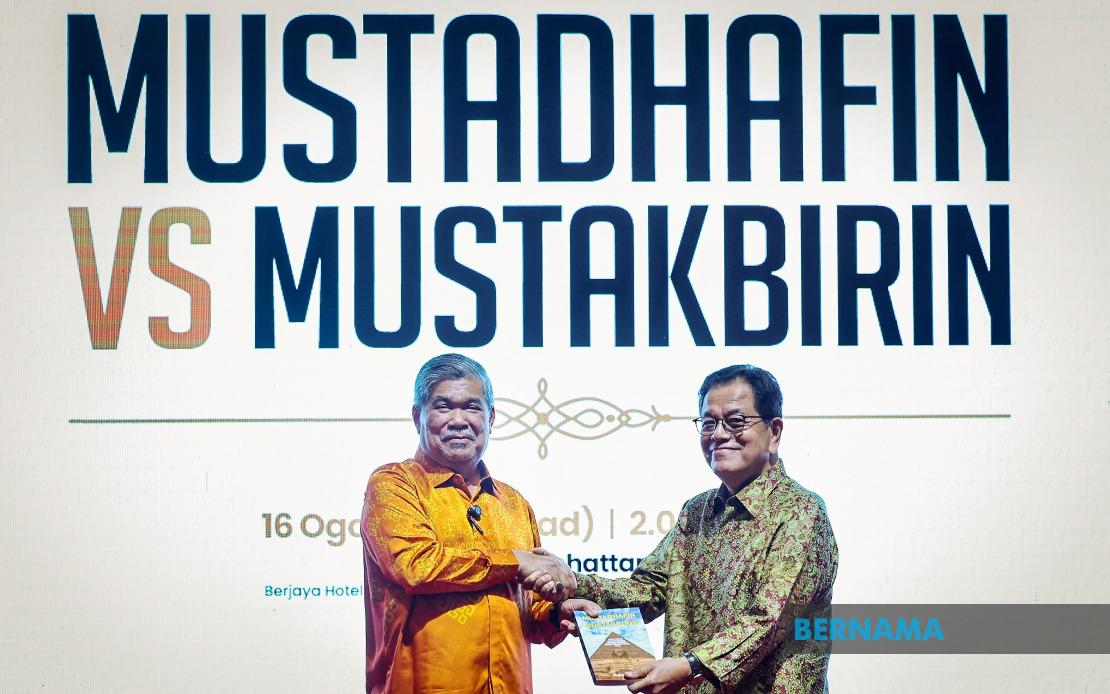
Datuk Seri Mohamad Sabu, president of Amanah, has issued a pointed warning to Malaysians about the dangers of accepting unexamined allegations, particularly in the nation's increasingly polarised political environment. Speaking after launching his memoir, the Agriculture and Food Security Minister emphasised that uncritical acceptance of claims without proper fact-checking enables 'asabiyyah'—a psychological tendency to irrationally defend one's own group while simultaneously dismissing the legitimate actions and achievements of others. This cautionary message carries particular weight in an era where misinformation spreads rapidly across social media platforms and traditional communication channels, often outpacing the slower dissemination of verified information.
The minister's remarks directly challenge the contemporary political culture in Malaysia, where sweeping accusations frequently dominate public discourse without undergoing rigorous scrutiny. Rather than passively accepting information from whatever source it originates, Mohamad Sabu advocated for a more disciplined approach whereby citizens independently verify facts and develop their own informed positions before committing to particular political viewpoints. This methodology represents a fundamental departure from the pattern whereby allegations, rumours, and unsubstantiated claims gain traction through repetition and emotional resonance rather than evidential grounding. His intervention suggests growing concern within certain political circles about the quality of public deliberation and the erosion of rational discourse.
The former defence minister illustrated his point through a contemporary example that resonates throughout Malaysian politics: the recurrent claim that the Democratic Action Party (DAP) operates as a communist organisation, and by extension, that any political coalition partnering with DAP necessarily endorses communist ideology. Mohamad Sabu questioned whether such assertions withstand basic factual examination, implicitly suggesting they do not. This particular allegation has circulated intermittently in Malaysian political rhetoric for decades, yet continues to gain credence among certain population segments despite the absence of substantive supporting evidence. His public pushback against this narrative demonstrates an attempt to inject reality-based analysis into discussions that have become increasingly detached from verifiable reality.
Central to Mohamad Sabu's argument is an observation about the relative difficulty of communicating factual information compared to spreading accusations. He noted that genuine facts and knowledge require cognitive effort to absorb and evaluate, demanding that audiences invest time in understanding complexity and nuance. Allegations and suspicions, by contrast, trigger immediate emotional reactions and spread with viral efficiency, particularly through social media ecosystems that algorithmically reward engagement-generating content. This asymmetry—wherein falsehood travels faster and farther than truth—poses profound challenges to democratic deliberation and informed citizenship, explaining why baseless charges often dominate political conversations despite their substantive weakness.
The minister's newly launched book serves as a vehicle for elaborating this broader intellectual framework. Rather than offering simple political arguments, the memoir chronicles his personal journey of seeking accurate understanding through direct engagement and observation rather than passive consumption of circulated narratives and propaganda. From his youth, Mohamad Sabu cultivated a practice of independently investigating matters rather than accepting whatever claims circulated within his immediate environment. This methodological preference reflects a commitment to empirical understanding over ideological confirmation, a distinction increasingly rare within contemporary Malaysian politics where tribal affiliations often determine interpretation of facts rather than facts determining conclusions.
Beyond domestic political concerns, Mohamad Sabu's book addresses broader geopolitical themes including colonialism, the trajectory of Islamic movements globally, the Palestinian-Israeli conflict, and contemporary shifts in international power dynamics. His treatment of these subjects emerges from accumulated experiences and observations rather than abstract theorising, suggesting that rigorous engagement with global realities demands the same critical methodology he advocates for domestic political assessment. The book thus positions epistemological discipline—the commitment to examining evidence before forming conclusions—as foundational to understanding both local and international affairs.
National Journalism Laureate Tan Sri Johan Jaaffar, who chairs the book launch event, brings credibility and institutional weight to this intervention regarding the quality of public information. As a director of Star Media Group Berhad, Jaaffar represents professional journalism traditions emphasising fact-checking, verification, and contextualisation—standards that often conflict with the speed and sensationalism of modern digital communication. The choice of Jaaffar to facilitate this public discussion underscores the book's emphasis on responsible information dissemination as essential to democratic health.
Mohamad Sabu's intervention arrives at a politically significant moment in Malaysia, where coalitional arrangements involve parties with historically adversarial relationships, and where accusations of ideological corruption regularly accompany such partnerships. His argument that political actors should be evaluated on their actual positions and records rather than inherited prejudices or sweeping characterisations challenges the narrative frameworks many Malaysians have internalised regarding particular parties and leaders. The DAP example proves particularly instructive: whether one disagrees with the party's policies, describing it as communist requires ignoring decades of empirical political engagement and organisational practice.
The practical implications of Mohamad Sabu's message extend throughout Malaysian society, affecting not merely elite political discourse but everyday conversations among ordinary citizens. If allegations spread more readily than facts, and if individuals frequently absorb and repeat claims without independent verification, the public sphere increasingly becomes divorced from reality. This phenomenon undermines not only specific policy debates but the broader democratic project itself, which depends upon citizens possessing sufficient shared understanding of factual reality to deliberate productively about competing values and interests. A polity wherein major sections of the population accept contradictory factual claims about the same organisations and individuals cannot meaningfully engage in democratic decision-making.
Moving forward, Mohamad Sabu's call for intellectual discipline and critical evaluation of information represents both a personal testimony and an implicit critique of current political practice. Whether Malaysian society can reverse the deteriorating quality of public discourse through greater individual commitment to fact-checking and verification remains uncertain, particularly given institutional and technological incentives favouring sensationalism over accuracy. Nevertheless, his articulated commitment to this standard and his willingness to publicly question widely circulated but unexamined allegations suggest that certain political figures recognise the costs of allowing evidence-free narratives to dominate public understanding of crucial political questions.

