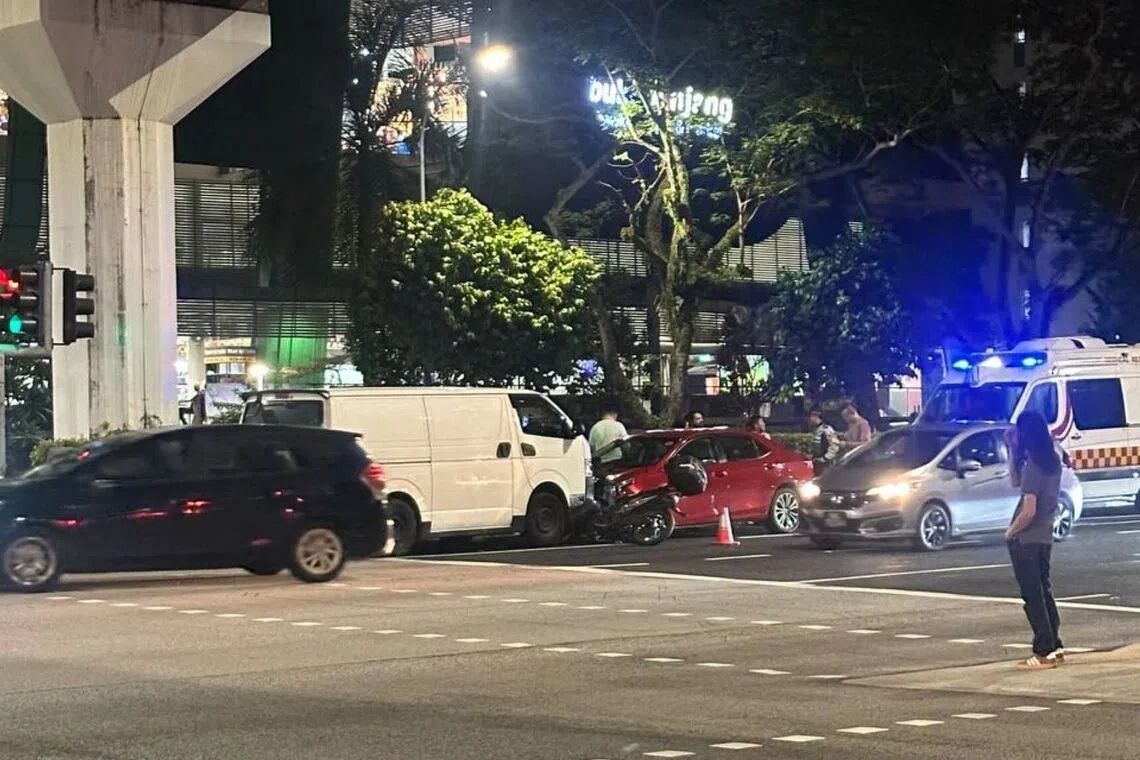
A van driver in Singapore was detained on suspicion of operating a motor vehicle while impaired by drugs following a serious traffic collision involving multiple vehicles in the Bukit Panjang district on Friday night. The incident, which unfolded along Bukit Panjang Road near its intersection with Bukit Panjang Ring Road, has drawn renewed attention to the dangers of impaired driving and illicit substance use on busy thoroughfares.
Emergency responders were dispatched to the scene at approximately 9pm after receiving reports of the accident. The collision ultimately involved four separate vehicles, including the van driven by the 27-year-old suspect, two passenger cars, and a motorcycle. Despite the apparent severity of the impact—particularly given that the van appeared to be travelling against the direction of traffic—the incident resulted in relatively minor casualties, with two individuals sustaining light injuries. Both victims declined transport to medical facilities for further evaluation.
Authorities investigating the crash discovered what would become a secondary focus of their inquiry: two vaporising devices and three associated refill pods were located inside the van. The seizure of these items has expanded the investigation beyond the core question of drug-impaired driving. The Health Sciences Authority has been engaged to examine the vaporiser-related evidence and determine whether any regulatory or legal violations occurred in connection with these devices, a process that underscores Singapore's stringent regulatory framework governing such products.
The arrest of the van driver for allegedly operating the vehicle while under the influence of drugs represents a serious charge carrying significant legal consequences. Singapore maintains notably strict drug laws, and driving under the influence compounds both the severity of penalties and the public safety implications. The distinction between simple drug possession and drug-impaired driving relates directly to culpability and risk to others on the roadway, making the latter a matter of substantial concern to traffic authorities.
Eyewitness footage of the accident scene, circulated through social media channels, provides a stark visual record of the collision's aftermath. The video shows the van positioned nose-to-nose with a red sedan, suggesting a high-impact frontal collision. A motorcycle lies wedged between the two larger vehicles, illustrating the violent nature of the impact and the vulnerability of motorcycle riders when struck by heavier traffic. A black sedan sits several metres further back, indicating that the initial collision created a cascade effect across multiple lanes.
The positioning of the vehicles, particularly the apparent counter-directional trajectory of the van, raises questions about whether impairment affected the driver's ability to maintain lane awareness and directional control. Road safety experts have long emphasised that drug-impaired driving significantly degrades judgment, reaction time, and spatial orientation—all critical functions for safe vehicle operation in busy urban environments like those found along Bukit Panjang Road.
For Malaysian readers, this incident carries particular relevance given the shared Southeast Asian context of road safety challenges and evolving substance use patterns. Many Malaysian highways and urban thoroughfares experience similar traffic densities and risks, with multi-vehicle collisions representing a persistent public health concern. The intersection of emerging substance use—including vaping culture—and traditional drug enforcement presents regulatory questions that regional authorities continue to grapple with.
The case also illustrates the importance of modern surveillance and digital documentation in traffic investigations. Social media footage has become an increasingly valuable evidentiary resource for law enforcement agencies reconstructing accident sequences and establishing liability. In this instance, the Instagram video likely provided investigators with crucial details about vehicular positions, angles of impact, and directional movement that support charges against the driver.
Investigations remain ongoing as police continue to examine both the drug-related allegations and the specific circumstances leading to the collision. Toxicology reports and forensic analysis of the vaporising devices will take time to complete, and the full legal picture may not emerge for several weeks. The role of any substances in the driver's system at the time of the accident will be central to establishing culpability, alongside assessments of whether any substance found in the vehicle was actively in use during the incident.
This accident serves as a reminder of the multifaceted nature of modern traffic enforcement. Law enforcement agencies must now address not only traditional drunk driving and classical drug impairment, but also the emerging landscape of vapourised substances and novel recreational products. The Health Sciences Authority's involvement signals that questions about the composition, regulation, and appropriate use of vaping devices remain unresolved in Singapore's regulatory framework.
The relatively fortunate outcome—minor injuries only, no fatalities—belies the serious potential for tragedy in multi-vehicle collisions, particularly those involving motorcycles. Had conditions been slightly different, the incident could easily have resulted in deaths and permanent injuries. This underscores why authorities maintain aggressive enforcement against impaired driving, viewing such violations as presenting unacceptable risks to public safety.

