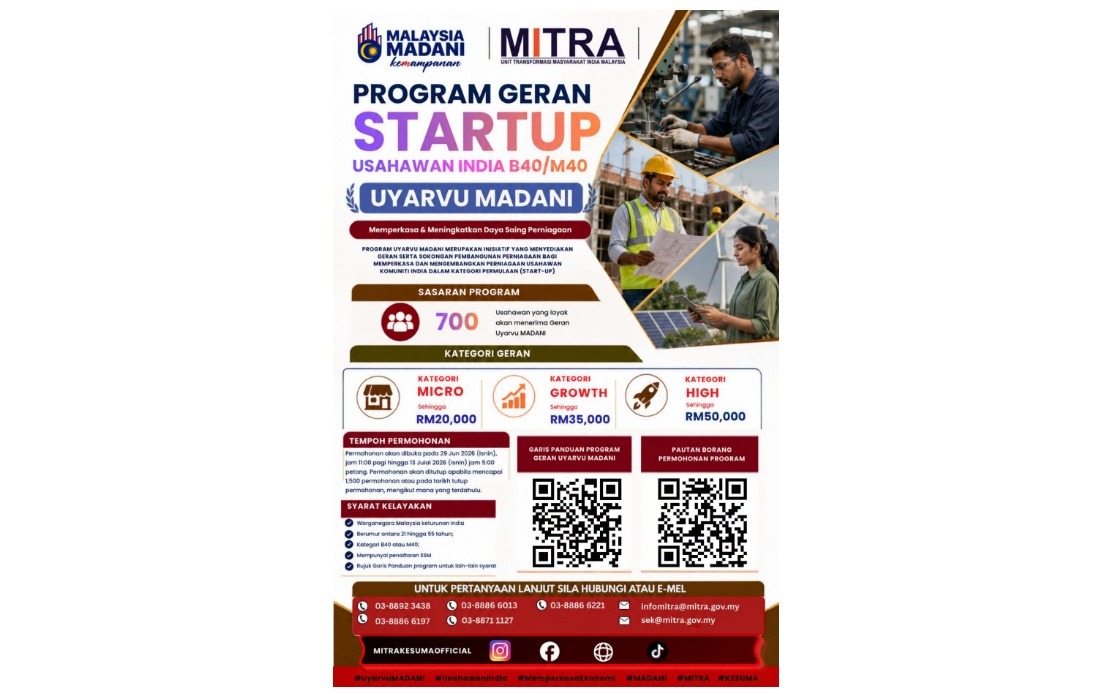
The Malaysian Indian Transformation Unit (MITRA) has begun accepting applications for the Startup Accelerator Grant Assistance Programme, known as Uyarvu MADANI, in what represents a targeted effort to strengthen entrepreneurship within Malaysia's Indian community. The application window runs until 5 pm on July 13, with MITRA reserving the right to close submissions earlier if demand reaches 1,500 applications. This reflects an anticipated uptake that could exceed initial expectations, underscoring the appetite for accessible startup financing among underrepresented business communities.
Eligibility for the programme extends to entrepreneurs belonging to the Indian community who fall within the B40 and M40 income brackets—categories that encompass households earning below RM5,880 monthly and between RM5,881 and RM9,810 respectively. The financial support available ranges from RM20,000 to RM50,000 per beneficiary, with the programme targeting a total of 700 grant recipients. This tiered approach allows MITRA to distribute resources strategically while accommodating entrepreneurs at different stages of venture maturation.
Uyarvu MADANI forms one component of six new initiatives that MITRA introduced for 2026, collectively drawing on a budget allocation of RM65.5 million. The broader initiative signals the government's recognition that targeted intervention across specific demographic communities can unlock entrepreneurial potential that remains constrained by unequal access to capital and business development infrastructure. The nomenclature—combining the Malay word "uyarvu," meaning to develop or uplift, with "MADANI," referring to the government's civilisational development agenda—demonstrates an intentional alignment with national policy frameworks.
Beyond the direct grant component, the programme incorporates business development support mechanisms designed to complement financial assistance. This dual-track approach addresses a fundamental challenge in startup ecosystems: many entrepreneurs from disadvantaged backgrounds possess viable business ideas but lack the institutional knowledge, mentorship networks, and technical expertise necessary to scale operations effectively. By pairing capital infusion with advisory services, MITRA aims to enhance the likelihood of long-term venture survival and profitability.
For the broader Malaysian entrepreneurial landscape, this initiative carries implications extending beyond the immediate Indian community. Startup accelerator programmes that target specific ethnic or income-based cohorts serve as proof-of-concept vehicles for inclusive economic development. Success metrics from Uyarvu MADANI could inform future design of similar schemes for other underrepresented groups, including indigenous communities and rural entrepreneurs. The programme thus functions as both a direct intervention and an experimental platform for testing scalable models of equitable capital distribution.
The timing of the July 13 deadline warrants consideration given Malaysia's fiscal calendar and the broader economic environment. Launching grant applications in late June positions the initiative to capture both those who have been planning applications in advance and spontaneous applicants who discover the opportunity through social media announcements and word-of-mouth promotion. The early-closure mechanism creates competitive pressure that encourages rapid submission, potentially accelerating the onboarding process for successful applicants.
Southeast Asian economies increasingly recognise that inclusive entrepreneurship drives both poverty reduction and innovation. Malaysia's positioning of Uyarvu MADANI within a broader MITRA framework suggests institutional commitment to systematic, rather than ad-hoc, community development. Neighbouring countries facing similar demographic composition challenges—including Singapore's minority enterprise support schemes and Indonesia's regional development programmes—demonstrate that targeted startup financing yields measurable economic and social benefits.
For prospective applicants, the application process represents a critical juncture. The 1,500-application threshold before deadline extension suggests MITRA anticipates substantial interest, potentially indicating either strong awareness-raising efforts or genuine unmet demand for accessible startup capital within the Indian business community. Entrepreneurs should prioritise completing applications well before the July 13 deadline to ensure inclusion, particularly if uptake accelerates in the final weeks.
The grant programme's emphasis on business competitiveness and expansion suggests MITRA views supported entrepreneurs not merely as aid recipients but as contributors to broader economic dynamism. This reframing—positioning startup grants as investments rather than welfare transfers—carries psychological and practical significance. It establishes expectations that beneficiaries will pursue scalable operations generating employment and tax revenue, thereby creating fiscal multiplier effects that extend beyond individual business success.
Fundamentally, Uyarvu MADANI reflects a policy recognition that entrepreneurial talent distributes evenly across demographic groups, but access to startup capital does not. By reducing financial barriers for 700 Indian entrepreneurs while providing complementary business development support, MITRA attempts to unlock economic value constrained by market failures and historical underinvestment. The programme's success will depend not only on initial grant distribution but on post-award monitoring and the sustained availability of mentorship and technical support infrastructure.

