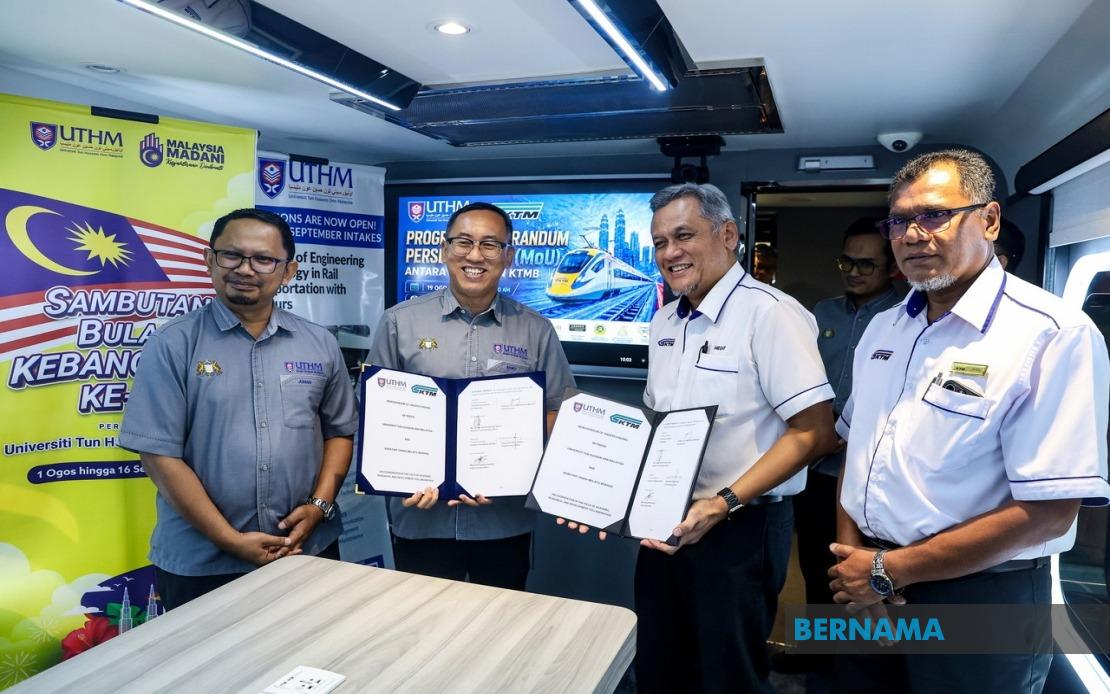
Malaysia's rail sector is set to benefit from a renewed and expanded collaboration between Universiti Tun Hussein Onn Malaysia (UTHM) and Keretapi Tanah Melayu Bhd (KTMB), as the two organisations formalised a three-year agreement aimed at developing skilled professionals and advancing technological innovation in the country's transportation infrastructure. The partnership, which extends from October 2026 to July 2029, represents a continuation and strengthening of ties first established in 2019, signalling the growing importance of sustained academia-industry cooperation in addressing Malaysia's evolving needs in rail operations and engineering.
The accord encompasses multiple dimensions of collaboration, with work-based learning (WBL) emerging as a centrepiece of the initiative. Through this mechanism, UTHM students pursuing studies in rail-related disciplines gain direct, hands-on exposure to KTMB's operational environment, technological infrastructure and the practical challenges that railway systems face in real-world deployment. This immersive approach bridges the persistent gap between classroom theory and workplace application, ensuring that graduates possess not merely academic credentials but a concrete understanding of how their knowledge translates into functioning railway networks that serve millions of Malaysians daily.
The evidence of this model's effectiveness is substantial. Nearly 200 graduates from UTHM's Bachelor of Rail Transportation Engineering Technology with Honours programme have already entered the workforce, with their employers including not only KTMB but also international operators in Singapore and Saudi Arabia. This geographical diversity demonstrates that the programme produces competencies recognised beyond Malaysia's borders, enhancing the country's reputation for producing qualified rail professionals and opening career pathways for Malaysian engineers in the regional and global transportation sector.
Professor Dr Mas Fawzi Mohd Ali, UTHM's vice-chancellor, contextualised the partnership within the university's broader vision as a Global Technopreneur University 2030 (GTU2030). This strategic framework seeks to integrate knowledge, technological advancement, innovation and entrepreneurial thinking into the education and professional development process. For UTHM, the collaboration with KTMB provides a concrete mechanism through which these aspirational goals become operationalised, transforming abstract institutional objectives into tangible learning experiences and research opportunities that address genuine industry needs.
Joint research and development constitutes another pillar of the expanded agreement. By combining UTHM's academic expertise, research infrastructure and analytical capabilities with KTMB's operational experience, real-world data and intimate knowledge of rail system constraints, the partnership is positioned to generate practical solutions to technical challenges in train operations and rail infrastructure maintenance. This combination of theoretical rigour and practical knowledge has historically proven effective in the engineering disciplines, where laboratory findings must ultimately withstand the demands of continuous, high-utilisation operational environments.
The competency development component of the agreement extends beyond students to include KTMB's own workforce. The railway operator has already enrolled five staff members in master's degree programmes in rail-related specialisations at UTHM, representing an investment in its personnel's professional advancement and signalling confidence in the university's capacity to deliver advanced technical education. This reciprocal arrangement—where the industry partner benefits educationally from the relationship—reinforces the mutual value creation inherent in well-designed academia-industry partnerships.
Academic consultation services form an additional layer of the collaboration, with UTHM providing guidance in the development and refinement of curriculum for diploma, bachelor's and postgraduate programmes in rail transportation engineering technology offered through KTM Academy (MyRA). This advisory role ensures that the competency frameworks embedded in Malaysia's railway-specific educational pathways remain current, internationally benchmarked and responsive to evolving operational requirements. Such curriculum alignment proves critical in technical fields where rapid technological change can render outdated approaches obsolete within years.
The partnership also encompasses industry forums, academic visits and structured competency development initiatives, creating multiple touchpoints for knowledge exchange between the academic and operational domains. These mechanisms facilitate not only the transfer of information but also the cultivation of professional networks and informal relationships that often prove invaluable when challenges arise in practice. KTMB personnel gain exposure to cutting-edge research methodologies and emerging technological solutions, while UTHM faculty maintain current understanding of how their research directions address genuine operational priorities.
From a broader policy perspective, this collaboration exemplifies how Malaysia's public institutions can respond to the country's infrastructure development trajectory. As Malaysia continues investing in rail expansion and modernisation—evident in initiatives such as the Light Rail Transit (LRT) expansion, Mass Rapid Transit (MRT) extensions and regional rail upgrades—the availability of a skilled pipeline of professionals becomes increasingly critical. The UTHM-KTMB partnership directly addresses this human capital requirement, ensuring that expertise development occurs in parallel with infrastructure investment rather than creating costly delays due to personnel shortages or capability gaps.
The agreement's formal exchange, which occurred aboard a KTMB chartered train travelling from Kluang Station to KL Sentral during celebrations marking the 69th National Month and the launch of Rel Merdeka 69, carried symbolic significance. The ceremonial setting underscored the national importance of rail sector development and positioned the partnership within the broader context of Malaysia's infrastructure transformation. Such public recognition of academia-industry collaboration sends important signals to other institutions and companies about the value and normality of sustained sectoral partnerships.
For Megat Khairulazhar Khairodin, KTMB's chief corporate officer, the agreement represents access to institutional capabilities that address specific operational and technical challenges within the railway system. Rather than developing solutions in isolation, KTMB gains the analytical power of a research-active university combined with student labour and emerging innovations. This represents a cost-effective mechanism for a government-linked company to enhance its technical capabilities while simultaneously fulfilling its broader national mission of workforce development.
The extension of the partnership through 2029 provides sufficient temporal scope for meaningful research outcomes to emerge, for cohorts of students to progress through their educational journey with KTMB involvement, and for the relationship itself to mature into institutionalised practice rather than remaining a novelty. This multi-year commitment signals confidence from both parties in the partnership's value and suggests that the arrangements established prove sufficiently effective to warrant continuation beyond the current formalised period.
As Malaysia positions itself within increasingly competitive global and regional transportation markets, the cultivation of domestic expertise through partnerships such as this becomes strategically significant. The UTHM-KTMB accord demonstrates how public institutions—a university and a major state-owned enterprise—can collaborate to build national capability in a critical infrastructure sector. This model, if replicated across other industries and institutions, offers a pathway through which Malaysia can develop world-class expertise while simultaneously addressing immediate workforce requirements in sectors fundamental to national economic competitiveness.

