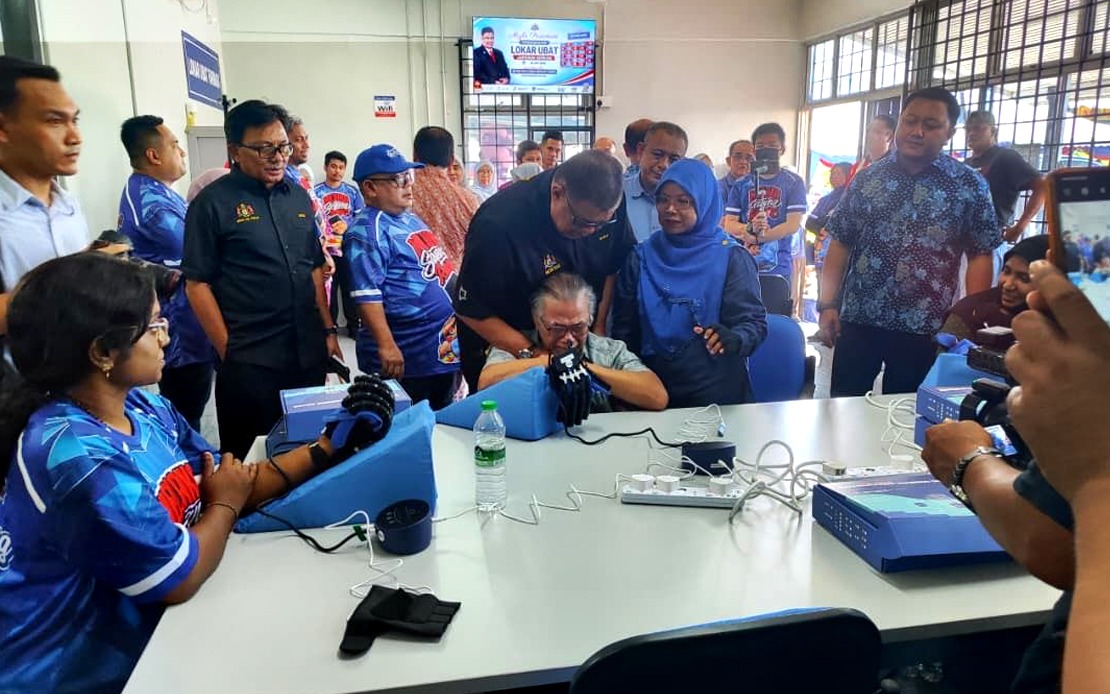
Universiti Teknikal Malaysia Melaka (UTeM) has officially opened a cutting-edge rehabilitation and physiotherapy facility in Serkam, Jasin, marking a significant step toward bridging the gap between academic research and public healthcare delivery. The MADANI Community Rehabilitation Centre and Gymnasium, inaugurated by Melaka Chief Minister Datuk Seri Ab Rauf Yusoh, represents a novel approach to patient recovery by integrating proprietary robotic systems and assistive technologies developed by UTeM researchers directly into clinical practice.
Funded through the Finance Ministry's UniMADANI 2024 Grant programme, the centre specifically targets stroke survivors, accident victims, and individuals struggling with mobility restrictions and muscle atrophy. Rather than relying solely on conventional physiotherapy methods, the facility deploys three primary technological innovations that UTeM has engineered over several years of research and development. This represents a departure from traditional rehabilitation approaches commonly seen across Malaysian public healthcare facilities, where resource constraints and limited access to specialised equipment often restrict recovery outcomes.
The Roboglove system forms the cornerstone of upper limb rehabilitation at the facility. This wearable robotic glove technology assists patients in relearning precise hand movements and regaining grip strength, a critical capability for stroke survivors who frequently experience paralysis or severe weakness on one side of the body. By providing mechanical support calibrated to each patient's recovery stage, the device reduces the physical burden on therapists while enabling more intensive and consistent training protocols. For Malaysian patients accustomed to longer waiting times and fewer intensive therapy sessions within public healthcare, access to such automated systems could meaningfully accelerate functional recovery.
Complementing hand rehabilitation is the Assistive Lower Limb Chair (ALLC), which automates lower limb exercises through a specially designed apparatus. Patients with limited mobility—whether from stroke, spinal injury, or age-related degeneration—can undergo structured leg movements without requiring constant manual intervention from therapists. The system's programmable intensity and duration mean that rehabilitation can be tailored precisely to individual recovery trajectories, optimising the probability of restoring walking capability and independence in activities of daily living.
Perhaps most significantly, the centre incorporates an exoskeleton system that substantially enhances the effectiveness of movement training. Exoskeletons are wearable robotic frames that provide motorised assistance or resistance to limb movements, allowing therapists to guide patients through complex movement patterns that would otherwise be difficult or impossible. Such technology has shown impressive results in international rehabilitation settings, particularly for severe neurological injuries, yet remains largely inaccessible in Malaysia outside research environments. The integration of this system into a community-facing facility represents genuine innovation in democratising advanced rehabilitation access.
Associate Professor Dr Mariam Md Ghazaly led the project development, coordinating the research team's efforts to transition laboratory prototypes into operational clinical tools. This transition from bench to bedside is notoriously challenging and often overlooked in Malaysian academia, where pressure to publish and secure research funding can overshadow the practical application of discoveries. The successful deployment at MADANI suggests that UTeM has established robust pathways for translating engineering solutions into tangible community benefits.
UTeM Vice-Chancellor Prof Datuk Dr Massila Kamalrudin articulated an ambitious vision for the facility beyond its immediate function as a rehabilitation provider. She positioned the centre as a prototype model that could be replicated across Malaysia, potentially transforming how public and private healthcare systems approach rehabilitation services. The institutional commitment to scaling the model addresses a genuine healthcare shortfall; Malaysia's ageing population and rising incidence of non-communicable diseases such as stroke create mounting demand for rehabilitation capacity that existing infrastructure struggles to meet. Currently, many Malaysian patients undergo physiotherapy privately or receive minimal intervention within public facilities due to resource limitations.
The centre's establishment reflects sophisticated stakeholder coordination spanning multiple government levels and agencies. The partnership encompasses UTeM itself, the Serkam State Constituency Development and Coordination Committee (Japerun) Office, the Kampung Pulai Village Development and Security Committee, the Social Welfare Department, and the Social Security Organisation (PERKESO). This multi-agency approach signals recognition that healthcare innovation requires alignment across education, local administration, and social protection systems rather than isolated institutional effort.
For Malaysia's regional standing, the MADANI centre demonstrates technological capability in medical device development that compares favourably with initiatives elsewhere in Southeast Asia. Thailand and Singapore have invested heavily in rehabilitation technology and medical robotics, creating competitive pressure on Malaysian institutions to demonstrate equivalent innovation capacity. UTeM's public commitment to community deployment, rather than purely commercial licensing of these technologies, positions the university as genuinely responsive to domestic healthcare needs rather than seeking only profit extraction.
The centre's model also carries implications for healthcare equity. While private rehabilitation clinics in Kuala Lumpur and other major cities offer advanced robotic therapies at premium costs, rural and semi-urban populations like those in Jasin typically lack such access. By locating MADANI in a smaller town and operating it with government support, UTeM has created a template for geographically distributed technology access. This approach potentially reduces the healthcare disparity that characterises many Malaysian services.
From a policy perspective, the facility's success or challenges over the coming months will likely influence government thinking about technology integration into public healthcare. If outcome metrics demonstrate that patients utilising the robotic systems achieve better functional recovery, shorter rehabilitation timelines, or improved cost-effectiveness compared to conventional therapy alone, the case for replicating the model becomes compelling. Malaysian health planners increasingly recognise that technology adoption, when properly implemented and adequately staffed, can enhance rather than replace human clinical expertise.
The centre now enters an operational phase where its true impact will be determined. Patient satisfaction, clinical outcome data, staff capacity and training, and financial sustainability will all require careful monitoring. The enthusiasm of university leadership and government officials at the launch must translate into consistent operational support, particularly for technician training and equipment maintenance—areas where Malaysian facilities have historically faced challenges. Success will require not only engineering excellence but also robust healthcare administration and genuine commitment to treating the facility as a permanent community asset rather than a temporary showcase.
Looking forward, the MADANI centre exemplifies how Malaysian universities can position themselves as drivers of healthcare innovation rather than merely as educational institutions. By anchoring research output in community benefit and demonstrating scalable solutions to pressing health challenges, UTeM and similar institutions contribute to Malaysia's broader aspirations of becoming a high-income nation with world-class healthcare delivery. The success of this Melaka facility may well establish a template that other Malaysian universities and healthcare providers seek to emulate.

